Introduction
Nylon 15%GF sits in a sweet spot. It offers more strength than unfilled nylon but remains easier to machine than highly reinforced grades like 30% glass-filled. The 15% glass fiber adds stiffness and heat resistance while preserving enough toughness to avoid brittleness.
But this balance creates its own challenges. The glass fibers are abrasive. They wear down tools faster than unfilled nylon. The material also absorbs moisture, which can throw off dimensions if you are not careful. And if your cutting parameters are off, you may end up with fuzzy surfaces or fiber pull-out.
At Yigu Technology, we have machined thousands of parts from this material. We have learned what works and what does not. This guide shares practical strategies to help you get consistent, high-quality results with Nylon 15%GF.
What Makes Nylon 15%GF Unique?
A Reinforced Polyamide with Balance
Nylon 15%GF is a polyamide matrix reinforced with 15% glass fibers by weight. The glass fibers increase strength, stiffness, and heat resistance without completely sacrificing nylon’s natural machinability.
The material is commonly used in applications that need:
- Higher strength than unfilled nylon
- Better impact resistance than highly filled grades
- Moderate heat resistance for under-hood or industrial environments
- Electrical insulation properties
Key Mechanical Properties
Here is how Nylon 15%GF compares to other common grades:
| Property | Nylon 15%GF | Nylon 20%GF | Unfilled Nylon PA6 |
|---|---|---|---|
| Tensile Strength | 75–90 MPa | 90–110 MPa | 45–60 MPa |
| Impact Resistance | 20–25 kJ/m² | 15–20 kJ/m² | 30–40 kJ/m² |
| Elongation at Break | 8–12% | 5–8% | 20–30% |
| Heat Deflection Temp (1.82 MPa) | 120–130°C | 110–130°C | 80–90°C |
| Moisture Absorption | 1.2–1.8% | 1–1.5% | 2–3% |
Tensile strength sits at 75–90 MPa. That is a significant jump from unfilled nylon’s 45–60 MPa. But it remains lower than 20% glass-filled grades, making it suitable for light-to-medium load applications.
Impact resistance is 20–25 kJ/m². This is higher than Nylon 20%GF or 30%GF. That means parts are less likely to crack during machining, assembly, or service under sudden loads.
Elongation at break is 8–12%. The material can stretch a bit before failing. This is helpful for parts that may experience occasional overloading.
Heat deflection temperature (HDT) reaches 120–130°C under load. That is enough for many automotive under-hood components and industrial machinery parts.
Moisture Sensitivity
Nylon absorbs moisture from the air. This causes dimensional changes. For Nylon 15%GF, moisture absorption is 1.2–1.8%. That is lower than unfilled nylon but still significant.
If you machine dry material and then expose it to humid conditions, it will swell. Critical dimensions can shift by 0.5% or more. We will cover how to manage this later.
Electrical and Chemical Properties
The material maintains excellent electrical insulation. Volume resistivity is 10¹³–10¹⁴ Ω·cm. This makes it suitable for electrical connectors, terminal blocks, and switch housings.
Chemical resistance is good against oils, fuels, and many solvents. It is less resistant to strong acids and bases.
What Machining Techniques Work Best?
Milling Operations
Nylon 15%GF machines well on 3-axis CNC mills for most geometries. For complex contours, 5-axis machines allow single-setup production.
Key parameters:
| Operation | Parameter | Recommended Value |
|---|---|---|
| Milling | Feed per tooth | 0.15–0.20 mm/tooth |
| Milling | Cutting speed | 150–300 m/min |
| Milling | Depth of cut (rough) | 1–2 mm |
| Milling | Depth of cut (finish) | 0.1–0.3 mm |
| Milling | Stepover | 50–60% of tool diameter |
The 15% glass content allows faster feed rates than higher-filled grades. This reduces cycle times while maintaining surface quality.
Climb milling is preferred. It reduces fiber pull-out and produces a cleaner finish compared to conventional milling.
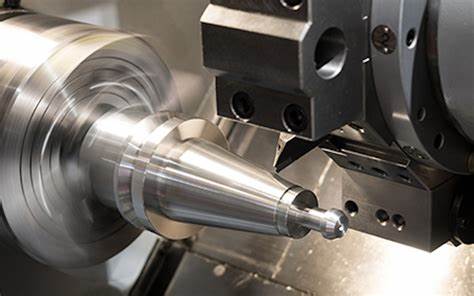
Turning Operations
Turning is ideal for cylindrical parts like rollers, bushings, and spacers.
| Operation | Parameter | Recommended Value |
|---|---|---|
| Turning | Cutting speed | 200–350 m/min |
| Turning | Feed (rough) | 0.15–0.25 mm/rev |
| Turning | Feed (finish) | 0.05–0.10 mm/rev |
| Turning | Depth of cut (rough) | 1–2 mm |
| Turning | Depth of cut (finish) | 0.1–0.3 mm |
The material’s toughness allows consistent chip formation. Use sharp inserts with polished rake faces to reduce material adhesion.
Drilling and Threading
Drilling requires sharp tools to prevent fiber pull-out. Standard twist drills work, but carbide drills with polished flutes perform better.
| Operation | Parameter | Recommended Value |
|---|---|---|
| Drilling | Cutting speed | 50–100 m/min |
| Drilling | Feed | 0.05–0.10 mm/rev |
| Drilling | Peck depth | 2–3 mm |
Thread milling is more reliable than tapping. Tapping can tear threads in glass-filled nylon. Thread milling produces clean, strong threads with less risk.
Coolant Strategy
For high-volume production, use water-soluble coolant at 5–7% concentration. This:
- Flushes away abrasive glass fiber chips
- Reduces heat buildup
- Extends tool life
For low-volume jobs, air cooling can work. But expect more tool wear and possible surface fuzzing.
How to Choose the Right Tools?
Tool Materials: Carbide vs. HSS
The glass fibers in Nylon 15%GF are abrasive. Tool material choice directly affects cost and quality.
| Tool Material | Best For | Tool Life Advantage |
|---|---|---|
| Carbide (K30 grade) | High-volume production | 20–30% longer than HSS |
| HSS (M2 or M42) | Low-volume, prototyping | Lower upfront cost |
For production runs over 100 parts, carbide tools pay for themselves through fewer tool changes and consistent quality.
Tool Geometry
Geometry matters as much as material. Poor geometry leads to fuzzing, fiber pull-out, and poor surface finish.
End mills:
- Helix angle: 30–35° improves chip evacuation
- Flute count: 2-flute for roughing (better chip flow), 4-flute for finishing
- Edge sharpness: Radius <0.02 mm minimizes fuzzing
Drills:
- Point angle: 118° reduces thrust and prevents fiber pull-out
- Flute design: Straight flutes preferred for reaming
Inserts for turning:
- Negative rake with polished surface reduces material adhesion
- Sharp edges minimize cutting forces
Tool Coatings
Coatings reduce friction and extend tool life.
| Coating | Benefit | Life Extension |
|---|---|---|
| TiN (Titanium Nitride) | General-purpose, reduces friction | 15–20% |
| TiAlN (Titanium Aluminum Nitride) | Better heat resistance for high-speed ops | 20–30% |
For most Nylon 15%GF applications, TiN-coated carbide offers the best balance of performance and cost.
Preventing Tool Breakage
Two main causes of tool failure:
- Excessive feed rates: Keep feed below 0.20 mm/tooth for milling
- Vibration: Use rigid tool holders and check runout
A tool that chatters will produce poor surface finish and fail prematurely.
How to Control Quality and Surface Finish?
Surface Finish Targets
| Application | Typical Ra Target |
|---|---|
| General industrial | 0.8–1.2 μm |
| Cosmetic surfaces | 0.4–0.6 μm (with finishing passes) |
| Functional surfaces | 1.6–3.2 μm |
Achieving fine finishes requires:
- Sharp tools
- Light finishing passes (0.1–0.2 mm depth)
- Proper coolant flow
Dimensional Accuracy
Nylon 15%GF can hold ±0.01 mm tolerances under controlled conditions. Tighter tolerances (±0.005 mm) are possible for critical features but require:
- Consistent material conditioning
- In-process measurement
- Temperature-controlled environment
Managing Moisture-Related Changes
Moisture absorption causes swelling. Here is how we handle it:
- Store material in a controlled environment (50% relative humidity) before machining
- Condition finished parts in the same humidity for 24–48 hours before final inspection
- Seal parts if they will be used in extreme humidity environments
If you machine dry material and measure it immediately, dimensions will change after the part absorbs moisture. Plan for this by conditioning parts before final inspection.
Inspection Methods
| Feature | Inspection Tool |
|---|---|
| Complex geometries | CMM (Coordinate Measuring Machine) |
| Linear dimensions | Micrometers, calipers |
| Surface finish | Profilometer |
| Hole position | Vision system or CMM |
First Article Inspection (FAI) is required for new part numbers. This documents compliance with all design requirements before production begins.
Common Defects and Solutions
| Defect | Likely Cause | Solution |
|---|---|---|
| Fiber pull-out | Dull tool | Replace tool; use sharper geometry |
| Fuzzing | Excessive feed or speed | Reduce feed; optimize RPM |
| Dimensional variation | Moisture changes | Condition material before machining |
| Burrs | Dull tool or wrong geometry | Sharper tools; climb milling |
| Heat damage | Insufficient coolant | Add coolant; reduce speed |
Where Is Nylon 15%GF Used?
The material’s balance of strength, toughness, and machinability makes it suitable for many industries.
Automotive Applications
- Interior trim components: Door handles, bezels, and brackets
- Under-hood parts: Sensor housings, connector bodies
- Door lock mechanisms: Internal components requiring toughness
In one project, we machined sensor housings for an automotive supplier. The parts required ±0.01 mm tolerances on critical mounting surfaces. Using conditioned material and carbide tools, we held these tolerances across a 5,000-part run with a scrap rate below 1%.
Electrical and Electronic Devices
- Connector housings: Insulation with moderate strength
- Terminal blocks: Dimensional stability for reliable connections
- Switch components: Wear resistance for moving parts
The material’s electrical insulation properties (10¹³–10¹⁴ Ω·cm) make it suitable for components that carry current.
Industrial Machinery
- Guides and rollers: Moderate friction and wear resistance
- Wear pads: Absorbing impact in moving assemblies
- Machine guards: Impact-resistant protective covers
Consumer Products
- Power tool handles: Impact resistance and surface finish
- Appliance knobs: Aesthetic appearance with durability
- Sporting goods: Lightweight structural components
Medical Devices (Non-Implantable)
- Instrument housings: Chemical resistance and sterilizability
- Diagnostic equipment components: Dimensional stability
Prototyping
Nylon 15%GF is excellent for functional prototypes. It machines predictably and its properties closely match production-grade glass-filled nylons. This allows designers to test form, fit, and function before committing to high-volume tooling.
Conclusion
CNC machining Nylon 15%GF requires understanding its unique characteristics. The 15% glass fiber adds strength and heat resistance but introduces abrasiveness. The material’s moisture sensitivity demands controlled storage and conditioning. And the balance of toughness and rigidity requires the right tool geometry and cutting parameters.
Success comes down to three things:
- Use sharp, carbide tools with TiN coating for production runs
- Condition material to 50% humidity before machining critical dimensions
- Optimize feeds and speeds to avoid fuzzing and fiber pull-out
When done right, Nylon 15%GF delivers reliable, precision-machined parts that perform well in demanding applications.
FAQ
How does Nylon 15%GF compare to Nylon 20%GF in machining?
Nylon 15%GF is more machinable than Nylon 20%GF. It allows higher feed rates (0.15–0.20 mm/tooth vs 0.10–0.15 mm/tooth) and longer tool life because the lower glass content is less abrasive. It also has higher elongation at break (8–12% vs 5–8%), reducing the risk of cracking during machining. However, it offers slightly lower tensile strength (75–90 MPa vs 90–110 MPa), so it is better suited for light-to-medium load applications.
Can Nylon 15%GF be machined without coolant?
Yes, but with trade-offs. Air cooling works for low-volume jobs and prototyping. However, dry machining increases fuzzing and accelerates tool wear. For production runs exceeding 50 parts, we recommend water-soluble coolant at 5–7% concentration. It extends tool life by 20–30% and produces better surface finishes.
What causes moisture-related dimensional changes, and how do I prevent them?
Nylon absorbs moisture from the air, causing swelling. This can shift critical dimensions by 0.5% or more. To prevent this:
- Store raw material in a controlled environment (50% relative humidity)
- Condition machined parts in the same environment for 24–48 hours before final inspection
- If parts will be used in extreme humidity, consider sealing them after machining
Measuring parts immediately after dry machining will give inaccurate results. Always condition before final inspection.
Contact Yigu Technology for Custom Manufacturing
At Yigu Technology, we specialize in CNC machining engineered plastics like Nylon 15%GF. Our team understands the nuances of glass-filled materials—from tool selection to moisture management to quality control.
We serve the automotive, electrical, industrial, and medical sectors with precision-machined components that meet tight tolerances and demanding performance requirements. Whether you need prototypes or full-scale production, we deliver consistent quality.
Contact us today to discuss your Nylon 15%GF machining project.