Introduction
Polyethylene is everywhere. It is in the milk jug in your refrigerator. It is in the squeeze bottle of honey on your shelf. It is in the chemical tank at your local water treatment plant. As one of the most widely used plastics in injection molding, polyethylene—in its low-density (LDPE) and high-density (HDPE) forms—serves applications from flexible packaging to rigid containers.
But working with these materials comes with distinct challenges. Manufacturers must choose between LDPE and HDPE for specific applications. They must optimize molding parameters for each type. They must deal with issues like warping, shrinkage, and dimensional stability.
This guide covers everything you need to know: material properties, process parameters, mold design, and applications for both LDPE and HDPE.
What Are the Key Types of Polyethylene?
Low-Density Polyethylene (LDPE)
LDPE is produced through high-pressure polymerization . This process creates a branched polymer structure. The branching gives LDPE:
- Low density: 0.910 to 0.925 g/cm³
- High flexibility
- Excellent impact resistance at low temperatures
LDPE is ideal for products that need to bend or stretch.
High-Density Polyethylene (HDPE)
HDPE is made via low-pressure polymerization . The polymer structure is linear with minimal branching. This results in:
- Higher density: 0.941 to 0.965 g/cm³
- Greater rigidity
- Higher tensile strength
HDPE is suited for load-bearing applications and rigid containers.
Linear Low-Density Polyethylene (LLDPE)
LLDPE has a linear structure with short branches. It offers better impact and puncture resistance than LDPE. LLDPE is common in stretch films and liners but is less frequently used in injection molding than LDPE and HDPE.
The table below compares the three types:
| Property | LDPE | HDPE | LLDPE |
|---|---|---|---|
| Polymer structure | Highly branched | Linear, minimal branching | Linear with short branches |
| Density (g/cm³) | 0.910 – 0.925 | 0.941 – 0.965 | 0.915 – 0.925 |
| Flexibility | High | Low | Very high |
| Rigidity | Low | High | Medium |
What Are the Key Properties of LDPE and HDPE?
Density
LDPE’s lower density makes it lighter. HDPE’s higher density contributes to its strength and rigidity.
Tensile Strength
HDPE has significantly higher tensile strength than LDPE.
| Material | Tensile Strength (MPa) |
|---|---|
| LDPE | 7 – 15 |
| HDPE | 22 – 38 |
This makes HDPE better suited for load-bearing applications.
Impact Resistance
LDPE offers excellent impact resistance at low temperatures. It remains flexible even when cold. HDPE stays tough at higher temperatures but becomes more brittle at very low temperatures.
Flexibility
LDPE is highly flexible. It can be folded or twisted repeatedly without breaking. HDPE is rigid and less flexible.
Chemical Resistance
Both LDPE and HDPE resist most acids, alkalis, and organic solvents. This makes them suitable for chemical storage containers and laboratory equipment.
Thermal Properties
| Material | Melting Point (°C) |
|---|---|
| LDPE | 105 – 115 |
| HDPE | 120 – 130 |
HDPE’s higher melting point allows it to withstand higher temperatures—such as boiling water in detergent bottles.
How Do You Injection Mold LDPE and HDPE?
Equipment Requirements
Injection molding machine: Use a screw with shallow flight depth to handle the low viscosity of molten PE. Screw diameters typically range from 30 to 100 mm , depending on part size.
Clamping force: Depends on part size. Small parts may need 50 to 100 tons . Large containers may require 200 to 500 tons . LDPE’s lower viscosity may require slightly lower clamping force than HDPE to prevent flash.
Critical Process Parameters
| Parameter | LDPE | HDPE |
|---|---|---|
| Injection pressure | 500 – 1000 bar | 800 – 1500 bar |
| Melt temperature | 105 – 115°C | 120 – 130°C |
| Cooling time (thin walls) | 10 – 30 seconds | 10 – 30 seconds |
| Cooling time (thick walls) | 30 – 60 seconds | 30 – 60 seconds |
| Shrinkage rate | 1.5 – 3.0% | 1.0 – 2.5% |
Injection pressure: HDPE’s higher viscosity requires higher injection pressure. Too much pressure causes flash, especially with LDPE’s lower melt strength.
Cooling time: HDPE’s higher crystallinity means it takes longer to cool than LDPE. Thicker parts require longer cooling.
Shrinkage: Both materials shrink, but LDPE shrinks more. Mold design must account for this difference to achieve dimensional accuracy.
Mold Design Considerations
Cooling channels: PE has high thermal conductivity. Molds need proper cooling channels to remove heat efficiently.
Shrinkage compensation: LDPE’s higher shrinkage rate (1.5–3.0%) requires larger compensation in mold design than HDPE (1.0–2.5%).
Venting: HDPE molds require precise venting to prevent air traps in rigid parts.
Surface finish: Both materials can achieve smooth surfaces, but HDPE is more prone to surface defects like sink marks if the process is not optimized.
What Are the Applications?
Packaging
| Material | Applications |
|---|---|
| LDPE | Plastic bags, shrink wraps, squeeze bottles |
| HDPE | Cereal box liners, detergent containers |
LDPE’s flexibility suits squeeze bottles for honey, mustard, and other condiments. HDPE’s rigidity suits detergent bottles and rigid containers.
Containers and Bottles
HDPE is the go-to material for:
- Milk jugs
- Water bottles
- Food containers
Its rigidity and chemical resistance make it ideal for these applications.
LDPE is used for squeeze bottles where flexibility is needed.
Automotive Parts
| Material | Applications |
|---|---|
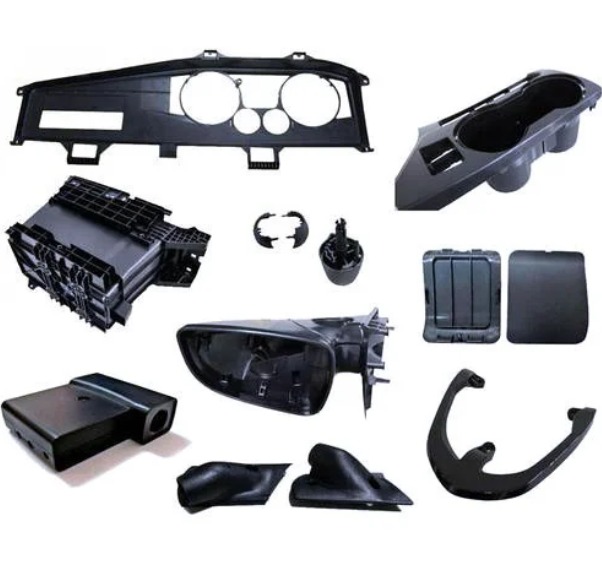
| HDPE | Fuel tanks, battery cases, interior trim |
| LDPE | Gaskets, seals |
HDPE’s strength and chemical resistance suit under-hood applications. LDPE’s flexibility suits sealing applications.
Consumer Goods
| Material | Applications |
|---|---|
| LDPE | Toys, shower curtains, squeeze toys |
| HDPE | Cutting boards, trash cans, storage bins |
Industrial Components
| Material | Applications |
|---|---|
| HDPE | Pipes, fittings, chemical storage tanks |
| LDPE | Liners, protective covers |
What Defects Occur and How to Prevent Them?
Warping
Cause: Uneven cooling or improper shrinkage compensation.
Solution: Design uniform cooling channels. Account for shrinkage differences in mold design. HDPE’s higher crystallinity requires careful cooling control.
Flash
Cause: Excessive injection pressure, especially with LDPE’s lower melt strength.
Solution: Reduce injection pressure. Ensure proper clamping force. For LDPE, keep clamping force adequate to prevent flash without over-clamping.
Sink Marks
Cause: Insufficient packing in thick sections. HDPE is more prone to sink marks.
Solution: Increase holding pressure. Optimize gate placement. Design uniform wall thickness.
Poor Dimensional Stability
Cause: Incorrect shrinkage compensation.
Solution: LDPE: compensate for 1.5–3.0% shrinkage. HDPE: compensate for 1.0–2.5% shrinkage. Verify with test shots.
What Does a Real-World Example Look Like?
A manufacturer needed to produce both flexible squeeze bottles and rigid detergent containers. LDPE was selected for the squeeze bottles—flexibility and low-temperature impact resistance were critical. HDPE was selected for the detergent containers—rigidity and chemical resistance were required.
Mold designs were adjusted for each material’s shrinkage rate. LDPE molds were oversized to compensate for 2.5% shrinkage. HDPE molds were oversized for 1.5% shrinkage.
Process parameters were optimized separately. LDPE ran at 110°C melt temperature with 600 bar injection pressure. HDPE ran at 125°C with 1000 bar injection pressure.
The result: both products met dimensional specifications. Scrap rate was under 2%. Production efficiency was high, with cycle times of 25 seconds for both materials.
Conclusion
LDPE and HDPE are both polyethylene, but they are not interchangeable. LDPE offers flexibility, low-temperature impact resistance, and higher shrinkage. HDPE offers rigidity, strength, higher melting point, and better dimensional stability.
Injection molding requires different approaches for each. LDPE needs lower injection pressure, lower melt temperature, and higher shrinkage compensation. HDPE needs higher pressure, higher temperature, and precise cooling control.
Applications range from flexible packaging (LDPE) to rigid containers (HDPE), automotive parts, consumer goods, and industrial components.
When you match the material to the application and optimize the process accordingly, polyethylene injection molding delivers consistent, high-quality results.
FAQ
Can LDPE and HDPE be recycled together?
No. LDPE and HDPE are recycled separately. LDPE carries resin code 4. HDPE uses code 2. Mixing them reduces the quality of recycled material. Separate collection and processing maintain material properties.
Which is more cost-effective, LDPE or HDPE?
LDPE is generally slightly more expensive than HDPE due to the high-pressure polymerization process. The cost difference is minimal. Selection should be based on performance requirements—flexibility versus rigidity—not cost alone.
Can PE parts be used in food contact applications?
Yes. Both LDPE and HDPE are FDA-approved for food contact. They are non-toxic and resistant to food acids and oils. Common applications include food packaging, containers, and cutting boards.
What is the main difference between LDPE and HDPE in injection molding?
LDPE has lower density, higher flexibility, and higher shrinkage (1.5–3.0%). It processes at lower melt temperatures (105–115°C) and requires lower injection pressure. HDPE has higher density, greater rigidity, and lower shrinkage (1.0–2.5%). It processes at higher melt temperatures (120–130°C) and requires higher injection pressure.
Why does HDPE require longer cooling time than LDPE?
HDPE has higher crystallinity than LDPE. Crystalline regions form during cooling and require more time to develop. Faster cooling can trap internal stresses and cause warping. LDPE’s branched structure limits crystallinity, allowing faster cooling.
Contact Yigu Technology for Custom Manufacturing
At Yigu Technology , we specialize in injection molding both LDPE and HDPE. We understand the differences between these materials and optimize processes accordingly.
Our mold designs account for shrinkage differences. Our process parameters are tuned for each material’s properties. We serve packaging, automotive, consumer goods, and industrial sectors.
Whether you need flexible LDPE squeeze bottles or rigid HDPE containers, we deliver consistent, high-quality parts.
Contact Yigu Technology today to discuss your polyethylene injection molding project.