
Introduction
Injection molding is one of the most precise and efficient manufacturing processes in existence. It produces billions of parts annually—from tiny medical components to large automotive panels—with tolerances as tight as ±0.01 mm. The ability to consistently create complex shapes with high dimensional accuracy is what makes injection molding the backbone of modern manufacturing.
But precision does not happen by accident. It requires careful control of every element: mold design, material selection, processing parameters, and quality assurance. Each factor interacts with the others, and a deviation in one area can compromise the entire production run.
This guide explains how injection molding achieves high precision. You will learn the step-by-step process, the key factors affecting accuracy, and practical strategies for crafting quality products. Whether you are new to injection molding or looking to improve your process, this guide provides the knowledge you need.
What Is Injection Molding?
Injection molding is a manufacturing process where molten material—typically thermoplastic or thermosetting polymer—is injected into a mold cavity under high pressure. The material cools and solidifies, taking the precise shape of the cavity. The mold opens, and the finished part is ejected.
The Basic Principle
The process is deceptively simple:
- Raw material (pellets or granules) feeds into a heated barrel
- Melting occurs through heat and mechanical shear from a rotating screw
- Injection forces the molten material into the mold cavity under high pressure
- Cooling solidifies the material into the shape of the cavity
- Ejection removes the finished part
Why Precision Matters
| Industry | Precision Requirement | Consequence of Deviation |
|---|---|---|
| Medical | ±0.01–0.05 mm | Device failure; patient safety risk |
| Aerospace | ±0.01–0.03 mm | Component failure; safety hazard |
| Automotive | ±0.05–0.1 mm | Fit issues; noise; vibration |
| Electronics | ±0.02–0.05 mm | Assembly failure; short circuits |
How Does the Injection Molding Process Work Step by Step?
Each stage of the process affects final product precision.
Step 1: Feeding (Charging)
Raw material in pellet or granule form is fed from the hopper into the barrel. Consistent feed rate is essential.
| Factor | Impact on Precision |
|---|---|
| Feed rate consistency | Variation >5% can cause 10–15% change in part density |
| Material drying | Moisture causes voids; surface defects; dimensional instability |
Example: Polypropylene used in automotive parts must be properly dried. High moisture content creates internal voids that weaken the structure and alter dimensions.
Step 2: Plasticizing
Inside the heated barrel, a rotating screw melts and homogenizes the material. The plasticizing process determines melt quality.
| Parameter | Optimal Range | Effect |
|---|---|---|
| Barrel temperature | Material-dependent (e.g., ABS: 200–250°C) | Too low = unmelted particles; too high = degradation |
| Screw rotation | 50–100 RPM | Affects mixing; shear heating |
Example: For ABS, barrel temperatures below 180°C leave unmelted particles, causing flow irregularities. Above 280°C, ABS decomposes, reducing strength and causing discoloration.
Step 3: Injection
The screw acts as a piston, forcing molten material through the nozzle into the mold cavity.
Fill Stage
| Parameter | Impact |
|---|---|
| Injection speed | Thin-walled parts: 80–100 mm/s; thick parts: 30–50 mm/s |
| Injection pressure | 50–200 MPa; ensures complete filling |
Pack and Hold Stage
After filling, lower pressure is applied to compensate for shrinkage as the plastic cools.
| Parameter | Typical Range |
|---|---|
| Holding pressure | 30–50% of injection pressure |
| Holding time | 5–10 seconds (for 3–5 mm wall thickness) |
Insufficient holding = sink marks; excessive = over-packing; stress; warpage.
Step 4: Cooling
Cooling solidifies the plastic. This stage accounts for 50–80% of cycle time.
| Factor | Cooling Time |
|---|---|
| Thin-walled parts (<2 mm) | 10–15 seconds |
| Thick-walled parts (5–10 mm) | 30–60 seconds |
| Material (PE cools faster than PC) | Material-dependent |
Critical: Too rapid cooling = internal stress; warpage. Too slow = reduced efficiency.
Step 5: Ejection
Ejector pins, sleeves, or stripper plates remove the solidified part.
| Factor | Consideration |
|---|---|
| Ejection force | Small parts: 50–100 N; large parts: 500–1000 N |
| Ejection system design | Even force distribution prevents part damage |
What Key Factors Affect Product Precision?
Precision is the result of careful control across mold design, material selection, and process parameters.
Mold Design and Manufacturing Precision
Mold Material Selection
The mold material determines how well the cavity maintains its shape over thousands or millions of cycles.
| Steel Type | Hardness (HRC) | Properties | Best For |
|---|---|---|---|
| P20 | 28–34 | Good machinability; moderate wear resistance | General-purpose molds; medium volume |
| H13 | 48–52 | Excellent heat resistance; wear resistance; corrosion resistance | High-volume; high-temperature materials |
Study finding: After 100,000 injection cycles of polycarbonate:
- P20 mold showed 0.1–0.2 mm wear; part dimensions varied
- H13 mold maintained ±0.01 mm tolerance; consistent wall thickness
Mold Structure and Geometry
| Design Element | Impact on Precision |
|---|---|
| Parting line | Poor location = flash; uneven surface |
| Core/cavity alignment | Misalignment = uneven wall thickness |
| Complex features | Slides; lifters must be precisely guided to maintain tolerances |
Processing Parameters
Temperature Control
| Parameter | Effect | Typical Tolerance |
|---|---|---|
| Barrel temperature | Affects viscosity; flow | ±5°C for general; ±2°C for precision |
| Mold temperature | Affects cooling rate; warpage | ±3°C |
Example – ABS molding:
| Barrel Temperature (°C) | Part Length (mm) | Deviation |
|---|---|---|
| 180 | 99.5 | -0.5 |
| 220 | 100.0 | 0.0 |
| 260 | 99.8 | -0.2 |
Low temperature = incomplete fill; high temperature = degradation.
Pressure Management
| Parameter | Effect |
|---|---|
| Plasticizing pressure (back-pressure) | Higher = better mixing; too high = overheating; degradation |
| Injection pressure | Higher = complete fill; too high = over-packing; stress; warpage |
Injection Speed
| Part Type | Optimal Speed | Effect |
|---|---|---|
| Thin-walled | 80–100 mm/s | Quick fill; prevents freeze-off |
| Thick-walled | 30–50 mm/s | Uniform fill; reduces over-packing risk |
Material Properties
Shrinkage Rate
Different plastics shrink at different rates. Mold design must compensate.
| Material | Shrinkage Rate (%) |
|---|---|
| ABS | 0.4–0.7 |
| Polypropylene (PP) | 1.0–2.5 |
| HDPE | 1.5–3.0 |
| Polystyrene (PS) | 0.3–0.6 |
Impact: A PP gear molded without shrinkage compensation will have undersized teeth, affecting meshing performance.
Flowability
| Material | Flowability | Processing Consideration |
|---|---|---|
| LDPE | Excellent | Fills complex cavities easily |
| PC | Moderate | Requires higher injection pressure |
| High-viscosity engineering plastics | Poor | May require specialized mold design |
Additives and Their Impact
| Additive | Effect on Precision |
|---|---|
| Glass fiber (30%) | Reduces shrinkage (PP: 1.5–2.5% → 0.5–1.2%); affects flowability |
| Plasticizers | Increases shrinkage; may reduce mechanical properties |
How Do You Ensure Precision Throughout Production?
Process Monitoring
| Parameter | Monitoring Method | Control Limits |
|---|---|---|
| Melt temperature | Thermocouples | ±2–5°C |
| Injection pressure | Pressure sensors | ±5% |
| Cycle time | Machine timer | ±2 seconds |
| Part weight | Scale | ±2% |
Statistical Process Control (SPC)
SPC tracks process stability over time. Control charts identify trends before defects occur.
Critical parameters to monitor:
- Cavity pressure curve
- Melt temperature
- Injection pressure
- Cycle time
- Part weight
Dimensional Inspection
| Tool | Application | Typical Tolerance |
|---|---|---|
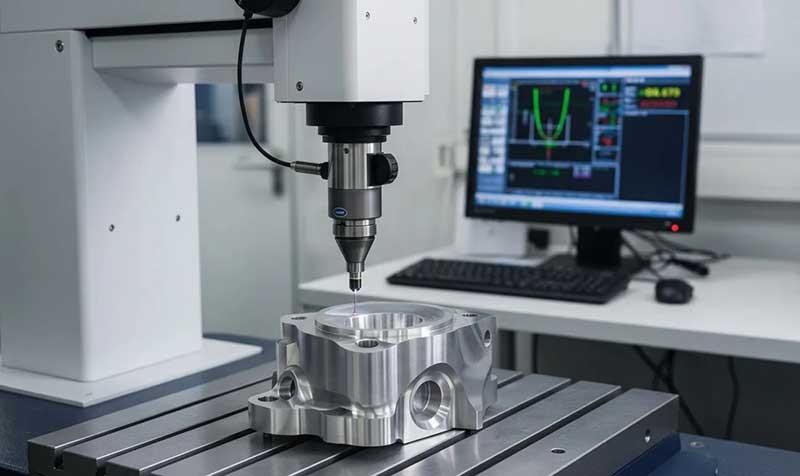
| CMM (coordinate measuring machine) | Critical dimensions | ±0.001–0.01 mm |
| Optical comparator | Contour; profiles | ±0.01 mm |
| Go/no-go gauges | Quick pass/fail | Design-dependent |
Mold Maintenance
| Frequency | Task |
|---|---|
| Daily | Clean parting line; check ejector pins |
| Weekly | Inspect gate; check cooling channels |
| Monthly | Measure critical dimensions; check for wear |
| Per production run | Clean; lubricate; inspect for damage |
What Are Common Precision Defects and Solutions?
| Defect | Cause | Solution |
|---|---|---|
| Short shot | Low temperature; low pressure | Increase temperature; increase injection pressure |
| Flash | Excessive pressure; worn mold | Reduce pressure; repair mold |
| Warpage | Uneven cooling; internal stress | Balance cooling; optimize holding pressure |
| Sink marks | Insufficient holding | Increase holding pressure/time |
| Dimensional variation | Process instability | Implement SPC; stabilize parameters |
| Surface flow marks | Low injection speed | Increase speed; raise melt temperature |
How Do You Choose Materials for High Precision?
Material Selection Criteria
| Criterion | Considerations |
|---|---|
| Shrinkage rate | Low and consistent for tight tolerances |
| Flowability | Good flow ensures uniform filling |
| Moisture sensitivity | Hygroscopic materials require drying |
| Mechanical properties | Must meet application requirements |
| Thermal stability | Maintains dimensions across temperature range |
Material Comparison for Precision Applications
| Material | Shrinkage | Flowability | Precision Suitability |
|---|---|---|---|
| ABS | 0.4–0.7% | Good | High |
| Polycarbonate | 0.5–0.7% | Moderate | High |
| Polypropylene | 1.0–2.5% | Good | Moderate (compensate for shrinkage) |
| PEEK | 0.5–1.0% | Poor | High (requires precision tooling) |
| Acetal (POM) | 0.5–0.8% | Good | High |
Conclusion
Injection molding achieves high precision through the careful integration of:
- Mold design – Precision-machined cavities; wear-resistant materials; proper gating and cooling
- Material selection – Matching shrinkage, flowability, and properties to requirements
- Process control – Stable temperature, pressure, and speed; statistical process control
- Quality assurance – In-process monitoring; dimensional inspection; mold maintenance
When these elements work together, injection molding produces parts with tolerances as tight as ±0.01 mm, consistently and efficiently. From medical devices to aerospace components, precision injection molding enables products that perform reliably in the most demanding applications.
Frequently Asked Questions (FAQ)
What are the common causes of dimensional inaccuracies in injection-molded products?
Common causes include mold wear (gradual cavity enlargement), unstable processing parameters (temperature fluctuations >10°C cause 0.2–0.5 mm deviations), inconsistent injection pressure (>10% variation causes over- or under-packing), and material variations (shrinkage inconsistencies). Regular mold maintenance, stable process control, and consistent material sourcing prevent these issues.
How can I choose the right plastic material for high-precision injection molding?
Consider shrinkage rate—materials with low, consistent shrinkage (ABS, PC, acetal) are preferred for tight tolerances. Flowability—good flow ensures uniform filling of complex cavities. Moisture sensitivity—hygroscopic materials require proper drying. Application requirements—temperature, chemical exposure, mechanical loads. For high-precision applications, materials like ABS, PC, and acetal are commonly used.
What are the key differences between injection molding for high-precision products and general-purpose products?
Mold tolerances: Precision parts require mold cavity tolerances of ±0.01 mm; general-purpose may accept ±0.1 mm. Process control: Precision demands temperature variation within ±2°C; general-purpose within ±5°C. Inspection: Precision parts often require 100% CMM inspection; general-purpose may use sampling inspection. Material selection: Precision favors materials with low, consistent shrinkage.
How does mold material affect part precision?
Mold material determines wear resistance and dimensional stability over production life. H13 steel (48–52 HRC) maintains ±0.01 mm tolerances for over 100,000 cycles. P20 steel (28–34 HRC) may show 0.1–0.2 mm wear after 100,000 cycles, causing dimensional drift. For high-volume precision production, hardened tool steel is essential.
What is the role of holding pressure in dimensional accuracy?
Holding pressure compensates for shrinkage as the plastic cools. Insufficient holding pressure causes sink marks and under-filled dimensions. Excessive holding causes over-packing, internal stress, and warpage. Proper holding pressure (typically 30–50% of injection pressure) and holding time (until gate freeze-off) ensure dimensional stability.
Contact Yigu Technology for Custom Manufacturing
At Yigu Technology, we specialize in high-precision injection molding for demanding applications. Our expertise spans medical, automotive, electronics, and industrial sectors where dimensional accuracy is critical.
Our precision capabilities include:
- Mold design and manufacturing – Tolerances to ±0.01 mm; H13 and P20 steel molds
- Process control – Closed-loop temperature and pressure control; SPC monitoring
- Material expertise – ABS, PC, acetal, PEEK, and engineering grades
- Quality assurance – CMM inspection; dimensional verification; mechanical testing
- Volume flexibility – Prototypes to high-volume production
We deliver parts that meet the tightest tolerances, consistently and reliably.
Contact us today to discuss your high-precision injection molding project. Let our expertise help you craft quality products with precision.


