Introduction
Imagine a 3D printer that works like an inkjet printer—but instead of depositing ink on paper, it deposits liquid plastic, wax, or even metal, building objects layer by layer with incredible detail and precision. That is jetting 3D printing. This family of technologies combines the speed of inkjet printing with the design freedom of additive manufacturing, producing parts with smooth surfaces, fine details, and even multiple materials in a single build. From jewelry with intricate filigree patterns to metal aerospace components, jetting 3D printing is revolutionizing how we make things. This article explores what jetting 3D printing is, how it works, the main technologies involved, and why it matters for modern manufacturing.
What Is Jetting 3D Printing?
Definition and Basic Concept
Jetting 3D printing, also called inkjet 3D printing, builds objects by depositing tiny droplets of liquid material through nozzles, layer by layer. Think of it as a high-precision inkjet printer for three-dimensional objects.
The process is elegant:
- A digital 3D model serves as the blueprint
- Software slices the model into thin layers (typically 10–100 micrometers)
- A print head with multiple nozzles moves across the build platform
- Tiny droplets of liquid material are deposited precisely where needed
- Each layer is cured or solidified immediately
- The process repeats until the object is complete
The result: parts with exceptional detail, smooth surfaces, and the ability to combine multiple materials in a single print.
Why It's Revolutionary
Jetting 3D printing stands out because it combines:
- High resolution: Layers as thin as 10–30 microns
- Smooth surfaces: Often ready to use as-printed
- Multi-material capability: Different materials in the same part
- Full color: Color printing possible with some technologies
- Speed: Entire layers deposited at once (in some methods)
This combination of capabilities is unmatched by other 3D printing technologies.
How Does Jetting 3D Printing Work?
Step 1: 3D Modeling
Everything starts with a digital 3D model created in CAD software or captured by 3D scanning. Designers define every detail—curves, surfaces, internal features. For multi-material or color prints, the model includes information about which materials go where.
In automotive engineering, a designer might create a complex air intake manifold with optimized internal channels for better airflow. Every angle, curve, and dimension is precisely defined.
Step 2: Slicing the Model
Specialized slicing software divides the 3D model into hundreds or thousands of thin horizontal layers—typically 10–100 micrometers thick. Each layer represents a cross-section of the final object.
The slicing software calculates:
- The exact shape of each layer
- Where material needs to be deposited
- Which material (for multi-material prints)
- Support structures for overhangs
This sliced data is converted into instructions (usually G-code) that the printer follows.
Step 3: Printing Process
The print head, equipped with multiple tiny nozzles, moves across the build platform according to the instructions. As it moves, it jets out small droplets of liquid material—typically 10–30 picoliters each.
For a coffee cup:
- First layer: Circular base
- Subsequent layers: Walls building up
- Each layer deposited with precision, following the shape
The print head may have hundreds or thousands of nozzles, allowing it to deposit material quickly and cover large areas efficiently.
Step 4: Curing and Solidification
After each layer is deposited, the material must be solidified:
For photopolymers: A UV light source immediately cures the resin, turning liquid droplets into solid plastic. This happens instantly, preventing droplets from flowing or merging.
For wax: Cooling solidifies the material.
For binder jetting: A liquid binder bonds powder particles, which are later sintered.
This immediate solidification ensures each layer adheres firmly to the previous one, creating strong, stable objects.
Step 5: Post-Processing
After printing, parts may need:
Support removal: Overhangs require support structures, which must be removed. Some supports dissolve in solution; others are removed mechanically.
Cleaning: Removing any uncured material.
Sintering: For binder-jetted metal or ceramic parts, heating in a furnace fuses particles into dense solids.
Finishing: Sanding, polishing, painting, or coating as needed.
What Are the Main Jetting 3D Printing Technologies?
Material Jetting
How it works: Multiple nozzles jet tiny droplets of liquid material (photopolymer resins, waxes, or metal-filled slurries) onto the build platform. Each layer is cured immediately with UV light.
Key characteristics:
- High resolution—layers as thin as 10–30 microns
- Smooth surfaces—often ready to use as-printed
- Multi-material capability—different resins in the same part
- Full color possible
Applications:
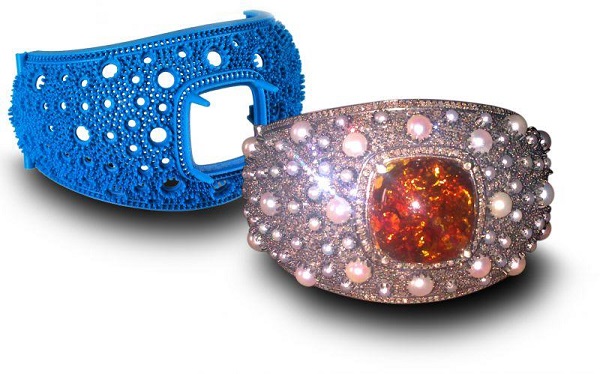
- Jewelry manufacturing: Intricate designs with delicate filigree patterns. The printed model serves as a master pattern for casting precious metals.
- Small precision parts: Micro-gears, tiny connectors for electronics, medical devices. High accuracy ensures perfect fit.
- Dental models: Highly detailed replicas for crown and bridge work.
- Prototypes: Visual models that look like production parts.
Binder Jetting
How it works: Instead of jetting the final material, a print head jets a liquid binder onto a bed of powder (metal, ceramic, sand). The binder bonds powder particles together in the desired shape.
Process steps:
- A thin layer of powder is spread across the build platform
- The print head deposits binder where the part should be solid
- The platform lowers, a new powder layer is spread
- The process repeats
- After printing, the "green" part is removed from loose powder
- Sintering (heating) fuses particles into dense solid
Key characteristics:
- Fast—entire layers printed at once
- Large build volumes possible
- No supports needed—loose powder supports parts
- Full color possible (for non-metal applications)
Applications:
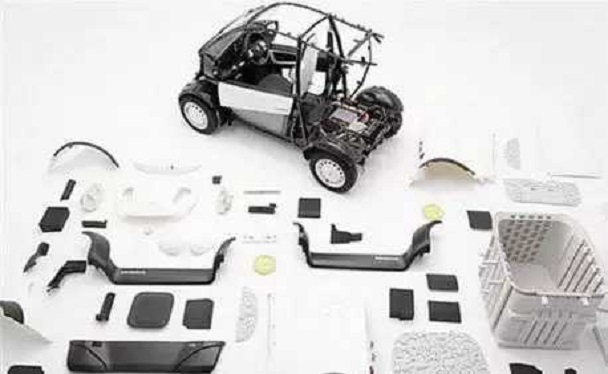
- Automotive: Engine blocks, transmission housings with complex internal geometries. Optimized designs improve fluid flow and heat dissipation.
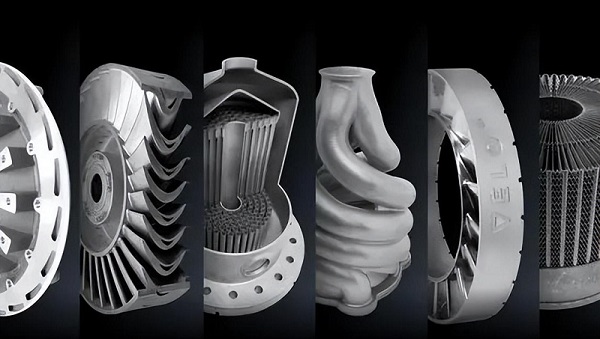
- Aerospace: Lightweight titanium components with lattice structures. Reduced weight improves fuel efficiency.
- Industrial molds: Sand casting molds printed directly.
- Medical: Custom implants with porous structures for bone ingrowth.
Comparison of Jetting Technologies
| Factor | Material Jetting | Binder Jetting |
|---|---|---|
| Material form | Liquid resin, wax | Powder + liquid binder |
| Layer thickness | 10–30 μm | 50–200 μm |
| Precision | ±0.05 mm | ±0.1–0.2 mm |
| Surface finish | Excellent—smooth | Moderate—slightly rough |
| Multi-material | Yes | Limited |
| Color | Full color possible | Full color possible (non-metal) |
| Post-processing | Support removal | Sintering, infiltration |
| Best for | High-detail parts, multi-material, color | Large parts, metal production, molds |
What Materials Can Be Used in Jetting 3D Printing?
Material Jetting Materials
Photopolymer resins: Most common. Available in various formulations:
- Standard: General purpose, good detail
- Tough/durable: Impact resistant, engineering properties
- Flexible: Rubber-like elasticity
- High-temperature: Withstands heat
- Biocompatible: Medical and dental applications
- Castable: Burns clean for investment casting
Wax: Used for investment casting patterns. Burns out completely, leaving no residue.
Metal-filled slurries: Metal powder suspended in binder. After printing, sintering removes binder and fuses metal.
Binder Jetting Materials
Metal powders:
- Stainless steel: Corrosion resistant, strong
- Titanium: High strength-to-weight, biocompatible
- Aluminum: Lightweight, conductive
- Inconel: High-temperature alloy
- Cobalt-chrome: Wear resistant, biocompatible
Ceramic powders:
- Alumina: Hard, heat resistant
- Zirconia: Tough, biocompatible
- Sand: For casting molds
Polymer powders: Nylon, polypropylene
Expanding Material Options
Researchers are constantly developing new materials:
- Composites: Combining properties of multiple materials
- Conductive materials: For electronics applications
- Biodegradable materials: For sustainable products
- Gradient materials: Properties change across a part
What Are the Advantages of Jetting 3D Printing?
Exceptional Detail and Surface Finish
Material jetting achieves layer thicknesses as low as 10–30 microns—finer than a human hair. This enables:
- Smooth surfaces straight from the printer
- Sharp edges and fine features
- Text readable without magnification
- Complex geometries with intricate details
For jewelry, this means masters that capture every design element. For dental, it means models with precise anatomy.
Multi-Material Capability
Material jetting can deposit multiple materials in a single build. A part can include:
- Rigid and flexible sections
- Opaque and transparent areas
- Different colors
- Materials with different mechanical properties
Real-world example: A medical simulator might include rigid bone-like structures surrounded by soft, tissue-like material—all printed in one operation.
Full-Color Printing
Some material jetting systems print in full color, combining multiple resins with different pigments. This enables:
- Realistic prototypes
- Color-coded medical models
- Vivid consumer products
- Artistic creations
Speed for Batch Production
Material jetting can print multiple parts simultaneously across the build platform. For small, detailed parts, this is highly efficient.
No Supports (Binder Jetting)
In binder jetting, loose powder supports overhangs. This means:
- Complete design freedom
- No support marks to remove
- Complex internal geometries possible
- Nesting multiple parts in the build volume
Large Build Volumes
Binder jetting systems can have very large build volumes—meters in size for sand casting applications.
What Are the Limitations?
Cost
- Equipment: Industrial jetting printers cost $50,000–$500,000+
- Materials: Resins cost $100–$400 per liter; metal powders $100–$600 per kg
- Per-part cost: For simple parts, cost may be high
Material Constraints
While the material range is broad, it is still limited compared to traditional manufacturing. High-performance thermoplastics (PEEK, PEKK) are not available in jetting.
Post-Processing Requirements
- Material jetting: Support removal, cleaning
- Binder jetting: Sintering, infiltration, heat treatment—adds time and cost
Build Size
Material jetting systems typically have limited build volumes. Large parts must be printed in sections and assembled.
Surface Finish (Binder Jetting)
Binder-jetted parts have slightly rough surfaces from powder. Post-processing (sanding, polishing, machining) may be needed.
Where Is Jetting 3D Printing Used?
Jewelry Manufacturing
Material jetting creates detailed patterns for investment casting. Intricate designs with fine filigree become reality. A jeweler can design a complex ring, print it in castable resin, and cast in precious metal—all with details hand-carving couldn't achieve.
Dental and Medical
- Dental models: High-accuracy replicas for crown and bridge work
- Surgical guides: Patient-specific tools for implant placement
- Medical devices: Biocompatible components
Automotive
- Prototyping: Detailed models for design validation
- Tooling: Custom jigs and fixtures
- Production parts: Binder-jetted metal components for low-volume applications
Aerospace
- Lightweight components: Binder-jetted titanium with lattice structures
- Complex geometries: Parts with internal channels impossible to machine
- Reduced weight: Direct fuel savings
Consumer Goods
- Customized products: Personalized phone cases, eyewear
- Full-color prototypes: Realistic models for market testing
- Limited editions: Small batches of unique items
Art and Design
- Sculptures: Intricate, organic forms
- Installations: Large-scale works printed in sections
- Color creations: Full-color artistic pieces
How Does Yigu Technology View Jetting 3D Printing?
As a non-standard plastic and metal products custom supplier, Yigu Technology sees jetting 3D printing as a transformative capability.
Our Perspective
Design freedom: Jetting enables products with complex internal structures and highly customized features that were impossible with traditional methods. We can integrate multiple functions into a single part, reducing components and assembly steps.
Material options: The range of materials—from flexible to rigid, from plastics to metals—allows us to match properties to application requirements.
Quality: High resolution and smooth surfaces mean parts often need minimal post-processing.
Challenges We Address
- Material costs: We optimize designs to minimize material use
- Process efficiency: We batch parts to maximize build volume utilization
- Post-processing: We have expertise in sintering, heat treatment, and finishing
Our Commitment
We constantly explore new materials and optimize processes to improve efficiency and reduce costs. Jetting 3D printing will play an increasingly significant role in custom manufacturing, and we're committed to leading in its application.
Conclusion
Jetting 3D printing represents a revolutionary approach to additive manufacturing. Its unique combination of capabilities sets it apart:
- Exceptional detail: Layers as thin as 10 microns
- Smooth surfaces: Often ready to use as-printed
- Multi-material: Different materials in one part
- Full color: Realistic, vibrant prints
- Large scale: Binder jetting for big parts
- Material variety: Plastics, metals, ceramics
Applications span industries—from jewelry with intricate details to aerospace components with optimized geometries, from dental models with perfect anatomy to full-color consumer prototypes.
Two main technologies serve different needs:
- Material jetting: For high-detail, multi-material, color parts
- Binder jetting: For large-scale metal and ceramic production
Challenges remain—cost, material limitations, post-processing requirements. But as technology advances, these barriers fall.
For manufacturers, designers, and innovators, jetting 3D printing opens possibilities previously unimaginable. Parts that were impossible to make. Geometries that optimize performance. Products that combine materials in new ways.
The revolution is underway. And jetting 3D printing is leading it.
Frequently Asked Questions
Q1: What materials can be used in jetting 3D printing?
Material jetting: Photopolymer resins (standard, tough, flexible, high-temp, biocompatible, castable), waxes, and metal-filled slurries.
Binder jetting: Metal powders (stainless steel, titanium, aluminum, Inconel, cobalt-chrome), ceramic powders (alumina, zirconia), sand, and polymer powders.
Q2: How accurate is jetting 3D printing?
- Material jetting: ±0.05 mm typical—excellent for fine details
- Binder jetting: ±0.1–0.2 mm typical—sufficient for most applications
Accuracy depends on printer, material, and part geometry.
Q3: What's the difference between material jetting and binder jetting?
Material jetting jets liquid material (usually resin) and cures it immediately. Produces smooth, detailed parts. Binder jetting jets binder onto powder, then sinters to fuse particles. Faster, larger parts, but rougher surface finish.
Q4: Can jetting 3D printing produce full-color parts?
Yes. Some material jetting systems combine multiple resins with different pigments to print in full color. Binder jetting can also produce color parts by adding pigments to the binder.
Q5: Is jetting 3D printing expensive?
Equipment and materials are costly—industrial systems $50k–$500k+, materials $100–$600/kg. For high-detail, multi-material, or color parts, the cost is often justified. For simple parts, other technologies may be more economical.
Q6: What post-processing does jetting 3D printing require?
- Material jetting: Support removal, cleaning
- Binder jetting: Sintering (heating to fuse particles), infiltration (optional), heat treatment, surface finishing
Q7: What industries use jetting 3D printing most?
Jewelry (detailed patterns), dental (models, surgical guides), medical (implants), automotive (prototypes, tooling), aerospace (lightweight components), and consumer goods (customized products, full-color prototypes).
Contact Yigu Technology for Custom Manufacturing
Ready to explore jetting 3D printing for your next project? At Yigu Technology, we combine jetting expertise with broader manufacturing capabilities. Our team helps you select the right technology and materials, optimize designs for printability, and deliver quality parts on schedule.
Visit our website to see our capabilities. Contact us today for a free consultation and quote. Let's bring your designs to life with jetting precision.