Introduction
You have a part to make. It needs specific dimensions, a certain surface finish, and tight tolerances. But which machine should you use? The milling machine or the lathe?
This question comes up every day in machine shops. Both processes remove material to create finished parts. But they work in fundamentally different ways. One spins the tool. The other spins the workpiece.
Choosing correctly affects your cost, quality, and delivery time. This guide explains the real differences between milling and turning. You will learn how each process works, where they excel, and how to select the right one for your project.
How Do Milling and Turning Actually Work?
The Mechanics of Milling
Milling uses a rotating multi-toothed cutter to remove material. The cutter spins at high speed while the workpiece stays fixed or moves beneath it.
Modern CNC milling machines move the cutter along multiple axes. 3-axis machines handle most basic work. 5-axis machines can reach nearly any angle. This multi-axis movement enables complex shapes.
Imagine cutting a slot in a metal block. The milling cutter moves along a programmed path. Its sharp teeth shear away material layer by layer. The result is a slot with precise dimensions.
For more complex parts like gears, the process becomes more detailed. The machine carefully controls cutter movement in multiple axes. It follows the exact tooth profile programmed into its computer.
Key parameters in milling include:
- Cutting speed – How fast the cutter teeth move relative to the workpiece
- Feed rate – How quickly the workpiece moves into the cutter
- Depth of cut – How much material is removed in one pass
Higher cutting speeds remove material faster. But they also generate more heat. Too much heat damages tools and harms surface quality.
The Mechanics of Turning
Turning works the opposite way. The workpiece rotates while a stationary cutting tool does the cutting.
Think of a simple shaft. The blank is clamped in a chuck on a lathe. As it spins, a cutting tool moves along two directions:
- Longitudinally – Parallel to the axis of rotation
- Radially – Perpendicular to the axis of rotation
By controlling these movements, the machine cuts the outer diameter to exact size.
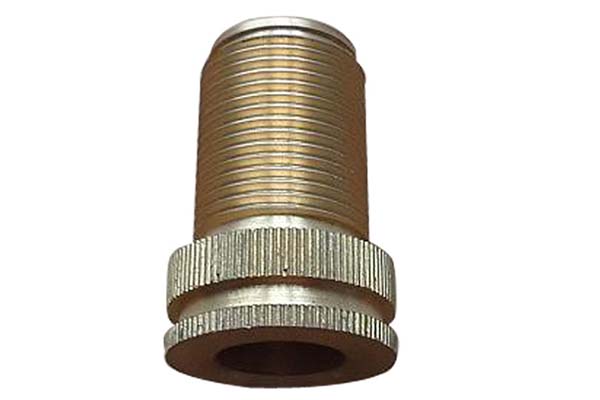
Threaded components are a classic turning application. The lathe moves the tool in a helical path. This creates threads on the workpiece surface. A common bolt is made this way—first the outer diameter is machined, then the threads are cut.
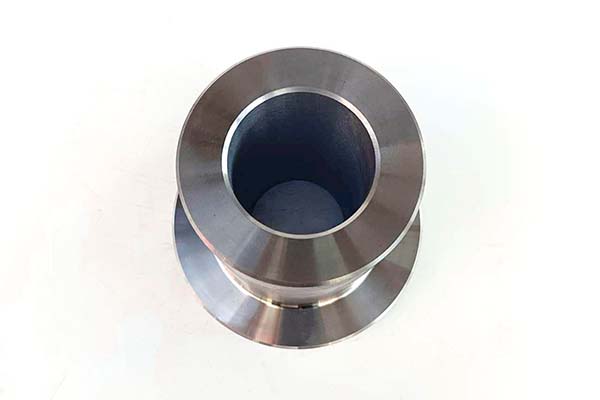
Bushings also come from turning operations. The outer diameter is machined first. Then a boring operation creates the central hole.
Modern CNC lathes with live tooling can do more. They can drill cross holes or mill flats without moving the workpiece to another machine.
Key parameters in turning include:
- Spindle speed – How fast the workpiece rotates
- Feed rate – How fast the tool moves relative to the rotating workpiece
- Depth of cut – Material removed in one pass
The table below summarizes the basic differences:
| Aspect | Milling | Turning |
|---|---|---|
| Moving Component | Rotating cutter | Rotating workpiece |
| Axes of Movement | 3–5 axes for cutter | 2 axes for tool (longitudinal and radial) |
| Typical Shapes | Slots, gears, contoured surfaces, complex 3D shapes | Cylindrical parts, shafts, bushings, threaded components |
What Are the Key Performance Differences?
Shape Complexity
Milling wins for complex shapes. The cutter can move in multiple axes to create:
- 3D contours – Curved surfaces and organic shapes
- Flat surfaces – Precise planes and angles
- Slots and pockets – Recesses of any shape
- Gear teeth – Straight, helical, or specialized profiles
Turning is limited to shapes with rotational symmetry. But within that domain, it excels:
- Cylindrical parts – Shafts, rods, and rollers
- Conical forms – Tapers and angled surfaces
- Threaded components – Bolts, screws, and fittings
Accuracy and Tolerance
Both processes achieve high precision. But turning typically delivers tighter tolerances.
| Process | Typical Tolerance Range |
|---|---|
| Milling | ±0.02 mm – ±0.05 mm |
| Turning | ±0.01 mm – ±0.03 mm |
For medical implants, where fit is critical, turning is often the choice. A hip replacement stem needs exact dimensions to bond properly with bone cement.
For automotive engine blocks, milling handles the tolerances well. Bore diameters and surface flatness fall within acceptable ranges.
Surface Finish
Turning generally produces smoother surfaces than milling.
| Process | Typical Surface Finish (Ra) |
|---|---|
| Milling | 0.8 – 3.2 μm |
| Turning | 0.4 – 1.6 μm |
Why the difference? In turning, the cutting tool maintains continuous contact with the rotating workpiece. This creates a consistent cutting action. In milling, each tooth makes intermittent contact, which can leave small marks.
For optical components or bearing surfaces, turning delivers the smooth finish required.
Material Removal Rate
Material removal rate (MRR) measures how fast a machine can cut.
Turning typically achieves higher MRR for cylindrical parts. The cutting tool contacts the workpiece continuously. Modern CNC lathes run at high speeds while maintaining accuracy.
Milling MRR varies widely. Large-diameter cutters remove material quickly in roughing operations. But finishing passes run slower to achieve good surface quality.
Production Time
Time matters for both prototypes and production runs.
| Process | Typical Lead Time for Prototypes |
|---|---|
| Milling | 3–7 days |
| Turning | 2–5 days |
Turning setups are often faster. Clamping a round part in a chuck takes minutes. Milling may require custom fixtures, especially for complex parts.
However, for parts requiring both operations, the total time depends on how well you sequence the work.
When Should You Choose Milling?
Complex Geometries and 3D Shapes
Choose milling when your part has:
- Curved surfaces that are not rotationally symmetric
- Multiple flat faces at different angles
- Pockets, slots, or cavities
- Undercuts or features that need tool access from multiple sides
A turbine blade is a perfect example. Its aerodynamic profile curves in three dimensions. It has thin walls and complex internal cooling channels. Only a multi-axis milling machine can produce it.
Prototypes and Low-Volume Work
Milling excels at prototyping. The same machine can make many different parts. You simply load a new program and change tools.
A product development team testing multiple design iterations benefits from this flexibility. They can make changes in software and have new parts in hours.
Materials That Are Difficult to Hold
Some parts are hard to grip in a lathe chuck. Irregular shapes, thin walls, or delicate features may distort under clamping pressure.
Milling allows you to hold the workpiece in a fixture designed specifically for its shape. This reduces distortion and improves accuracy.
When Should You Choose Turning?
Cylindrical and Threaded Parts
Choose turning when your part is:
- Shafts of any diameter or length
- Bushings requiring precise inner and outer diameters
- Threaded fasteners like bolts and studs
- Pins, rollers, or axles
A steel shaft for a jet engine requires high concentricity. The shaft must rotate smoothly at extreme speeds. Turning produces this with consistent accuracy.
High-Volume Production
Turning is highly efficient for cylindrical parts. Once the machine is set up, cycle times are short. A CNC lathe with a bar feeder can run unattended for hours.
An automotive manufacturer producing thousands of transmission shafts uses turning for its speed and consistency.
Tight Tolerances and Smooth Finishes
When your part needs the best possible surface finish or the tightest tolerances, turning is often the answer.
A bearing journal must be perfectly round and smooth. Any imperfection causes vibration and premature failure. Turning delivers the required precision.
Can You Combine Both Processes?
The Hybrid Approach
Many parts need both milling and turning. A shaft might have keyways milled into its surface. A housing might have turned diameters and milled mounting faces.
Mill-turn centers combine both capabilities in one machine. The workpiece rotates for turning operations. Then live tooling performs milling operations without repositioning.
This approach offers several benefits:
- Eliminates setups – Part stays clamped for all operations
- Improves accuracy – No errors from moving between machines
- Reduces lead time – One machine does the work of two
Real-World Example: Transmission Components
In automotive transmission manufacturing, both processes play essential roles.
Milling creates the gear teeth. The tooth profile must be precise for smooth meshing. Straight, helical, or specialized profiles are all milled to tight tolerances.
Turning produces the smooth, concentric shafts. These shafts transmit power from the engine through the gears. Concentricity is critical for minimizing vibration.
By using both processes in parallel, manufacturers cut development time significantly. One study showed a 40% reduction in development time for new transmissions when milling and turning were used together effectively.
How Do You Make the Right Choice?
A Decision Framework
Ask these questions when selecting a process:
- What shape is the part? Cylindrical? Go with turning. Complex 3D? Milling.
- What tolerances are required? Tighter than ±0.02 mm? Turning may be better.
- What surface finish is needed? Ra below 0.8 μm? Turning often wins.
- What is the production volume? High volume cylindrical parts suit turning. Low volume complex parts suit milling.
- What material is being machined? Some materials respond better to one process.
When to Use Both
For many parts, the best answer is not one or the other. It is both.
Plan your manufacturing sequence to use each process where it excels. Turn the cylindrical features first. Then mill the flats, slots, or holes. This approach combines the strengths of both.
Conclusion
Milling and turning are not competitors. They are complementary technologies, each with distinct strengths.
Milling handles complex 3D shapes, flat surfaces, and intricate details. Its multi-axis capability creates parts that would be impossible on a lathe.
Turning excels at cylindrical and threaded components. It delivers tighter tolerances, smoother finishes, and faster cycle times for rotationally symmetric parts.
The best manufacturers do not choose one over the other. They choose the right process for each feature. They combine turning and milling to produce parts efficiently, accurately, and cost-effectively.
Understanding these differences helps you make better decisions. It saves time. It reduces costs. And it ensures your parts meet their specifications.
FAQ
Which process is more accurate, milling or turning?
Turning typically achieves tighter tolerances, ranging from ±0.01 mm to ±0.03 mm, compared to milling at ±0.02 mm to ±0.05 mm. The continuous cutting action in turning allows for more consistent precision.
Can a turning center perform milling operations?
Yes. Modern CNC lathes with live tooling can perform milling operations like drilling cross holes, milling flats, and cutting keyways. This eliminates the need to move the workpiece to a separate machine.
Which process is better for prototypes?
It depends on the part geometry. Milling offers more flexibility for complex shapes. Turning is faster for cylindrical parts. For prototypes requiring both, a mill-turn center or careful sequencing between machines works best.
How do I decide between milling and turning for my part?
Consider shape, tolerances, surface finish, and volume. Cylindrical parts suit turning. Complex 3D shapes require milling. Parts with both features often need both processes.
What is the cost difference between milling and turning?
Cost depends on part complexity, volume, and tolerances. Turning is generally more efficient for high-volume cylindrical parts. Milling may be more cost-effective for low-volume complex parts that would require multiple setups on a lathe.
Contact Yigu Technology for Custom Manufacturing
At Yigu Technology, we specialize in both milling and turning operations. Our CNC machining centers include 3-axis and 5-axis mills for complex geometries, plus CNC lathes with live tooling for combined turning and milling in one setup.
We help customers select the right process for their parts. Our engineers analyze shape, tolerances, and production volume to recommend the most efficient approach. We maintain ISO 9001 and AS9100 certifications to ensure consistent quality across all operations.
Contact us today to discuss your machining project. Let our team help you choose the right process for your specific requirements.