Introduction
Imagine spending weeks manually machining a batch of steel parts, only to discover inconsistent dimensions that render half of them useless. Or picture an aerospace company struggling to meet tight deadlines because their old equipment cannot keep up with complex part designs. These scenarios were common before CNC metalworking transformed the manufacturing landscape.
By combining computer control with advanced machinery, CNC metalworking delivers what manual methods cannot: unparalleled precision, consistent quality, and rapid production. Tolerances as tight as ±0.0005 mm are routine. Machines run 24/7 with minimal supervision. Complex geometries that once required multiple setups are now completed in a single operation.
This guide explores how CNC metalworking works, why it is essential for modern manufacturing, and how to leverage it to overcome production challenges.
What Is CNC Metalworking?
CNC metalworking uses computer numerical control to automate metal cutting, shaping, and forming processes. Unlike manual machining, which depends on operator skill, CNC systems follow pre-programmed instructions to execute precise movements—eliminating the variability that comes with human error.
Key Characteristics
| Feature | Impact |
|---|---|
| Precision | Tolerances as tight as ±0.0005 mm |
| Automation | 24/7 operation with minimal oversight |
| Versatility | Simple bolts to complex turbine blades |
| Consistency | Identical parts across production runs |
| Efficiency | 45% higher output than manual operations |
Data point: A study by the Association for Manufacturing Technology found that CNC-equipped shops increased production output by 45% compared to manual operations. Manufacturers also report a 30% reduction in scrap rates and a 25% decrease in labor costs after adopting CNC metalworking.
What Machines Power CNC Metalworking?
The right machines are essential for achieving optimal results. Here are the most common types and their strengths.
CNC Milling Machines
CNC mills use rotating cutting tools to remove material from a stationary workpiece.
| Machine Type | Capability |
|---|---|
| 3-axis mills | Basic shapes, flat surfaces, pockets |
| 4-axis mills | Added rotary axis for more complex geometries |
| 5-axis machining centers | Complex curves, undercuts, single-setup production |
Advantage: A 5-axis machine can produce an aerospace bracket in one setup that would require three setups on a 3-axis machine—saving time and improving accuracy.
CNC Lathes and Turning Centers
Lathes spin the workpiece while a cutting tool shapes it—ideal for cylindrical parts.
- Standard lathes: Turning, facing, threading
- Live tooling lathes: Add milling capabilities (slots, holes) without repositioning
- Swiss-type lathes: High-precision small parts
Electrical Discharge Machining (EDM)
EDM uses electrical sparks to erode metal. It is ideal for:
- Hard materials: Tungsten, hardened steel
- Intricate shapes: Sharp internal corners, deep narrow slots
- High precision: Wire EDM achieves tolerances of ±0.0002 mm
Laser and Waterjet Cutting
These non-contact tools cut metal without mechanical force:
| Method | Best For | Thickness Capability |
|---|---|---|
| Laser cutting | Thin materials, complex patterns | Up to 25 mm |
| Waterjet cutting | Thick materials, heat-sensitive metals | Up to 100 mm |
Advantage: Minimal heat distortion, no tool wear, and the ability to cut virtually any metal.
What Processes Are Involved in CNC Metalworking?
CNC metalworking encompasses a range of processes that transform raw metal into finished parts.
Milling
Uses end mills to create flat surfaces, slots, and pockets.
- Climb milling: Tool rotates in same direction as feed—produces smoother finish
- Conventional milling: Tool rotates opposite to feed—better for roughing
- Surface finish: Ra as low as 0.8 μm in steel
Turning
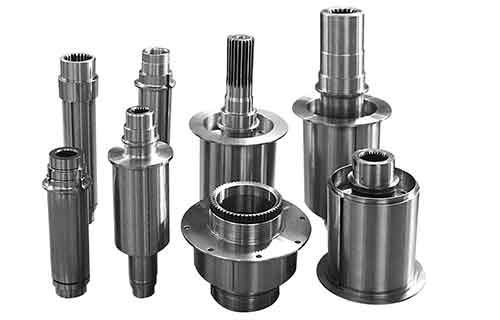
Shapes cylindrical parts like shafts and bushings.
- External turning: Reduces outer diameter
- Internal turning (boring): Enlarges holes
- Surface finish: Ra 1.6 μm achievable, reducing post-machining polishing
Drilling and Tapping
Creates holes and threads with precision.
- Peck drilling: Tool retracts periodically to clear chips—reduces tool breakage by 50%
- Deep hole drilling: Specialized techniques for depth-to-diameter ratios over 10:1
Grinding
Refines surface finish and tightens tolerances.
- Surface grinding: Flat surfaces
- Cylindrical grinding: Round parts
- Achievable finish: Ra as low as 0.02 μm—essential for bearing races and high-precision components
What Materials Can CNC Metalworking Handle?
CNC metalworking excels with a wide range of materials, each requiring specific approaches.
| Material | Machining Considerations | Ideal Processes | Common Applications |
|---|---|---|---|
| Aluminum | Fast feed rates, prone to chip adhesion | Milling, turning, laser cutting | Aircraft parts, electronics |
| Steel | High toughness, generates heat | Milling with carbide, grinding | Automotive, structural |
| Stainless steel | Work hardening, abrasive | Slow feeds, coolant-rich | Medical devices, kitchen equipment |
| Titanium | Low thermal conductivity | Slow speeds, high coolant pressure | Aerospace, medical implants |
| Exotic metals (Inconel, Hastelloy) | High strength at high temps | EDM, grinding with diamond | Jet engines, oil rig components |
Material selection principle: Match the material to the application. Aluminum’s light weight suits aerospace. Stainless steel’s corrosion resistance suits medical devices. Titanium’s strength-to-weight ratio suits demanding structural applications.
How Do Cutting Tools Impact Results?
Tooling is critical to CNC metalworking success. The right tools improve precision, extend tool life, and reduce costs.
Tool Materials
| Tool Material | Performance | Best For |
|---|---|---|
| High-speed steel (HSS) | Good toughness, lower cost | Low-volume, soft materials |
| Carbide | 5–10× longer life than HSS | High-volume, hard materials |
Example: A carbide end mill can machine 1,000 stainless steel parts before needing replacement, compared to 100 parts for an HSS end mill.
Coatings
| Coating | Benefit |
|---|---|
| TiAlN (Titanium Aluminum Nitride) | Reduces friction, handles high temperatures |
| TiCN (Titanium Carbonitride) | Excellent wear resistance |
| Diamond | Maximum wear resistance for abrasive materials |
Data point: Coated inserts extend tool life by 30–50% compared to uncoated carbide.
Tool Holders and Collets
Tool holders ensure tools are held securely, minimizing runout (vibration). A tool holder with runout less than 0.001 mm improves surface finish and extends tool life.
How Is Quality Ensured in CNC Metalworking?
Quality and precision are built into every step of the process.
Tolerances and Surface Finish
- Tolerances: Achievable to ±0.0005 mm
- Surface finish: Controlled through tool selection and cutting parameters
Example: Reducing feed rate by 20% in turning can lower Ra values from 3.2 μm to 1.6 μm.
Inspection Methods
| Method | What It Verifies |
|---|---|
| CMM (Coordinate Measuring Machine) | Dimensional accuracy |
| Optical comparator | Complex geometries |
| Surface profilometer | Surface finish |
| In-process inspection | Real-time quality monitoring |
Data point: In-process inspection catches errors early, reducing scrap rates by 40% in one automotive application.
Quality Standards
- ISO 9001: General quality management
- AS9100: Aerospace quality
- ISO 13485: Medical device manufacturing
Where Is CNC Metalworking Applied?
CNC metalworking serves industries where precision, reliability, and efficiency are critical.
Aerospace
- Components: Turbine blades, structural brackets, fuel system parts
- Requirements: Tight tolerances, high strength, full traceability
Automotive
- Components: Engine parts, transmission components, chassis parts
- Requirements: High-volume consistency, durability
Case study: A leading automotive supplier reduced production time for a transmission part from 15 minutes to 5 minutes after switching to CNC metalworking, while improving part consistency.
Medical
- Components: Surgical instruments, implants, diagnostic equipment
- Requirements: Biocompatible materials (titanium, stainless steel), precision, cleanliness
Energy
- Components: Valve bodies, drill bits, turbine components
- Requirements: High strength, corrosion resistance, reliability in extreme conditions
How Do Design and Engineering Impact Results?
Design and engineering play a crucial role in maximizing the benefits of CNC metalworking.
CAD/CAM Workflow
- CAD (Computer-Aided Design): Creates 3D models
- CAM (Computer-Aided Manufacturing): Converts models to machine instructions
- Benefit: Digital workflow reduces errors and speeds design iterations
Design for Manufacturing (DFM)
Optimizing part designs for CNC machining saves time and cost:
| Design Change | Benefit |
|---|---|
| Add radii to corners | Reduces tool wear, improves finish |
| Standardize hole sizes | Reduces tool changes |
| Avoid deep narrow features | Simplifies machining |
Data point: DFM optimization can save 15% in production costs.
Prototyping
CNC prototyping allows quick testing of designs before full production. A product development team reduced time to market by 30% by using CNC prototyping to identify design flaws early.
Conclusion
CNC metalworking has transformed manufacturing from a craft dependent on manual skill to a precision-driven, automated process. It delivers tolerances as tight as ±0.0005 mm, output 45% higher than manual methods, and consistency that manual machining cannot match.
Success depends on selecting the right machines (5-axis mills, CNC lathes, EDM), processes (milling, turning, grinding), and tooling (carbide, coated inserts). Quality is ensured through rigorous inspection (CMM, in-process monitoring) and adherence to standards (ISO 9001, AS9100). And the benefits span industries—from aerospace turbine blades to automotive transmission components to medical implants.
By leveraging CNC metalworking, manufacturers overcome the challenges of inconsistency, slow production, and complex geometries—delivering high-quality parts efficiently and reliably.
FAQs
What is the difference between 3-axis and 5-axis CNC metalworking?
3-axis machines move along X, Y, and Z axes, handling basic shapes like flat surfaces and simple pockets. 5-axis machines add rotation around two additional axes, enabling complex geometries (undercuts, curved surfaces) and reducing multiple setups to one—saving time and improving accuracy.
How long does it take to program a CNC machine for a custom part?
Simple parts can be programmed in 1–2 hours using CAM software. Complex parts with intricate geometries may take 8–10 hours. Prototyping often requires additional programming adjustments for design iterations.
Can CNC metalworking handle both small and large production runs?
Yes. CNC machines excel at both. For small batches (1–100 parts), flexible programming allows rapid changeovers. For large-scale production (10,000+ parts), automated loading systems and dedicated production cells ensure consistency and efficiency.
What materials can CNC metalworking machine?
CNC metalworking machines a wide range of materials, including aluminum, steel (carbon, alloy, stainless), titanium, copper, brass, and exotic alloys like Inconel and Hastelloy. Each material requires specific cutting parameters, tooling, and cooling strategies.
How is quality controlled in CNC metalworking?
Quality is controlled through multiple layers: in-process inspection (real-time monitoring), CMM verification (dimensional accuracy), surface finish testing, and adherence to certified quality standards (ISO 9001, AS9100, ISO 13485). First article inspection validates the first part; statistical process control ensures consistency across production runs.
Contact Yigu Technology for Custom Manufacturing
At Yigu Technology, we specialize in CNC metalworking for demanding industries. With 15 years of experience, advanced 5-axis machining, EDM, and laser cutting capabilities, and ISO 9001 certification, we deliver precision components that meet the highest standards.
Our team works closely with clients—from design optimization to final inspection—to ensure efficient production without compromising quality. Whether you need aerospace components, automotive parts, or medical devices, we have the expertise and capacity to deliver. Contact us today to discuss your CNC metalworking project.