Introduction
POM-C is everywhere in precision engineering. It spins inside automotive fuel systems as gears that must last millions of cycles. It slides within mechanical assemblies as bearings that operate with minimal friction. It forms the structural components of surgical instruments that must be sterilized repeatedly.
Polyoxymethylene Copolymer (POM-C) offers a unique combination of properties: high strength, low friction, excellent wear resistance, and exceptional dimensional stability. But machining this high-performance plastic is not without challenges. Its high crystallinity accelerates tool wear. Its low friction can cause workholding issues. Improper parameters lead to surface defects and dimensional inaccuracies.
This guide covers everything you need to CNC machine POM-C successfully. You will learn about material properties, optimal cutting parameters, tool selection, surface finish techniques, and quality control. By the end, you will have a clear strategy for producing precision parts from this demanding engineering plastic.
What Makes POM-C a High-Performance Engineering Plastic?
Material Characteristics
POM-C (Polyoxymethylene Copolymer) is a high-performance engineering plastic with exceptional properties.
| Property | Value | Significance |
|---|---|---|
| Tensile strength | 60–70 MPa | Higher than many plastics |
| Flexural modulus | 2500–3000 MPa | Rigidity under load |
| Friction coefficient | 0.15–0.3 | Self-lubricating for moving parts |
| Wear rate | 50% lower than POM-H | Superior in dry sliding conditions |
| Crystallinity | 70–80% | Excellent dimensional stability |
| Melting point | 165–175°C | Continuous operation up to 100°C |
| Density | 1.41–1.43 g/cm³ | Heavier than ABS, lighter than aluminum |
Key Advantages
Low friction – Coefficient of 0.15–0.3 makes POM-C ideal for bearings, gears, and sliding components. Self-lubricating properties reduce or eliminate the need for external lubricants.
High wear resistance – Outperforms nylon and acetal homopolymer (POM-H). Wear rate is 50% lower than POM-H in dry sliding conditions, extending component life in moving assemblies.
Dimensional stability – High crystallinity (70–80%) ensures parts maintain tight tolerances over time. Unlike plastics that absorb moisture or creep under load, POM-C holds its shape.
Chemical resistance – Resists oils, greases, and many solvents. Not resistant to strong acids or alkalis, but suitable for most industrial and automotive applications.
Electrical properties – Low dielectric loss makes it suitable for electrical components like insulators and switch parts.
What Are the Machining Challenges with POM-C?
| Challenge | Cause | Consequence |
|---|---|---|
| Tool wear | High crystallinity, hardness | Faster dulling than softer plastics; surface defects |
| Chip adhesion | Low friction; chips cling to tools | Poor chip evacuation; re-cutting |
| Surface defects | Improper parameters | Burns, chatter, poor finish |
| Workholding | Smooth surface | Slippage under cutting forces |
| Thermal expansion | Heat buildup | Dimensional inaccuracies |
What Machining Techniques Work Best for POM-C?
Milling
Climb milling is preferred over conventional milling. It reduces tool wear and produces smoother surfaces by cutting into the material rather than pulling against it.
| Operation | Recommended Parameters |
|---|---|
| Cutting speed | 150–250 m/min |
| Feed rate | 300–500 mm/min |
| Depth of cut | 0.5–2.0 mm (roughing); 0.1–0.3 mm (finishing) |
A 3-axis mill handles most POM-C parts. 5-axis mills are reserved for highly complex geometries requiring multiple orientations in a single setup.
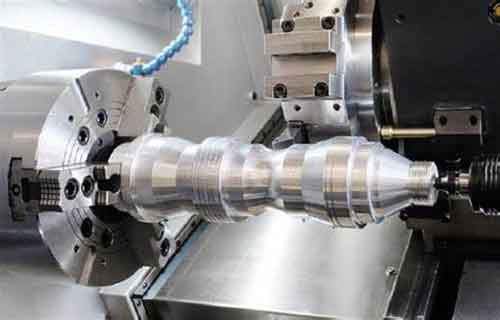
Turning
Use sharp, high-speed steel inserts with positive rake angles. Positive rake reduces cutting forces, minimizing the risk of chipping.
| Parameter | Range |
|---|---|
| Cutting speed | 100–200 m/min |
| Feed rate | 0.1–0.2 mm/rev |
| Depth of cut | 0.5–2.0 mm (roughing); 0.1–0.3 mm (finishing) |
Drilling
Peck drilling (intermittent retraction of the drill) helps clear chips. POM-C’s low friction can cause chips to cling to the drill bit, leading to clogging and heat buildup.
| Parameter | Range |
|---|---|
| Drill point angle | 118° |
| Speed | 50–100 m/min |
| Feed | 0.05–0.15 mm/rev |
| Peck depth | 2–3× drill diameter |
Coolant and Heat Management
Coolant use for POM-C is debated:
| Approach | Benefit | Consideration |
|---|---|---|
| Air cooling | Prevents heat buildup; no residue | May not be sufficient for high-volume roughing |
| Light mineral oil | Reduces friction; improves surface finish | Requires cleaning |
| Mist coolant | Balance of cooling and lubrication | Avoids soaking the material |
Tool wear monitoring is essential. POM-C’s high crystallinity dulls tools faster than softer plastics. Replace tools at the first sign of wear to prevent surface defects.
What Tooling and Setup Are Required?
Cutting Tools
| Tool Type | Recommendation | Rationale |
|---|---|---|
| Carbide | Ideal for high-volume production | Maintains edge longer than HSS |
| High-speed steel (HSS) | Suitable for low-volume | Lower cost, but requires more frequent sharpening |
| End mills | 2-flute for chip evacuation; 4-flute for finer finish | Match flute count to operation |
| Drill bits | 118° point angle; polished flutes | Prevents splitting; reduces chip adhesion |
Tool Geometry
| Feature | Recommendation | Benefit |
|---|---|---|
| Helix angle | 35–45° | Improves chip flow |
| Cutting edge | Sharp | Minimizes deformation |
| Flute count | 2 for roughing; 4 for finishing | Roughing: chip removal; finishing: surface quality |
| Tool diameter | 3–12 mm (most parts); 1–3 mm (detailed work) | Match to feature size |
Workholding
POM-C’s smooth surface can slip under cutting forces. Secure fixturing is essential.
| Method | Best For |
|---|---|
| Soft jaws | Round parts; distributes clamping force |
| Vacuum fixtures | Thin sheets; uniform hold |
| Custom fixtures | Complex geometries; even support |
Tool holder selection – Ensure minimal runout. Even small vibrations can mar POM-C’s surface. Secure tool clamping prevents slippage.
What Surface Finish and Quality Can You Achieve?
Surface Finish Targets
| Application | Target Ra |
|---|---|
| Standard machined surfaces | 0.8–1.6 μm |
| Precision components | 0.4–0.8 μm |
| High-precision (gears, bearings) | 0.2–0.4 μm |
Achieving Superior Finishes
Polishing – A buffing wheel with mild abrasive compound enhances surface finish. POM-C’s natural smoothness often requires little post-machining finishing.
Grinding – Surface grinders achieve tolerances of ±0.001 mm on flat surfaces. Effective for precision components requiring tight tolerances.
Sanding – Rarely needed, but fine-grit sandpaper (800–1200 grit) removes minor blemishes if required.
Dimensional Accuracy
POM-C’s excellent dimensional stability enables tight tolerances:
| Feature | Achievable Tolerance |
|---|---|
| General dimensions | ±0.01–0.02 mm |
| Precision features | ±0.005 mm |
| Critical bores/shafts | ±0.002 mm (with grinding) |
Quality Control
| Method | Purpose |
|---|---|
| CMM (Coordinate Measuring Machine) | Verify dimensions against specifications |
| Optical comparator | Check surface finish, profile |
| In-process monitoring | Catch issues before parts are completed |
Where Is POM-C Used?
Automotive Components
| Component | Property Leveraged |
|---|---|
| Fuel system parts | Chemical resistance, dimensional stability |
| Door lock mechanisms | Low friction, wear resistance |
| Window regulators | Durability, smooth operation |
| Throttle bodies | Heat resistance, rigidity |
Mechanical Parts
| Component | Property Leveraged |
|---|---|
| Bearings | Low friction, self-lubricating |
| Gears | High strength, wear resistance |
| Slides | Low friction, dimensional stability |
Electrical Components
| Component | Property Leveraged |
|---|---|
| Insulators | Good electrical properties |
| Switch parts | Chemical resistance, durability |
| Connectors | Dimensional stability, low dielectric loss |
Consumer Electronics
| Component | Property Leveraged |
|---|---|
| Camera components | Precision, durability |
| Smartphone hinges | Low friction, strength |
| Enclosures | Aesthetics, dimensional stability |
Industrial Machinery
| Component | Property Leveraged |
|---|---|
| Conveyor system parts | High wear resistance |
| Valve components | Chemical resistance, tight tolerances |
| Pump parts | Low friction, dimensional stability |
Medical Devices (Non-Implantable)
| Component | Property Leveraged |
|---|---|
| Surgical instrument handles | Chemical resistance, sterilizable |
| Diagnostic equipment components | Precision, durability |
| Drug delivery devices | Dimensional stability, low friction |
Prototyping and Custom Parts
POM-C is ideal for functional prototypes requiring the same performance as production components. Custom parts like specialized gears and bushings are often machined from POM-C to meet unique application requirements.
Conclusion
POM-C delivers exceptional performance for precision components. Its high strength, low friction, and superior wear resistance make it indispensable in automotive, mechanical, electrical, and medical applications. Its dimensional stability enables tolerances as tight as ±0.005 mm —critical for parts that must maintain accuracy over time.
Machining POM-C requires understanding its unique characteristics. High crystallinity accelerates tool wear—use carbide tools for high-volume production. Low friction requires secure workholding—use soft jaws, vacuum fixtures, or custom fixturing to prevent slippage.
Optimal parameters balance material removal with surface quality. Cutting speeds of 150–250 m/min for milling, 100–200 m/min for turning. Climb milling produces smoother surfaces. Peck drilling prevents chip adhesion. Coolant choice depends on operation—air cooling for heat management, light mineral oil for friction reduction.
Surface finishes as low as Ra 0.2 μm are achievable with sharp tools and proper parameters. Quality control with CMM and optical comparators ensures parts meet specifications.
With the right approach, POM-C machines reliably and consistently, delivering precision components that perform in demanding applications.
FAQ
Why does POM-C wear out tools faster than other plastics?
POM-C’s high crystallinity (70–80%) and hardness increase tool friction, leading to faster wear. Using carbide tools and optimizing cutting speeds (150–250 m/min for milling, 100–200 m/min for turning) reduces this issue. Regular tool wear monitoring and replacement at the first sign of dulling prevent surface defects.
Can POM-C be machined to very tight tolerances?
Yes. POM-C’s excellent dimensional stability allows machining to tolerances as tight as ±0.005 mm . For critical features like bores and shafts, grinding achieves ±0.002 mm . This makes POM-C ideal for precision gears, bearings, and mating components.
Is POM-C suitable for food contact applications?
Yes, certain grades of POM-C are FDA-approved for food contact . They are non-toxic and resistant to food oils and acids. Always verify specific grade certifications for your application. Common uses include food processing equipment components and packaging machinery parts.
What coolant is best for machining POM-C?
Air cooling is often sufficient for POM-C and prevents residue that may require cleaning. For high-volume operations or applications requiring reduced friction, light mineral oil or mist coolant can be used. Avoid excessive coolant that could saturate the material or cause thermal shock.
How does POM-C compare to POM-H (acetal homopolymer) for machining?
POM-C offers lower wear rate (50% lower than POM-H in dry sliding conditions) and better chemical resistance. It machines similarly but requires similar attention to tool wear due to its hardness. POM-C’s superior dimensional stability makes it preferred for precision components requiring tight tolerances.
Contact Yigu Technology for Custom Manufacturing
At Yigu Technology, we specialize in CNC machining POM-C for high-performance applications. Our expertise includes carbide tool selection, optimized cutting parameters, and precision workholding to achieve superior surface finishes and tight tolerances.
We use CMM inspection and optical comparators to verify dimensional accuracy. From automotive gears to medical instrument components, we deliver POM-C parts that meet the most demanding specifications.
Contact us today to discuss your POM-C machining project. Let our expertise help you leverage this high-performance plastic for precision components that perform reliably.