Introduction
In industries like aerospace and automotive manufacturing, machining complex parts with extreme accuracy has always been a major challenge. Traditional methods often fall short when you need to machine multiple sides of a large component without losing precision. This is where the horizontal machining center (HMC) comes in.
Unlike vertical machines, an HMC features a horizontally oriented spindle. This simple change unlocks powerful capabilities: multi-sided machining in a single setup, automated pallet systems for continuous operation, and the ability to handle heavy, complex parts with micron-level accuracy. Today, these machines serve as a key benchmark for a manufacturer’s technical capability.
Industry data shows that shops integrating HMCs often see productivity gains of 30–50% compared to traditional setups. For precision-critical sectors, this leap in efficiency and accuracy is reshaping what’s possible in modern manufacturing.
What Exactly Is a Horizontal Machining Center?
How Does It Differ From a Vertical Machine?
A horizontal machining center is a CNC machine where the spindle axis runs parallel to the worktable. It comes equipped with an automatic tool changer and often a pallet system for rapid workpiece exchange.
The horizontal spindle design offers a key advantage: gravity works with the cutting process rather than against it. Chips fall away naturally, reducing recutting and improving surface finishes. This makes HMCs ideal for machining large, box-shaped parts like engine blocks or gearbox housings.
What Are Its Main Components?
Several core components determine an HMC’s capability:
| Component | Function | Typical Specification |
|---|---|---|
| Horizontal Spindle | Rotates the cutting tool | Speed: 10,000–20,000 rpm; Torque: 50–1000 N·m |
| Pallet System | Exchanges workpieces automatically | Change time: 10–30 seconds; 2 to 12 pallets |
| Multi-Axis Mechanism | Enables complex geometry | 4-axis (X/Y/Z + A) or 5-axis (adds B or C) |
| CNC Control | Executes the program | Fanuc 31i, Siemens 840D; processes up to 1000 blocks/sec |
Each component works together to deliver high precision, fast cycle times, and the ability to machine complex parts in one setup.
Why Do Manufacturers Prefer Horizontal Machining Centers?
How Does It Achieve Such High Precision?
Precision is where HMCs truly shine. Standard positioning accuracy reaches ±0.005 mm, while repeatability often hits ±0.002 mm. This level of accuracy comes from three key features:
- Rigid machine bed: Cast iron or granite construction dampens vibration and resists thermal deformation.
- Closed-loop feedback: Glass scales continuously monitor position and correct motion errors in real time.
- Thermal compensation: Sensors detect temperature changes across the machine and automatically adjust for drift.
Consider an aerospace manufacturer machining titanium structural parts. Using a five-axis HMC, they consistently hold hole tolerances of ±0.003 mm. That level of precision meets the strict requirements for aircraft components where failure is not an option.
What Makes It So Efficient?
Efficiency gains come from two main sources: multi-sided machining and automation integration.
When you can machine four or five sides of a part in a single setup, you eliminate errors from repositioning and reduce non-cutting time. One automotive parts supplier switched to a multi-pallet HMC line for engine blocks. The results:
- Cycle time dropped from 45 minutes per piece to 22 minutes
- Production capacity increased by 104%
- Scrap rates fell due to consistent fixturing
Automation takes this further. By integrating robots, AGVs, and pallet systems, you create a flexible manufacturing cell (FMC) . Workpieces move automatically from blank to finished part with minimal human intervention.
How Does It Handle Complex Parts?
For complex parts like hydraulic valve bodies, turbine blades, or large bearing housings, traditional machines often struggle. An HMC with five-axis linkage changes that.
Take aero engine blades. Their twisted, curved surfaces require continuous tool motion across multiple axes. A five-axis HMC simultaneously controls X, Y, Z, B, and C axes, allowing the cutter to maintain optimal contact with the surface. The result: smooth surfaces with minimal hand finishing.
What Types of Horizontal Machining Centers Exist?
Which One Fits Your Application?
Different machining tasks call for different HMC configurations:
| Machine Type | Key Feature | Best Application |
|---|---|---|
| Horizontal Boring Mill | High torque, extreme rigidity | Heavy machinery frames, large castings |
| Multi-Pallet HMC | Continuous pallet exchange | High-volume auto parts, electronics |
| High-Speed HMC | Fast spindle and feed rates | Precision molds, thin-walled parts |
| Five-Axis HMC | Multi-axis coordination | Aerospace structures, complex curves |
What Technologies Make Them Work?
Several advanced technologies drive HMC performance:
- B-axis rotation: The spindle swings around the Y-axis (up to ±90°), allowing angled cuts without repositioning the workpiece.
- Direct-drive spindle: The motor connects directly to the spindle, eliminating transmission errors. This increases rigidity by about 20% and reduces vibration during high-speed cutting.
- Dual-table system: Two pallets alternate—one in the cutting zone while the operator loads the other. Changeover takes 15 seconds or less, maximizing spindle uptime.
Where Are Horizontal Machining Centers Used?
Aerospace: Building the Precision Skeleton
Aerospace components like wing spars, engine casings, and landing gear parts demand extreme precision from difficult materials like titanium and Inconel.
One aerospace supplier used a five-axis HMC to machine engine casings. The single setup allowed them to complete deep holes, curved surfaces, and threads in one operation. Machining accuracy reached IT5 grade, and the first-pass yield jumped from 82% to 99.5%.
Automotive: Powering the Heart of the Vehicle
Engine blocks and transmission housings are ideal HMC applications. A major automaker installed a multi-pallet HMC line for cylinder block production. The fully automated line now produces 500,000 units annually, with processing costs down 18% and dimensional consistency held within ±0.01 mm.
Energy Equipment: Ensuring Reliable Power
Wind turbine gearbox housings and nuclear flanges require heavy-duty machining. Horizontal boring mills with torque up to 1000 N·m handle these large, high-strength steel components efficiently.
Other Critical Applications
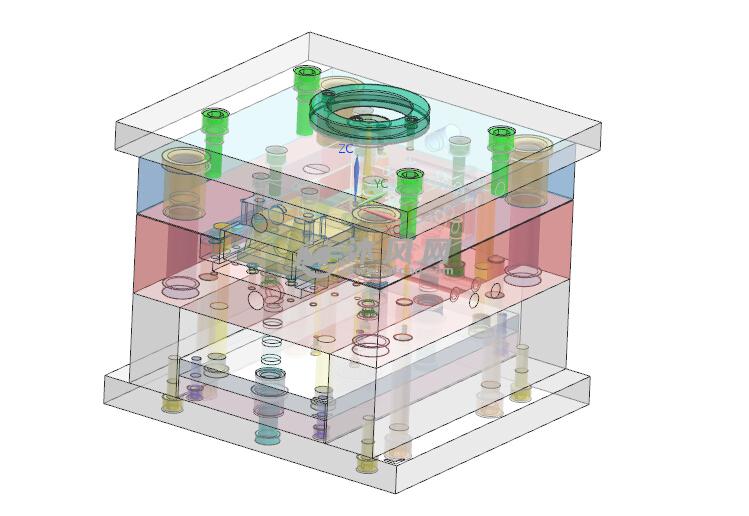
- Mold manufacturing: Large injection mold cavities with surface finishes down to Ra0.8 μm
- Hydraulics: Valve bodies with bore tolerances of ±0.005 mm to ensure leak-free operation
How Can You Optimize Process Design and Production?
What Makes a Good Fixture Design?
Fixturing directly impacts both quality and cycle time. Follow these principles:
- Accurate positioning: Use modular fixtures to handle different part sizes
- Reliable clamping: Hydraulic clamps distribute force evenly to avoid distortion
- Quick changeover: Reduce setup time with standardized interfaces
In one gearbox housing application, switching to hydraulic clamps with three-point positioning cut clamping time from 8 minutes to 2 minutes.
How Do You Optimize Cutting Parameters?
Material-specific parameters extend tool life and improve surface quality:
| Material | Cutting Speed | Feed Rate | Impact |
|---|---|---|---|
| 45 Steel | 80–120 m/min | 0.2–0.5 mm/r | Tool life +30% |
| Aluminum | 300–600 m/min | 0.1–0.3 mm/r | Cycle time -25% |
| Titanium | 40–80 m/min | 0.05–0.15 mm/r | Tool wear reduced |
Using a tool life management system helps monitor wear and replace tools at the optimal time. CAM software with optimized toolpaths reduces air cutting and improves efficiency.
What Is a Flexible Manufacturing Cell?
An FMC integrates multiple HMCs with robots, AGVs, and storage systems. This setup delivers:
- Automatic workpiece loading and transfer
- Collaborative machining across multiple machines
- Remote production monitoring
Manufacturers using FMCs typically see capacity increases of 40% with reduced labor costs.
Conclusion
Horizontal machining centers have fundamentally changed how manufacturers approach complex, high-precision parts. Their combination of rigid construction, multi-axis capability, and automation integration delivers accuracy measured in microns and efficiency gains that directly impact the bottom line.
For businesses, choosing the right HMC means balancing precision, throughput, and automation compatibility. For professionals, understanding these machines opens doors to advanced manufacturing roles. As Industry 4.0 continues to evolve, HMCs will become even smarter—with real-time monitoring, predictive maintenance, and adaptive control becoming standard features.
Whether you’re machining aerospace structural parts or automotive engine blocks, the horizontal machining center stands as a cornerstone of modern precision manufacturing.
FAQ
What is the main difference between horizontal and vertical machining centers?
The spindle orientation. Horizontal machines position the spindle parallel to the table, making them ideal for large, box-shaped parts and multi-sided machining. Vertical machines suit flat plates and smaller components. HMCs also offer stronger pallet systems and multi-axis capabilities.
When should I use a five-axis horizontal machining center?
Use five-axis HMCs for aerospace structural parts, complex curved surfaces, and precision molds. They complete complex geometries in one setup, reducing clamping errors and improving accuracy.
How can I increase productivity with a horizontal machining center?
Optimize cutting parameters, use multi-pallet systems, integrate automation, and improve toolpaths. Regular maintenance also minimizes unplanned downtime.
What accuracy can I expect from a horizontal machining center?
Standard HMCs offer positioning accuracy of ±0.005 mm. High-end five-axis models achieve ±0.002 mm repeatability.
Contact Yigu Technology for Custom Manufacturing
At Yigu Technology, we specialize in precision CNC machining across a range of industries. Our team brings deep experience with horizontal machining centers, helping clients optimize processes for complex parts and high-volume production. Whether you need prototyping, production runs, or process improvement support, we’re here to help. Contact us today to discuss your custom manufacturing needs.