Introduction
Plastics have become essential materials in modern manufacturing. They offer lightweight properties, corrosion resistance, and design flexibility that metals cannot match. But CNC machining of plastics presents unique challenges. Unlike metals, plastics can melt, warp, or develop stress cracks if machined improperly. Material selection affects everything from tool life to surface finish. And achieving tight tolerances requires understanding how each plastic behaves under cutting forces. This guide covers the critical aspects of plastic machining—material selection, process optimization, quality control, and common pitfalls—to help you produce consistent, high-quality plastic parts.
What Plastics Are Best for CNC Machining?
Understanding Material Families
Different plastics have different machining characteristics. Selecting the right material for your application is the first step toward success.
| Material | Key Properties | Typical Applications | Machinability |
|---|---|---|---|
| Acrylic (PMMA) | High transparency (92% light transmittance), good weather resistance | Display cases, optical components, signs | Good; requires sharp tools to prevent cracking |
| Polycarbonate (PC) | Exceptional impact resistance (250× stronger than glass), good clarity | Safety goggles, automotive headlights, enclosures | Fair; prone to stress cracking |
| ABS | Good mechanical properties, impact resistance, low cost | Enclosures, automotive parts, prototypes | Excellent; easy to machine |
| PEEK | High temperature stability (260°C continuous), chemical resistance, biocompatible | Aerospace components, medical implants, high-performance parts | Fair; abrasive, requires carbide tools |
| Nylon (PA6, PA66) | Good strength, wear resistance, low friction | Gears, bushings, bearings | Good; absorbs moisture, requires sharp tools |
| Acetal (POM/Delrin) | Low friction, dimensional stability, stiffness | Precision gears, bearings, medical devices | Excellent; machines very well |
Material Properties That Affect Machining
Hardness: Harder plastics like PEEK and glass-filled nylons are more abrasive. They wear tools faster and require carbide cutters.
Thermal stability: Plastics with low melting points (acrylic, ABS) can soften and smear if cutting generates too much heat. PEEK and polycarbonate handle higher temperatures but still require heat management.
Moisture absorption: Nylon absorbs moisture from the air. This changes dimensions—a part machined dry may shrink later. Condition nylon stock before machining or account for post-machining dimensional changes.
Material Testing and Certification
For critical applications, verify material properties:
- Tensile strength: Nylon 66 achieves approximately 75 MPa, confirming its suitability for load-bearing parts
- Flexural modulus: Measures stiffness under bending loads
- Impact resistance: Critical for safety components
Reputable suppliers like BASF, Dow, and Sabic provide material certifications. ISO 9001 certification ensures consistent material quality.
How Do You Machine Different Plastics?
Milling Plastics
Milling is the most common plastic machining operation. The approach depends on the material.
Tool selection:
- Carbide tools for hard, abrasive plastics (PEEK, glass-filled materials)
- High-speed steel (HSS) for softer plastics (acrylic, ABS) where a sharp edge improves finish
- 2-flute or 3-flute end mills allow better chip evacuation than 4-flute tools
Cutting parameters:
- Cutting speeds: 200–500 m/min for most plastics (higher than metals)
- Feed rates: 0.05–0.2 mm/tooth depending on material hardness
- Climb milling preferred to reduce heat and improve finish
Turning Plastics
Turning operations require attention to workpiece holding. Plastic parts can deform under clamping pressure.
Techniques:
- Use soft jaws or collets to distribute clamping force
- Consider expanding mandrels for thin-walled parts
- Sharp inserts with positive rake angles reduce cutting forces
- Cutting speeds: 200–400 m/min typical
Drilling Plastics
Drilling presents specific challenges. Plastics can melt around the drill, causing hole size variation and poor finish.
Best practices:
- Use 135° split-point drills to reduce thrust force
- Peck drilling with frequent retracts clears chips
- Maintain feed rate—too slow causes rubbing and melting
- Consider through-tool coolant for deep holes
Case example:
A medical device manufacturer drilling 5 mm diameter holes in polycarbonate experienced melting and cracking. Switching to a 135° split-point drill with peck cycles (2 mm per peck) eliminated melting. Hole quality improved, and tool life increased by 300%.
How Do You Optimize Cutting Parameters?
Speed, Feed, and Depth of Cut
| Material | Cutting Speed (m/min) | Feed Rate (mm/tooth) | Depth of Cut (mm) |
|---|---|---|---|
| Acrylic | 300–500 | 0.1–0.2 | 1–3 |
| Polycarbonate | 200–300 | 0.1–0.15 | 1–2 |
| ABS | 250–400 | 0.1–0.2 | 1–4 |
| PEEK | 100–200 | 0.05–0.1 | 0.5–2 |
| Acetal | 300–500 | 0.1–0.2 | 1–3 |
These are starting points. Actual parameters depend on machine rigidity, tool geometry, and specific material grade.
Coolant and Chip Management
Dry machining: Many plastics machine well without coolant. Air blast clears chips and provides cooling. This avoids potential chemical reactions between coolants and plastics.
Wet machining: For heat-sensitive plastics or high-production runs, use:
- Water-soluble coolants at low concentrations (3–5%)
- Mist cooling for light cuts
- Through-tool coolant for deep holes
Chip evacuation is critical. Plastic chips can wrap around tools, melt, and damage surfaces. Use:
- Air blast directed at the cutting zone
- Chip breakers in turning operations
- Peck cycles for drilling
What Quality Issues Affect Plastic Machining?
Common Defects and Causes
| Defect | Cause | Prevention |
|---|---|---|
| Warping | Uneven cooling, residual stresses | Stress relief before machining, proper fixturing, balanced material removal |
| Cracking | High internal stresses, aggressive feeds | Sharp tools, reduced feed rates, proper clamping pressure |
| Melting/smearing | Excessive heat generation | Reduce cutting speed, use coolant, maintain chip load |
| Poor surface finish | Dull tools, incorrect feeds | Sharp tools, proper feed rate, climb milling |
| Burrs | Tool exit issues | Support workpiece, use sharp tools, deburring operations |
Achieving Tight Tolerances
Plastics expand and contract with temperature changes. They also relax after machining, releasing internal stresses.
Best practices for precision:
- Machine in temperature-controlled environment (20–22°C)
- Allow parts to stabilize before final inspection (24 hours recommended)
- Consider post-machining stress relief (annealing) for critical parts
- Achievable tolerances: ±0.05 mm standard; ±0.02 mm with careful process control
Example: Medical implant components often require ±0.05 mm tolerances. This is achievable with high-precision CNC machines, sharp tools, and stable environmental conditions.
Surface Finish Requirements
Surface finish affects both function and appearance:
| Application | Target Ra (μm) |
|---|---|
| Structural parts | 1.6–3.2 |
| Visible consumer parts | 0.8–1.6 |
| Optical components | 0.2–0.4 |
| Medical implants | 0.4–0.8 |
Polishing after machining can achieve mirror finishes on materials like acrylic and polycarbonate.
What Quality Control Measures Are Needed?
Inspection Methods
Dimensional inspection:
- Coordinate measuring machines (CMMs) for complex geometries
- Optical comparators for profile verification
- Micrometers and bore gauges for simple dimensions
Surface finish inspection:
- Optical profilometers measure roughness without contacting the part
- Visual inspection under magnification for scratches or defects
Process Monitoring
Real-time monitoring prevents defects before they occur:
- Cutting force monitoring: Sudden increases indicate tool wear or chip packing
- Temperature monitoring: Excessive heat leads to melting and warping
- Tool wear detection: Predictable tool life schedules prevent quality drift
Quality Standards
Adhere to relevant standards for your industry:
- ISO 9001: General quality management
- ISO 13485: Medical device manufacturing
- AS9100: Aerospace applications
- FDA regulations: For medical and food-contact parts
What Equipment and Tooling Work Best?
CNC Machine Selection
Vertical machining centers (VMCs): Most common for plastic machining. Choose machines with:
- Spindle speeds of 10,000–20,000 RPM (higher for small tools)
- Enclosures to contain chips
- High-pressure coolant systems optional
Horizontal machining centers (HMCs): Better chip evacuation for production runs. Less common for plastics but useful for high-volume work.
CNC lathes: For cylindrical parts. Live tooling adds milling capability.
Fixturing Considerations
Plastic parts can deform under clamping pressure. Effective fixturing includes:
- Vacuum chucks for thin sheets
- Soft jaws machined to part contours
- Expanding mandrels for thin-walled tubes
- Low-pressure clamps with rubber pads
Tooling for Plastics
Carbide tools: Essential for abrasive plastics (PEEK, glass-filled materials). Fine-grain carbide maintains sharp edges longer.
Diamond-coated tools: For very high-volume production or when extreme surface finish is required. Cost is higher, but tool life can exceed carbide by 10×.
Tool geometry:
- High helix angles (35–45°) improve chip evacuation
- Sharp edges are critical—dull tools generate heat
- Polished flutes prevent chip adhesion
Tool Maintenance
Establish tool replacement schedules based on:
- Number of parts machined
- Observed wear patterns
- Surface finish degradation
Dull tools are the leading cause of melting, poor finish, and dimensional drift in plastic machining.
Where Are CNC-Machined Plastics Used?
Automotive Industry
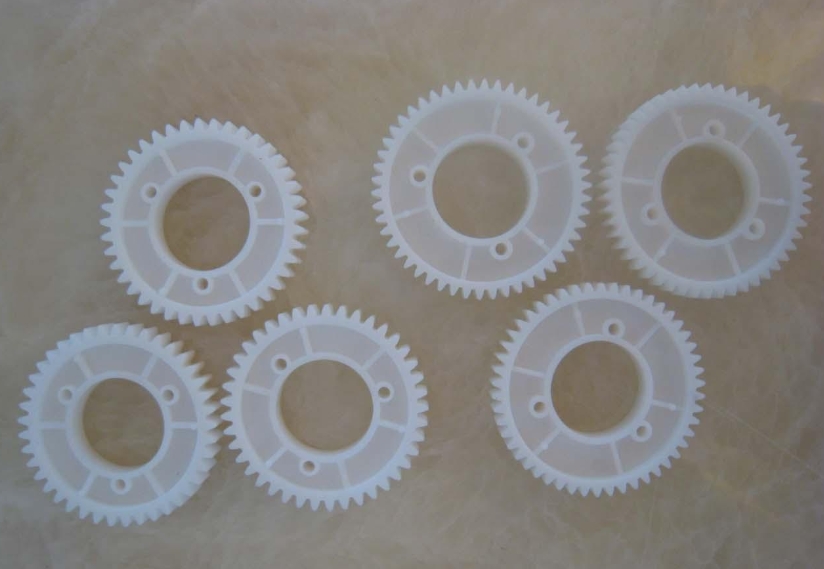
Plastic gears reduce weight and noise compared to metal. A typical automotive transmission may contain multiple plastic gears that contribute to fuel efficiency. Plastic interior components, sensor housings, and under-hood parts (with heat-resistant materials) are common.
Aerospace Industry
Weight reduction is critical in aerospace. Plastics replace metals in:
- Interior cabin components
- Enclosures for electronics
- Non-structural brackets
Carbon fiber-reinforced plastics offer high strength-to-weight ratios. PEEK components withstand the high temperatures found near engines.
Medical Industry
PEEK implants are biocompatible and can be machined to precise shapes for spinal fusion, dental implants, and orthopedic applications. Surgical instruments benefit from plastics that withstand repeated sterilization. Diagnostic equipment housings require tight tolerances for assembly.
Electronics Industry
Prototypes and production parts for consumer electronics rely on plastic machining. Enclosures, connectors, and internal components benefit from plastics’ electrical insulation properties and design flexibility.
A Real-World Plastic Machining Success
A consumer electronics company needed 500 custom enclosures for a new portable device. Initial requirements:
- ABS material
- ±0.1 mm tolerances
- Matte surface finish
- Two-week delivery
The manufacturer implemented:
- High-speed machining center with 15,000 RPM spindle
- Carbide 2-flute end mills for roughing and finishing
- Vacuum fixture to hold thin-walled parts without distortion
- Air blast for chip evacuation (no coolant to avoid staining)
Results:
- Tolerances held to ±0.05 mm
- Surface finish achieved Ra 1.2 μm
- Cycle time: 8 minutes per part
- 100% first-article inspection passed
- Delivery met the two-week deadline
Conclusion
CNC machining of plastics requires a different mindset than metal machining. Success depends on selecting the right material for the application, choosing appropriate tools and parameters, managing heat generation, and implementing effective chip evacuation. Plastics offer unique advantages—lightweight, corrosion-resistant, cost-effective—but they demand respect for their thermal and mechanical properties. By understanding how each plastic behaves under cutting forces and applying the techniques outlined here, manufacturers can produce precision plastic parts that meet the most demanding requirements across automotive, aerospace, medical, and electronics industries.
FAQs
What is the best plastic material for high-temperature applications in CNC machining?
PEEK is the best choice for high-temperature applications. It maintains its mechanical properties up to 260°C continuously and can withstand short-term exposure to higher temperatures. It is commonly used in aerospace, medical, and oil and gas applications.
How can I improve surface finish in plastic CNC machining?
Improve surface finish by using sharp tools with polished flutes, maintaining proper feed rates (avoiding both too slow and too fast), using climb milling, applying air blast or coolant to clear chips, and taking a light finishing pass (0.1–0.2 mm depth) after roughing.
What are common defects in plastic CNC machining, and how can they be avoided?
Common defects include warping (avoid by stress-relieving material and balanced material removal), cracking (use sharp tools and proper clamping), melting (reduce cutting speed and use coolant), and poor surface finish (maintain sharp tools and proper feeds). Process monitoring and preventive maintenance catch issues early.
Can I machine plastics on equipment designed for metals?
Yes, but consider modifications. Metal-cutting machines often have lower spindle speeds than ideal for plastics. High spindle speeds (10,000–20,000 RPM) improve finish on small features. Also ensure chip evacuation is adequate—plastic chips are lighter and can accumulate more easily than metal chips.
What coolants work best for plastic machining?
For most plastics, dry machining with air blast is sufficient and avoids potential chemical reactions. When coolant is needed (deep holes, high-production runs), use water-soluble coolants at low concentrations (3–5%). Avoid coolants containing sulfur or chlorine, which can attack some plastics. Test compatibility with your specific material before production.
Contact Yigu Technology for Custom Manufacturing
At Yigu Technology, we specialize in CNC machining of plastics across the full range of engineering materials—from common ABS and acrylic to high-performance PEEK and polycarbonate. Our engineering team helps select the right material for your application and develops machining strategies that optimize quality, cycle time, and cost. We operate high-speed machining centers with precise temperature control and use advanced fixturing to prevent distortion. Quality control includes CMM inspection and surface finish verification to ensure your parts meet specifications. Whether you need prototypes or production quantities, contact us to discuss your plastic machining project.