Introduction
Thermoplastic Polyurethane (TPU) is a material of contradictions. It stretches like rubber yet wears like steel. It is soft to the touch yet highly resistant to abrasion. This unique combination makes TPU invaluable for automotive seals, medical devices, consumer electronics, and sporting goods. But these same properties create significant machining challenges.
TPU’s elasticity means it can stretch or rebound during cutting, making it difficult to hold precise dimensions. Its low melting point causes it to stick to cutting tools, especially at elevated temperatures. Balancing cutting speed to avoid heat while achieving clean cuts adds complexity—especially for parts requiring tight tolerances.
This guide addresses these challenges. You will learn about TPU material properties, optimal machining parameters, tool selection strategies, and quality control methods. Whether you are machining soft gaskets or hard industrial rollers, these insights will help you achieve precision and consistency.
What Makes TPU Unique?
Understanding TPU’s properties is essential for successful machining. This elastomer combines rubber-like flexibility with thermoplastic processability.
Key Material Properties
| Property | Range / Value | Impact on Machining |
|---|---|---|
| Elasticity | Up to 600% elongation | Material stretches, rebounds; difficult to hold tolerances |
| Durometer hardness | Shore A 60 to Shore D 80 | Soft grades prone to stretching; hard grades machine like rigid plastics |
| Tensile strength | 20–70 MPa | Higher strength grades (50–70 MPa) used for load-bearing parts |
| Abrasion resistance | Excellent | Good for wear parts; requires sharp tools to avoid tearing |
| Softening point | 80–120°C | Low melting point; heat causes sticking, surface defects |
| Melting point | 170–220°C | Avoid overheating; use cooling to prevent gumming |
TPU Grades Comparison
| Property | Soft TPU (Shore A 70) | Medium TPU (Shore A 90) | Hard TPU (Shore D 70) |
|---|---|---|---|
| Tensile Strength | 20–30 MPa | 30–50 MPa | 50–70 MPa |
| Elongation at Break | 400–600% | 300–500% | 100–300% |
| Max Service Temp | 80°C | 90°C | 120°C |
| Abrasion Resistance | Excellent | Excellent | Very Good |
| Machining Challenge | Stretching | Moderate | Heat management |
Key insight: Softer TPU grades require slower speeds and feeds to prevent stretching. Harder grades tolerate higher speeds but remain sensitive to heat.
What Machining Processes Work for TPU?
CNC machining TPU requires processes tailored to its elasticity and stickiness.
Milling
Milling is the most common process for TPU. It handles complex shapes, pockets, and 3D contours.
| Parameter | Recommendation |
|---|---|
| Tools | 2-flute end mills, polished flutes, high helix angle (30–40°) |
| Toolpath | Smooth, gradual changes—avoid abrupt direction changes that stretch material |
| Cooling | Compressed air (preferred); liquid coolants can cause swelling |
Turning
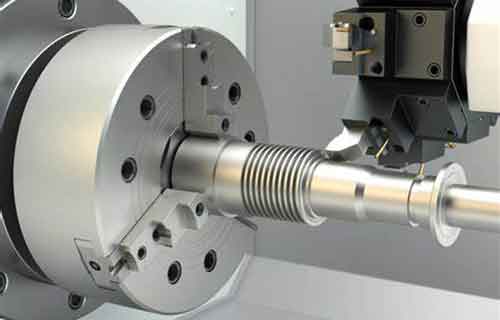
Turning produces cylindrical TPU parts like bushings, rollers, and seals.
| Parameter | Recommendation |
|---|---|
| Tools | Sharp carbide inserts, polished rake face |
| Feed rate | 0.1–0.2 mm/rev (slower for soft TPU) |
| Cooling | Compressed air to prevent heat buildup |
Drilling
Drilling TPU requires care to avoid tearing and gumming.
| Parameter | Recommendation |
|---|---|
| Drill type | Brad-point or parabolic flute drills; 118° point angle |
| Technique | Peck drilling—intermittent retraction to clear chips |
| Speed | Moderate; avoid heat buildup |
Cutting and Engraving
- Laser cutting: Works for thin TPU sheets (under 3 mm)
- CNC routing: Spiral bits produce clean edges for thicker materials
What Tools Are Best for TPU Machining?
Tool selection is critical to overcoming TPU’s stickiness and elasticity.
Tool Material
| Tool Material | Performance | Best For |
|---|---|---|
| Carbide (K10–K20) | Sharp edges, wear resistance | All TPU grades—preferred |
| High-speed steel (HSS) | Lower cost, dulls faster | Low-volume runs only |
End Mill Selection
| Feature | Recommendation | Why |
|---|---|---|
| Flute count | 2-flute | Better chip evacuation than 4-flute |
| Helix angle | 30–40° | Improves chip flow, reduces adhesion |
| Surface finish | Polished flutes | Prevents TPU from sticking |
| Cutting edge | Sharp (<0.02 mm radius) | Reduces cutting forces, minimizes stretching |
Tool Coatings
| Coating | Benefit | Life Extension |
|---|---|---|
| Diamond-like carbon (DLC) | Low friction, anti-stick | 40–60% longer than uncoated carbide |
| TiN (Titanium Nitride) | Cost-effective, moderate friction reduction | 20–30% longer |
Tool Diameter
- Small diameter (3–10 mm): Better for intricate parts; generates less heat
- Larger diameter: For roughing; ensure adequate chip clearance
What Machining Parameters Should You Use?
Optimizing parameters balances material removal, heat management, and surface finish.
Cutting Speed and Spindle Speed
| TPU Grade | Spindle Speed (RPM) | Cutting Speed (m/min) |
|---|---|---|
| Soft (Shore A 60–80) | 3000–5000 | 50–80 |
| Medium (Shore A 90) | 4000–6000 | 70–100 |
| Hard (Shore D 60–80) | 6000–8000 | 80–120 |
Key principle: Lower speeds for softer TPU prevent stretching and heat buildup.
Feed Rate
| Operation | Soft TPU | Hard TPU |
|---|---|---|
| Roughing | 0.05–0.10 mm/tooth | 0.10–0.15 mm/tooth |
| Finishing | 0.02–0.05 mm/tooth | 0.03–0.08 mm/tooth |
Depth of Cut
| Operation | Depth |
|---|---|
| Roughing | 1–3 mm |
| Finishing | 0.1–0.5 mm |
Cooling Strategy
Compressed air is preferred over liquid coolants for TPU:
- Prevents moisture absorption and swelling
- Clears chips effectively
- Cools tools without affecting material properties
Avoid: Flood coolant—TPU can absorb moisture and swell, affecting dimensions.
Chip Removal
TPU produces stringy chips that can clog tools:
- Use peck drilling for holes—intermittent retraction clears chips
- Apply air blasts to clear chips from end mills
- Consider through-spindle air for deep features
How Do You Control Quality in TPU Parts?
Quality control for TPU requires attention to its unique characteristics.
Surface Finish
| Application | Acceptable Ra |
|---|---|
| General parts | 1.6–3.2 μm |
| Glossy finish | <1.6 μm |
| Medical or aesthetic | <1.6 μm with finishing pass |
To improve finish:
- Use sharp tools (replace when dull)
- Take light finishing pass (0.1–0.2 mm depth)
- Reduce feed rate for final pass
Dimensional Inspection
TPU’s elasticity means dimensions can change after machining:
- Wait 30 minutes after machining before measurement—allows springback to stabilize
- Use CMM (Coordinate Measuring Machine) for critical dimensions
- Optical comparators work well for complex profiles
Tolerances achievable:
- Small parts: ±0.05 mm
- Large parts: ±0.1 mm
- Critical features with rigid fixturing: ±0.03 mm
Hardness Verification
Use a durometer to check hardness consistency. Acceptable range: ±5 Shore units from specification.
Non-Destructive Testing
For critical applications (aerospace seals, medical devices):
- Ultrasonic testing detects internal defects in thick parts
- Visual inspection checks for surface tears, sticking marks
Where Is CNC Machined TPU Used?
TPU’s combination of flexibility, durability, and chemical resistance serves diverse industries.
Automotive Parts
| Component | Requirement |
|---|---|
| Gaskets, seals | Oil resistance, elasticity |
| Cable jackets | Flexibility, abrasion resistance |
| Interior trim | Soft-touch feel, durability |
Industrial Components
| Component | Requirement |
|---|---|
| Rollers, conveyor belts | Abrasion resistance, low friction |
| O-rings, gaskets | Chemical resistance, sealing |
| Wear pads | Impact resistance, durability |
Medical Devices
| Component | Requirement |
|---|---|
| Surgical tool grips | Biocompatibility (USP Class VI), comfort |
| Catheter components | Flexibility, smooth surface |
| Orthopedic padding | Softness, skin-friendly |
Consumer Electronics
| Component | Requirement |
|---|---|
| Phone cases | Shock absorption, grip |
| Smartwatch bands | Flexibility, durability |
| Headphone cushions | Softness, comfort |
Sporting Goods
| Component | Requirement |
|---|---|
| Shoe soles | Elasticity, wear resistance |
| Protective gear | Impact absorption |
| Equipment handles | Grip, durability |
Prototyping and Wearables
TPU’s machinability makes it ideal for:
- Testing flexible designs before mass production
- Custom-fit wearable device components
- Low-volume specialty parts
Conclusion
CNC machining TPU requires understanding the material’s unique properties and adapting processes accordingly. Its elasticity, low melting point, and tackiness create challenges that demand specific strategies.
Success depends on:
- Sharp carbide tools with polished flutes and DLC coatings
- Compressed air cooling to manage heat without moisture absorption
- Optimized parameters—lower speeds for soft TPU, moderate speeds for hard grades
- Chip management through peck drilling and air blasts
- Post-machining stabilization—wait 30 minutes before measurement
When machined correctly, TPU delivers components that combine flexibility, durability, and precision—serving industries from automotive to medical to consumer electronics.
FAQs
Why does TPU stick to cutting tools, and how can I prevent it?
TPU’s low melting point and tackiness cause it to adhere to tools, especially when heat builds up. Prevention strategies: use polished carbide tools with DLC coatings, maintain low cutting speeds (50–80 m/min for soft TPU), use compressed air to cool tools and clear chips, and regularly clean tools with alcohol to remove residue.
What tolerances can I achieve when machining TPU?
TPU typically achieves ±0.05 mm for small parts and ±0.1 mm for larger parts—wider than rigid plastics due to elasticity. For critical features, using rigid fixtures, slow feed rates, and measuring after 30-minute stabilization can achieve tighter tolerances (±0.03 mm).
How does durometer hardness affect machining parameters?
Softer TPU (Shore A 60–80) requires slower feed rates (0.05–0.1 mm/tooth) and lower spindle speeds (3000–5000 RPM) to prevent stretching. Harder TPU (Shore D 60–80) can handle faster feeds (0.1–0.15 mm/tooth) and higher speeds (6000–8000 RPM), similar to rigid plastics but with continued attention to heat management.
What cooling method works best for TPU machining?
Compressed air is preferred over liquid coolants. TPU can absorb moisture, causing swelling and dimensional changes. Air cools the tool, clears chips, and does not affect material properties. For deep holes, through-spindle air is effective.
How do I improve surface finish on TPU parts?
Use sharp tools with polished flutes. Take a light finishing pass (0.1–0.2 mm depth). Reduce feed rate for the final pass. If finish remains poor, replace tools—dull tools generate heat and cause sticking. For glossy finishes, consider post-machining with progressively finer abrasive pads.
Contact Yigu Technology for Custom Manufacturing
At Yigu Technology, we specialize in CNC machining TPU and other elastomers for demanding applications. With 15 years of experience, advanced CNC machining capabilities, and ISO 9001 certification, we deliver precision components that meet tight tolerances.
Our approach includes diamond-coated carbide tools, optimized parameters for each TPU grade, and post-machining stabilization to ensure dimensional accuracy. Whether you need automotive seals, medical device components, or consumer electronics parts, we have the expertise to deliver quality and consistency. Contact us today to discuss your TPU project.