Have you ever wondered how a power drill changes the direction of rotation from its motor to the drill bit? The answer often lies in a small but critical component: the miter gear. These gears transmit motion between shafts that meet at a right angle. When made from plastic, they offer unique advantages over metal versions. But choosing the right plastic material makes all the difference. This guide walks you through the benefits of plastic miter gears, the materials available, and how to select the right one for your application.
What Are Plastic Miter Gears?
Structure and Working Principle
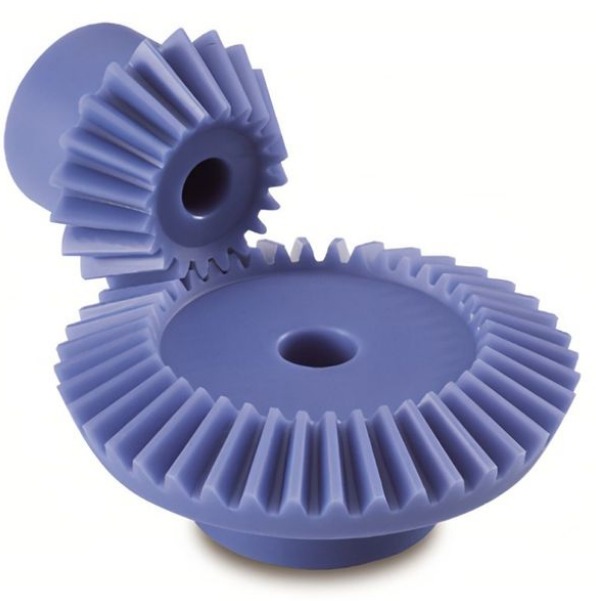
A miter gear is a type of bevel gear. Its teeth are cut at a 45-degree angle to the axis. Two identical miter gears mesh together to transmit power between intersecting shafts—typically at a 90-degree angle.
The gear has two main parts:
- Hub — attaches to the shaft
- Rim — holds the precisely cut teeth
As one gear rotates, its teeth engage with the other. The mating gear rotates in the opposite direction. This simple action changes the direction of rotation within a compact space.
Where Are They Used?
Plastic miter gears appear in many everyday and industrial applications:
| Industry | Application | Why Plastic? |
|---|---|---|
| Automotive | Windshield wipers, seat adjusters | Lightweight improves fuel efficiency |
| Aerospace | Small avionics systems | Quiet operation, low maintenance |
| Industrial | Conveyor systems, small machinery | Corrosion resistance in harsh environments |
| Consumer | Power drills, printers, hobbyist projects | Cost-effective, noise reduction |
In a hand-held power drill, plastic miter gears redirect the motor's rotation to drive the drill bit perpendicular to the motor shaft. Without them, the tool would not function.
What Are the Key Advantages of Plastic Miter Gears?
Lightweight and Fuel Efficient
Plastic miter gears are significantly lighter than metal ones. This weight reduction matters most in automotive and aerospace applications. Replacing metal gears with plastic in a car's interior components can reduce overall vehicle weight. Lower weight means better fuel efficiency—a critical factor in modern vehicle design.
Corrosion Resistant
Metal gears rust. Plastic gears do not. In food processing plants and chemical industries, equipment faces moisture and harsh substances. Plastic miter gears maintain their integrity where metal gears would quickly degrade. This resistance translates to less maintenance and longer service life.
Quiet Operation
Plastics naturally dampen vibration and noise. When gears mesh, metal-to-metal contact can create significant sound. Plastic gears absorb much of that energy. In consumer electronics and medical devices, quiet operation is essential. A printer or infusion pump running silently improves the user experience.
Cost-Effective
Injection molding makes plastic gears affordable. For large production runs, the cost difference is substantial. Producing plastic miter gears through molding can cost up to 50% less than machining metal equivalents. Additionally, plastic gears often require no external lubrication, reducing maintenance costs over time.
What Materials Are Used for Plastic Miter Gears?
Choosing the right material is critical. Each plastic offers a different balance of strength, stability, and durability.
Nylon (Polyamide, PA)
Nylon is a strong, wear-resistant material. It handles significant mechanical stress well. Nylon 66, for example, has a tensile strength of 80–90 MPa. Its self-lubricating properties reduce friction between teeth, extending gear life.
However, nylon absorbs moisture. In humid environments, this can cause dimensional changes. A gear that fits perfectly in dry conditions may swell and bind in high humidity.
Best for: High-load applications where moisture exposure is limited
Polyoxymethylene (POM / Acetal)
POM is prized for dimensional stability. It has a low coefficient of thermal expansion—it maintains its shape across temperature changes. With a flexural modulus of 2.6–3.0 GPa, it offers high stiffness and rigidity.
POM also resists many organic solvents and is self-lubricating. Its main limitation is heat resistance. Continuous use above 80–100°C can cause deformation.
Best for: Precision applications requiring stable dimensions
Polycarbonate (PC)
Polycarbonate excels at impact resistance. It withstands sudden shocks without cracking. Its impact strength can reach 600–900 J/m (Izod notched)—far higher than many other plastics.
PC is also transparent. This allows visual inspection of gear operation in applications like optical equipment. The downside: its surface hardness is lower than nylon or POM, making it more prone to wear in high-friction settings.
Best for: Applications with shock loads or where visual inspection is needed
Comparison Table
| Material | Strength | Dimensional Stability | Impact Resistance | Heat Limit | Best Use Case |
|---|---|---|---|---|---|
| Nylon | High | Moderate (moisture affects) | Good | 80–120°C | High-load, dry environments |
| POM | Medium-High | Excellent | Moderate | 80–100°C | Precision, stable dimensions |
| PC | Moderate | Good | Excellent | 120–130°C | Shock loads, visual inspection |
How Do You Select the Right Material?
What Load Will the Gear Carry?
Load requirements are the first filter. Match material strength to application demands.
- High load: Nylon provides the tensile strength needed for heavy-duty applications. A small industrial conveyor moving heavy packages, for example, benefits from nylon miter gears.
- Medium load: Either nylon or POM works. Nylon offers strength; POM offers a balance of performance and cost.
- Low load: POM is often the most cost-effective choice. It provides sufficient strength for light-duty applications like hobbyist projects or consumer electronics.
What Temperature and Chemicals Will It Face?
Operating environment determines material survival.
In normal indoor conditions (20–30°C, no harsh chemicals), nylon, POM, or PC all perform well.
In high-temperature environments, POM's limit is around 100°C. If temperatures exceed this, consider advanced materials like PEEK (polyetheretherketone), which can operate continuously at 260°C.
In chemical-heavy environments like processing plants, standard plastics may degrade. PEEK again offers superior chemical resistance. For outdoor applications exposed to UV radiation, select materials with UV-stabilizing additives.
How Much Precision Is Required?
For precision instruments or aerospace components, dimensional stability is paramount. POM's low thermal expansion and resistance to moisture make it the top choice.
In a high-precision optical tracking device, POM miter gears maintain accurate positioning over time. Nylon, while strong, may shift dimensions with humidity changes. PC offers good stability but its lower wear resistance can be a drawback in continuous motion applications.
What Does Yigu Technology Offer?
At Yigu Technology, we specialize in custom plastic miter gears. Our approach combines material expertise with precision manufacturing.
We start with rigorous material selection. Every batch of incoming plastic undergoes testing—tensile strength, impact resistance, and dimensional verification. We work only with trusted suppliers to ensure consistent quality.
Our manufacturing process uses advanced injection molding techniques. We employ simulation software to optimize filling and cooling. This reduces defects like warping and shrinkage, ensuring each gear meets specifications.
We are also innovating. Our R&D team is developing new plastic blends that combine nylon's strength with POM's dimensional stability. The goal: materials that perform in more demanding applications while maintaining cost-effectiveness.
Conclusion
Plastic miter gears offer clear advantages: they are lightweight, corrosion-resistant, quiet, and cost-effective. But material choice determines whether those advantages translate to reliable performance. Nylon delivers strength for high loads. POM provides dimensional stability for precision applications. Polycarbonate absorbs shocks where impact resistance matters. By matching material properties to your application's load, environment, and precision requirements, you ensure long-term reliability. When selected correctly, plastic miter gears outperform metal in many scenarios—not by matching their strength, but by excelling where strength is not the only requirement.
FAQ About Plastic Miter Gears
What is the main advantage of plastic miter gears over metal ones?
Plastic miter gears are lighter, resist corrosion, operate more quietly, and typically cost less to produce in volume. They also require no external lubrication in many applications.
How do I choose the right plastic material for my miter gear?
Consider three factors: load (nylon for high loads, POM for low to medium), operating environment (temperature and chemical exposure), and precision requirements (POM for tight tolerances).
Can Yigu Technology customize plastic miter gears?
Yes. Yigu Technology specializes in custom plastic miter gears. We tailor material selection, design, and production to meet your specific load conditions, environmental factors, and dimensional specifications.
Contact Yigu Technology for Custom Manufacturing
Need plastic miter gears built to your exact specifications? Yigu Technology combines material science with precision injection molding to deliver gears that perform reliably in your application. From material selection to final inspection, we ensure quality at every step. Contact us today to discuss your custom manufacturing needs.