Introduction
Metal additive manufacturing—you might know it as metal 3D printing—is changing how we make things. Instead of cutting away material like traditional machining, these technologies build parts layer by layer from nothing. It sounds simple, but the implications are huge.
Industries from aerospace to healthcare are adopting these methods because they solve problems old techniques can't touch. Complex internal channels? No problem. Lightweight lattice structures? Easy. Custom implants that fit one specific patient? Done.
But what exactly are these technologies? How do they work? And why should you care whether your next metal part comes from a printer or a machine shop?
I've spent years at Yigu technology working with these processes. This guide walks through the main types, real applications, and what they mean for manufacturing today and tomorrow.
What Exactly Is Metal Additive Manufacturing?
The Basic Idea: Building Up, Not Cutting Down
Metal additive manufacturing starts with a digital 3D model—usually created in CAD software. That model gets sliced into hundreds or thousands of thin layers. Then a machine builds the part by adding metal exactly where needed, one layer at a time.
Think of it like printing a stack of paper, but each sheet bonds to the one below and the stack becomes a solid object.
This reverses how we've made things for centuries. Traditional subtractive manufacturing starts with a block of metal and cuts away everything that doesn't belong. You lose material. You create waste. And complex internal shapes become impossible because tools can't reach inside.
Additive manufacturing adds material only where the part exists. Waste drops dramatically. Internal features become design opportunities instead of limitations.
The Digital Thread
Every metal 3D printing process follows the same basic workflow:
- Design the part in CAD software
- Slice the model into thin layers
- Send data to the printer
- Build layer by layer
- Remove from machine
- Post-process as needed
The magic happens in step 4. Different technologies use different methods to fuse metal, but all share this layer-by-layer approach.
What Are the Main Types of Metal Additive Manufacturing?
Powder Bed Fusion: Precision Champion
Powder Bed Fusion (PBF) dominates metal 3D printing for good reason. It delivers exceptional detail and surface finish.
Here's how it works:
- A thin layer of metal powder spreads across a build platform
- A laser or electron beam melts specific areas according to the slice data
- The platform lowers slightly
- A new powder layer spreads
- The process repeats
Two main variants exist:
Selective Laser Melting (SLM) uses a laser as the energy source. It's precise and produces dense parts with excellent mechanical properties. Aerospace companies use it for turbine blades with internal cooling channels. Medical implant manufacturers rely on it for custom hip replacements.
Electron Beam Melting (EBM) uses an electron beam instead of a laser. It runs hotter and faster, which can reduce residual stress in parts. The vacuum environment also prevents oxidation, critical for reactive metals like titanium.
What PBF excels at:
- Complex geometries with fine details
- Smooth surface finishes
- High accuracy (±0.05-0.15 mm typical)
- Intricate internal features
- Small to medium parts
Real example: GE Aviation's LEAP engine fuel nozzle was previously 20 separate parts welded together. Now it's one 3D-printed component using PBF. Weight dropped 25%. Durability improved five times. And performance increased because the internal geometry optimizes fuel flow in ways machining couldn't achieve.
Directed Energy Deposition: Speed and Scale
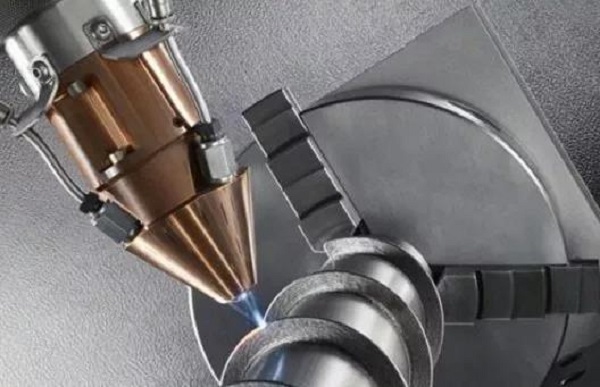
Directed Energy Deposition (DED) takes a different approach. Instead of melting powder in a bed, it feeds metal into a focused energy beam.
Think of it like a welding torch controlled by a robot, building up material exactly where needed.
The energy source can be:
- Laser
- Electron beam
- Plasma arc
Material feeds as:
- Powder blown through a nozzle
- Wire fed into the melt pool
What DED excels at:
- Large parts (meters in size)
- High deposition rates (faster building)
- Repairing existing components
- Adding features to forged or cast parts
- Cladding and coatings
Real example: A damaged turbine shaft on a power generator might cost millions to replace. Using DED, technicians build up worn areas with new metal, then machine back to original dimensions. The repaired component goes back into service at a fraction of replacement cost.
Comparing PBF and DED
| Factor | Powder Bed Fusion | Directed Energy Deposition |
|---|---|---|
| Detail | Excellent (fine features) | Good (larger features) |
| Surface finish | Smooth | Rough (needs machining) |
| Accuracy | High (±0.05-0.15 mm) | Lower (±0.2-1 mm) |
| Build size | Limited by powder bed | Large (robot arm reach) |
| Speed | Slower | Faster |
| Material use | Powder bed | Powder or wire |
| Best for | Complex small parts | Large parts, repairs |
What Metals Can You 3D Print?
Titanium and Its Alloys
Titanium is the superstar of metal 3D printing. Ti-6Al-4V—the most common alloy—offers:
- Exceptional strength-to-weight ratio
- Excellent corrosion resistance
- Biocompatibility for medical use
- High-temperature capability
Aerospace applications dominate: brackets, engine components, structural parts. Weight savings of 30-50% compared to machined parts aren't unusual. Every kilogram saved on an aircraft saves thousands in fuel over its lifetime.
Medical applications grow even faster. About 70% of custom orthopedic implants now use 3D-printed titanium. Hip replacements match patient anatomy exactly. Spinal cages promote bone growth through designed porosity. Surgical guides position cuts precisely.
Stainless Steel
316L stainless steel is the workhorse of industrial 3D printing. It provides:
- Good corrosion resistance
- Reliable mechanical properties
- Reasonable cost
- Weldability and machinability
Applications span:
- Medical instruments needing sterilization
- Food processing equipment
- Marine components
- Tooling and fixtures
Unlike machined parts, 3D-printed stainless can include internal cooling channels impossible to drill. Conformal cooling in injection molds reduces cycle times dramatically.
Aluminum
Aluminum alloys bring lightweight benefits to metal 3D printing:
- Low density
- Good thermal conductivity
- Moderate strength
Automotive and aerospace industries use it for brackets, housings, and heat exchangers. The combination of light weight and complex geometry makes it ideal for performance applications.
Nickel-Based Alloys
Inconel and other nickel-based alloys handle extreme heat:
- Maintain strength at 1000°C+
- Resist oxidation and corrosion
- Used in turbine engines and chemical processing
Aerospace prints combustion chambers and turbine blades. Power generation uses it for hot gas path components.
Cobalt-Chrome
Cobalt-chrome alloys offer:
- Excellent wear resistance
- Biocompatibility
- High-temperature capability
Dental and orthopedic implants dominate—hip stems, knee components, dental frameworks. The material's hardness means it lasts decades inside the body.
Why Does Metal Additive Manufacturing Matter?
Design Freedom Changes Everything
Traditional manufacturing constraints disappear. You're no longer limited by:
- Tool access (can't cut what you can't reach)
- Draft angles (needed for mold release)
- Straight holes (drills go straight)
- Uniform walls (machining prefers constant thickness)
With metal 3D printing, you design for performance, not for the machine shop.
Internal channels follow part contours instead of straight lines. Cooling flows where heat builds. Fluid passages optimize for pressure drop. Lattice structures replace solid material where loads allow, saving weight without sacrificing strength.
A bracket that used to be a simple L-shape becomes an organic form following stress lines. It weighs less, carries more, and looks like something from nature rather than a machine shop.
Part Consolidation Saves Assembly
Multiple parts become one. GE's fuel nozzle went from 20 pieces to 1. No welding. No fasteners. No leak paths between components.
Benefits cascade:
- Fewer suppliers to manage
- Less inventory to stock
- No assembly labor
- Higher reliability (fewer failure points)
- Lighter final assembly
Material Efficiency Reduces Waste
Traditional machining of a titanium part might remove 90% of the starting block. You buy a kilogram of material and throw away 900 grams.
Additive manufacturing typically uses over 95% of the material purchased. Unused powder gets recycled into the next build. Waste becomes negligible.
For expensive materials like titanium, this changes economics completely.
Customization Without Cost Penalty
Making each part different traditionally costs more—different programs, different setups, different tooling.
With 3D printing, customization is free. The printer reads a different file and makes a different part. No extra cost. No extra time.
This enables:
- Patient-specific medical implants
- Custom racing components
- Personalized consumer goods
- Optimized parts for each application
Where Is Metal Additive Manufacturing Used Today?
Aerospace: Leading the Way
Aerospace adopted metal 3D printing early because it solves critical problems:
- Weight reduction saves fuel
- Complex cooling improves engine efficiency
- Part consolidation increases reliability
- Small production volumes fit the process
GE Aviation now produces over 100,000 3D-printed fuel nozzles. Each one performs better than the machined version it replaced.
Airbus uses printed brackets in its A350 XWB. Lighter brackets mean lighter planes.
SpaceX prints SuperDraco engine chambers. The complex internal geometry enables cooling that keeps the chamber intact during firing.
Numbers tell the story:
- 30-50% weight savings common
- 5x durability improvements reported
- 80% reduction in lead time for some components
Healthcare: Personalizing Treatment
Medical applications prove the value of customization:
Orthopedic implants match patient anatomy exactly. A hip replacement printed from CT data fits better than any standard size. Recovery improves. Complications drop. A study found 20% lower complication rates with customized implants.
Dental restorations—crowns, bridges, frameworks—print in cobalt-chrome or titanium. Fit is precise because the digital model comes from the patient's mouth.
Surgical guides position cuts exactly where planned. A surgeon knows before the first incision that the implant will fit.
Cranial implants replace skull sections after trauma or surgery. Printed in titanium or PEEK, they match the missing piece perfectly.
Automotive: Performance and Prototyping
Automotive uses metal 3D printing for:
- Rapid prototyping: Test designs in days instead of months
- Performance parts: Lightweight components for racing
- Tooling: Custom fixtures and jigs
- Small production runs: Limited edition models
McLaren prints parts for its supercars. Prototypes validate designs quickly. Production components save weight where it matters most.
Porsche prints pistons for high-performance engines. The complex internal design improves cooling and reduces weight, increasing power output.
Formula 1 teams print exhausts, brackets, and aerodynamic components. Every gram saved improves lap times.
Industrial: Tools and Spare Parts
Industrial applications grow steadily:
- Custom tooling with conformal cooling
- Spare parts for legacy equipment
- Replacement components for machines
- Repair of worn parts using DED
A factory with a broken machine no longer waits weeks for a spare. If they have the 3D model, they print the part overnight.
What Are the Challenges?
Equipment Cost Remains High
Industrial metal 3D printers cost $500,000 to $1.5 million typically. High-end systems exceed that. For many companies, this means using service bureaus rather than buying machines.
Speed Limits Production
Building a part layer by layer takes time. For small, complex parts, it's fine. For large volumes, traditional methods remain faster. The sweet spot is low-to-medium volumes of complex parts.
Post-Processing Adds Steps
Parts don't come off the printer ready to use:
- Support removal
- Heat treatment
- Hot isostatic pressing (for critical applications)
- Machining critical surfaces
- Surface finishing
Each step adds time and cost.
Qualification Challenges
For critical applications—aerospace, medical, power generation—proving the part meets requirements takes work. Standards are still evolving. Each part or process may need individual validation.
Yigu Technology's View
At Yigu technology, we see metal additive manufacturing as a powerful tool in our custom manufacturing toolkit. It's not the answer for everything, but for the right applications, nothing else compares.
We help clients navigate:
- When to use additive vs. traditional methods
- Which technology fits their parts
- Material selection for their requirements
- Design optimization for additive
- Post-processing to meet specifications
The technology keeps advancing. Costs gradually decrease. Materials expand. Applications grow. We stay current so our clients don't have to.
Custom manufacturing means matching process to part. Sometimes that's machining. Sometimes it's casting. Increasingly, it's metal 3D printing.
Conclusion
Metal additive manufacturing matters because it changes what's possible. Parts that couldn't be made before now print routinely. Assemblies that required dozens of components become single pieces. Weight drops without sacrificing strength. Customization becomes free instead of expensive.
The main technologies—Powder Bed Fusion for precision and Directed Energy Deposition for scale—serve different needs but share the layer-by-layer approach that enables new possibilities.
Materials from titanium to stainless steel to nickel alloys cover applications from aerospace to healthcare to automotive. Each brings specific properties matched to specific needs.
Challenges remain—cost, speed, post-processing, qualification. But as technology advances and experience grows, these barriers continue falling.
For anyone designing or manufacturing metal parts, understanding these technologies isn't optional anymore. They're tools that belong in the toolbox, ready for the right job.
FAQ
What types of metals can be used in metal additive manufacturing?
Common metals include titanium alloys (Ti-6Al-4V for aerospace and medical), stainless steel (316L for corrosion-resistant applications), aluminum (lightweight parts), nickel-based alloys (Inconel for high-temperature use), and cobalt-chrome (for wear-resistant medical implants). Each offers specific properties matched to application requirements.
How accurate are parts produced by metal additive manufacturing?
Powder Bed Fusion typically achieves ±0.05-0.15 mm accuracy for small to medium parts. Directed Energy Deposition ranges ±0.2-1 mm due to larger melt pools and higher deposition rates. Post-processing machining can improve accuracy to micron levels for critical features.
Is metal additive manufacturing suitable for large-scale production?
It depends on the parts. For high-volume, simple geometries, traditional methods remain faster and cheaper. For complex parts, low-to-medium volumes, or highly customized components, additive manufacturing excels. The sweet spot is parts where complexity justifies the process, or where customization adds value.
What's the difference between SLM and EBM?
Both are Powder Bed Fusion processes. Selective Laser Melting (SLM) uses a laser as the energy source, operates in inert gas, and achieves fine detail. Electron Beam Melting (EBM) uses an electron beam, runs in vacuum, operates at higher temperatures, and typically builds faster with different residual stress characteristics. Choice depends on material and application requirements.
Can you repair existing metal parts with additive manufacturing?
Yes. Directed Energy Deposition excels at repair. Worn areas get built up with new material, then machined back to original dimensions. This saves components that would otherwise be scrapped—turbine shafts, mold dies, large castings worth far more than repair cost.
How expensive is metal 3D printing equipment?
Industrial metal 3D printers typically range from $500,000 to $1.5 million, with high-end systems exceeding that. Entry-level systems exist for research and smaller applications, but production-ready machines represent significant investment. Many companies use service bureaus to access the technology without capital expense.
Contact Yigu Technology for Custom Manufacturing
Ready to explore metal additive manufacturing for your projects? Yigu technology specializes in custom manufacturing with both traditional and advanced methods.
We help with:
- Design for additive manufacturing guidance
- Material selection for your application
- Printing in titanium, stainless steel, and other metals
- Post-processing to meet specifications
- Hybrid approaches combining additive and traditional methods
Contact us to discuss your requirements. Tell us what you're making. We'll recommend the best approach from today's manufacturing possibilities.