Introduction
ABS (Acrylonitrile Butadiene Styrene) is everywhere. It's the plastic in LEGO bricks, car dashboards, power tool housings, and drone frames. It's strong, tough, and heat-resistant.
But anyone who's tried 3D printing ABS knows the struggle:
- Prints that look perfect mid-way suddenly warp at the corners
- Layers peel apart like a bad sticker
- The final part shatters when you apply moderate force
- Stringing ruins fine details
- Post-processing leaves uneven surfaces
These issues aren't just annoying. They make ABS feel more trouble than it's worth.
The truth? ABS has unique material properties that demand specific techniques. With the right knowledge, you can turn frustration into consistent, high-quality results.
At Yigu technology, we've mastered ABS 3D printing for clients across industries. This guide covers everything—material properties, printing settings, post-processing, and applications.
What Makes ABS Unique?
Chemical Structure: Three Monomers, One Material
ABS is a terpolymer—made from three different monomers:
| Component | Typical Ratio | Contribution |
|---|---|---|
| Acrylonitrile | 20-30% | Tensile strength, chemical resistance |
| Butadiene | 15-30% | Impact resistance, toughness |
| Styrene | 40-60% | Rigidity, smooth surface finish |
This combination makes ABS both strong and tough—a rare balance in 3D printing materials.
- Acrylonitrile provides the backbone strength
- Butadiene adds flexibility to absorb impacts
- Styrene gives stiffness and that characteristic smooth surface
Thermal Properties
ABS has a glass transition temperature (Tg) of 105°C—it softens above this point but doesn't melt until 200-250°C.
Its Vicat softening point (temperature at which it deforms under light load) is 90-100°C. This makes ABS suitable for applications needing moderate heat resistance, like electronic enclosures.
Important: Prolonged exposure above 60°C can cause gradual warping. ABS isn't for extreme heat applications.
Mechanical Strength
| Property | ABS Value | PLA (for comparison) |
|---|---|---|
| Tensile strength | 20-40 MPa | 40-60 MPa |
| Young's modulus (stiffness) | 1.4-2.8 GPa | 2.0-3.5 GPa |
| Impact resistance (Izod) | 20-40 kJ/m² | 2-5 kJ/m² |
Key takeaway: ABS isn't as strong as PLA in pure tension, but it's far tougher. It absorbs impacts that would shatter PLA. That's why it's used for drone frames and RC car parts.
Other Important Properties
- Density: 1.04-1.06 g/cm³—lightweight but sturdy
- Melt flow index (MFI) : 3-10 g/10min at 220°C/10kg. Higher MFI means easier extrusion but may reduce strength.
- UV resistance: Poor—parts fade and become brittle in sunlight
- Moisture absorption: 0.2-0.3% over 24 hours. Can cause popping during printing if not dried.
- Structure: Amorphous (no crystalline structure)—consistent mechanical behavior
What Printing Settings Tame ABS's Temperament?
Temperature and Enclosure: The Foundation
Nozzle temperature: 230-250°C
- Too low (220-230°C): Under-extrusion, weak layers
- Too high (250-260°C): Stringing, material degradation
Heated bed temperature: 90-110°C
- Ensures first layer adhesion
- Use PEI sheet or hairspray on glass for better grip
Enclosure: Non-negotiable
- ABS shrinks as it cools. Drafts cause uneven cooling—the main cause of warping.
- An enclosure maintains 40-60°C ambient temperature, slowing cooling and improving layer adhesion
- Without an enclosure, large prints will likely fail
Adhesion and Warping Prevention
Raft vs. brim vs. skirt:
| Feature | Best For | Why |
|---|---|---|
| Raft | Large, flat parts | Lattice under the part distributes stress, prevents warping |
| Brim | Smaller parts | Single-layer edge adds adhesion without extra material |
| Skirt | Calibration | Loop around part primes nozzle—not for adhesion |
First-layer squish: Calibrate first layer to be slightly thicker (120-150% of normal layer height). This "squishes" into the bed, creating a strong bond.
Warping prevention:
- Use enclosure and proper bed temperature
- Add raft or brim
- Reduce print speed for first layer (30-50% of normal)
- Avoid large, flat surfaces—split them into smaller sections with gaps for heat dissipation
Speed, Retraction, and Infill
Print speed: 40-60 mm/s for general printing
- Faster (70-80 mm/s): May reduce layer adhesion
- Slower (30-40 mm/s): Better detail, longer prints
Retraction distance: 2-5 mm at 25-40 mm/s
- Too little: Stringing
- Too much: Under-extrusion
Infill pattern: Honeycomb or grid offer best strength-to-weight
- Functional parts: 50-100% infill
- Decorative parts: 10-30% infill
Cooling fan:
- First 3-5 layers: Off or 10-20% to let layers bond
- Upper layers: 30-50% to prevent overheating
- Avoid full fan—rapid cooling causes warping
How Do You Post-Process ABS for Professional Results?
ABS Vapor Smoothing
The gold standard for finishing ABS prints.
Process: Expose prints to acetone vapor in a sealed container for 10-30 minutes. The acetone dissolves the surface layer, melting small layer lines into a glossy, seamless finish.
Important: Use vapor, not liquid. Submerging in acetone will soften or deform the part.
Results: Injection-mold-like glossy surface. Layer lines disappear.
Sanding ABS Prints
- Start with 120-200 grit sandpaper to remove layer lines
- Move to 400-600 grit for smoothness
- Wet-sanding prevents dust and clogs
- Follow with primer (plastic-specific) to fill tiny scratches before painting
Spray Painting ABS
- Use enamel or acrylic paints designed for plastics
- Apply light, even coats—avoid thick layers that drip
- For durable finish, add UV-resistant clear coat (though it won't fix ABS's inherent UV weakness)
Mechanical Finishing
- Mechanical polishing: Buffing wheel with plastic polish (like Novus) adds mirror shine
- Tapping threads: Use lubricant to prevent cracking
- Ultrasonic welding: Creates strong, seamless joints
- Chemical bonding: ABS cement (acetone + ABS pellets) fuses parts better than superglue
Annealing ABS
Heat printed parts to 80-90°C for 1-2 hours, then cool slowly. This reduces internal stress and improves strength.
Dyeing ABS
You can dye ABS filament before printing using alcohol-based dyes for custom colors.
Where Does ABS Excel?
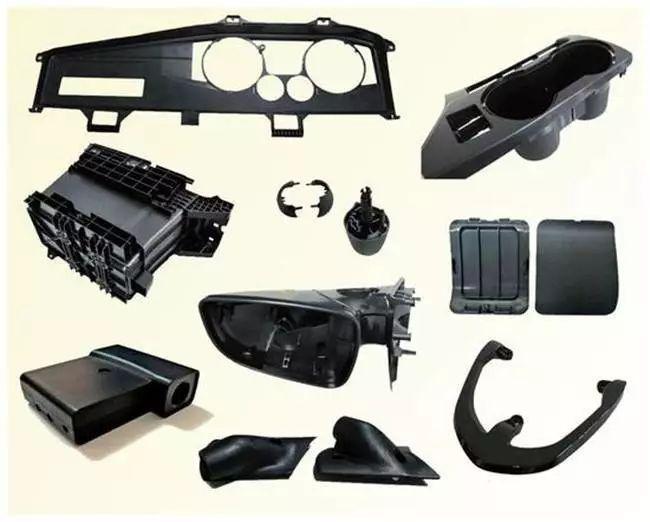
Automotive Prototyping
Engineers use ABS for durable, heat-resistant prototypes:
- Electronic enclosures
- Dashboard components
- Trim parts
Its impact resistance withstands rough handling during testing.
Drone Frames and RC Car Parts
These need to be:
- Lightweight (ABS's density is ideal)
- Tough enough to survive crashes (butadiene component absorbs impacts)
ABS outperforms PLA here—where PLA shatters, ABS bends and survives.
LEGO Bricks
The iconic toy uses ABS for:
- Snap-fit strength—bricks stay together but come apart when needed
- Color retention—years of play don't fade colors
- Precise shapes—molded or printed to tight tolerances
Pipe Fittings and Industrial Parts
ABS's chemical resistance (from acrylonitrile) makes it suitable for:
- Low-pressure pipe fittings
- Jigs and fixtures in factories
Cosplay Armor
3D-printed ABS armor is:
- Rigid enough to hold shape
- Flexible enough to move with the wearer
- Post-processable—vapor smoothing and painting give professional, prop-like finish
Educational STEM Projects
ABS is affordable and (with the right setup) reliable. Students can print functional parts—gears, hinges—that actually work.
Yigu Technology's Perspective
At Yigu technology, we've mastered ABS 3D printing for clients across industries. Here's what we've learned:
ABS's quirks are manageable with the right approach. Moisture absorption ruins prints? Dry your filament. Warping? Use an enclosure and proper bed temperature. Weak layers? Dial in nozzle temp.
Small changes matter. A 5°C nozzle temperature change affects layer bond. Consistent settings are essential.
Post-processing transforms parts. Vapor smoothing turns rough prints into professional-looking components. It's worth the extra step.
Applications we serve:
- Drone frames needing impact resistance
- Automotive prototypes requiring heat resistance
- Industrial parts where chemical resistance matters
- Cosplay armor demanding smooth finishes
- Educational projects teaching real-world engineering
ABS isn't the easiest material to print. But with mastery, it's one of the most versatile.
Conclusion
ABS 3D printing delivers parts that are:
- Strong: 20-40 MPa tensile strength
- Tough: 20-40 kJ/m² impact resistance—far outperforms PLA
- Heat-resistant: Withstands moderate temperatures (60-100°C)
- Post-processable: Vapor smoothing, sanding, painting, bonding
- Versatile: Automotive, drone frames, LEGO-style parts, cosplay armor
Success requires:
- Proper temperature: Nozzle 230-250°C, bed 90-110°C
- Enclosure: Non-negotiable—prevents warping
- Adhesion strategies: Rafts, brims, first-layer squish
- Optimized settings: Speed 40-60 mm/s, retraction 2-5 mm
- Post-processing: Vapor smoothing for professional finish
Applications prove its value. From Ford prototypes to LEGO bricks to drone frames, ABS delivers where toughness matters.
The challenges are real—warping, stringing, layer adhesion. But with the right knowledge, they're solvable.
ABS isn't for beginners. But for those who master it, it's indispensable.
FAQ
Why does my ABS print warp even with a heated bed?
Warping is usually due to uneven cooling. Ensure your printer is enclosed to maintain consistent temperature. Use a brim or raft to improve adhesion. Check that bed temperature is consistent (90-110°C). Avoid large, flat surfaces without breaks—add vents or split designs to reduce stress.
Can I print ABS without an enclosure?
It's possible but risky. Use a draft shield (cardboard or acrylic around the printer), keep room temperature stable (25-30°C), and print small parts. Larger prints will likely warp. An enclosure is worth the investment for reliability.
How do I fix stringing in ABS prints?
Increase retraction distance (3-5 mm) and speed (30-40 mm/s). Lower nozzle temperature by 5-10°C. Add a small z-hop (0.4-0.6 mm) when retracting. Ensure filament is dry—moisture causes popping that mimics stringing.
What's the best bed surface for ABS?
PEI sheets work excellently—ABS adheres well when heated and releases when cool. Glass with hairspray or glue stick is another reliable option. Avoid bare glass—adhesion will be inconsistent.
How do I make ABS prints stronger?
- Increase infill (50-100% for functional parts)
- Use honeycomb or grid infill patterns
- Annealing: Heat to 80-90°C for 1-2 hours, then cool slowly
- Ensure proper layer adhesion with correct temperature and enclosure
Can I use ABS for outdoor parts?
Generally no. ABS has poor UV resistance—parts fade and become brittle in sunlight. For outdoor use, consider ASA (similar properties with UV resistance) or apply a UV-resistant coating.
Contact Yigu Technology for Custom Manufacturing
Ready to master ABS 3D printing for your project? Yigu technology specializes in custom manufacturing with all major 3D printing materials.
We offer:
- Free quotes within 24 hours—just send your CAD file
- ABS expertise—optimized settings for strength and quality
- Enclosed printers for consistent results
- Post-processing—vapor smoothing, sanding, painting
- Production runs—from prototypes to small batches
Contact us to discuss your project. Tell us what you're making and what it needs to do. We'll help bring your design to life—with ABS done right.