Introduction
You are designing a structural component. It needs to be strong enough to carry a load, but light enough to keep overall weight down. It must resist corrosion in outdoor conditions. And it needs to be machinable without driving up costs.
This is why engineers turn to AL6063. This aluminum alloy offers an exceptional balance of formability, corrosion resistance, and machinability. But the choice between T5 and T6 temper can determine whether your project meets performance targets or falls short.
The difference matters. T6 temper delivers 48% higher tensile strength than T5. But that extra strength comes with slightly different machining considerations. Choosing the wrong temper for your application could mean parts that warp during machining, fail under load, or cost more than necessary.
This guide covers everything you need to know about CNC machining AL6063 T5 and T6. You will learn the material properties, machining parameters, heat treatment science, and quality control practices that separate success from scrap.
What Are the Key Properties of AL6063?
Chemical Composition and Characteristics
AL6063 is an aluminum-magnesium-silicon alloy (6000 series). Its primary alloying elements are magnesium and silicon, which form magnesium silicide—the compound that enables precipitation hardening.
What makes AL6063 distinctive is its excellent formability. It extrudes easily into complex shapes. It accepts anodizing beautifully, producing a consistent, attractive finish. And it resists corrosion well enough for decades of outdoor exposure.
Mechanical Properties: T5 vs. T6
The numbers tell the story. Here is how the two tempers compare:
| Property | AL6063 T5 | AL6063 T6 |
|---|---|---|
| Tensile strength | 145 MPa (21,000 psi) | 215 MPa (31,200 psi) |
| Yield strength | 110 MPa (16,000 psi) | 180 MPa (26,100 psi) |
| Hardness (Brinell) | 60 HB | 73 HB |
| Elongation | 8% | 10% |
T6 delivers 48% higher tensile strength and 64% higher yield strength than T5. The elongation—a measure of ductility—is slightly better in T6 as well. For load-bearing applications, T6 is the clear choice.
But T5 has its place. Its lower strength means lower cutting forces during machining. It is slightly more forgiving in thin-wall sections where warping is a concern. And for applications where strength requirements are modest, T5 offers adequate performance at lower material cost.
Corrosion Resistance
Both tempers offer excellent corrosion resistance. The magnesium-silicon chemistry forms a protective oxide layer that resists atmospheric corrosion, salt spray, and many chemicals.
This makes AL6063 a preferred material for architectural applications—window frames, door rails, curtain walls—where decades of outdoor exposure are expected. The alloy accepts anodizing exceptionally well, producing a hard, durable surface finish that further enhances corrosion protection.
How Do You Machine AL6063 T5 and T6?
Milling Operations
Milling AL6063 is straightforward with the right approach. The alloy's softness compared to steel means high material removal rates are possible, but tool selection matters.
For roughing operations:
- Use carbide cutting tools with polished flutes to prevent built-up edge
- Spindle speed: 3,000–6,000 RPM
- Feed rate: 100–300 mm/min
- Depth of cut: 1–3 mm
For finishing passes:
- Reduce feed rate to 50–150 mm/min
- Maintain spindle speeds at the higher end of the range
- Use light depths of cut (0.2–0.5 mm) for optimal surface finish
Climb milling is preferred over conventional milling. The cutting action reduces work hardening and produces cleaner surfaces.
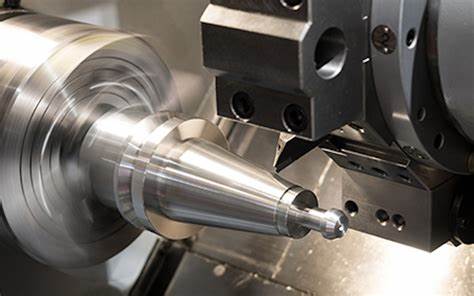
Turning Operations
Turning AL6063 works well for cylindrical components like shafts, bushings, and fittings.
Recommended parameters:
- Spindle speed: 2,000–4,000 RPM
- Feed rate: 0.1–0.3 mm/rev
- Depth of cut: 1–4 mm
The key challenge in turning AL6063 is chip control. The material produces long, stringy chips that can wrap around the tool. Using tools with chip breakers designed for aluminum and maintaining consistent feed rates prevents this problem.
Drilling Operations
Drilling AL6063 requires attention to chip evacuation and heat management.
- Use high-speed steel (HSS) or carbide drills with polished flutes
- Spindle speed: 1,500–3,000 RPM
- Feed rate: 0.05–0.15 mm/rev
Peck drilling—withdrawing the drill periodically to clear chips—prevents chip packing that can break tools or damage hole walls. Coolant is essential for deep holes to prevent heat buildup that could soften the material and cause work hardening.
Parameter Adjustments for T6 Temper
T6 temper is harder than T5. While both machine well, T6 requires slight adjustments:
- Reduce cutting speeds by 5–10% compared to T5
- Use carbide tools rather than HSS for extended runs
- Monitor tool wear more closely—the higher hardness accelerates edge breakdown
A shop machining T6 extrusions for automotive structural components found that reducing feed rates by 8% and switching to carbide tools extended tool life by 40% compared to their T5 parameters.
What Heat Treatment Creates T5 and T6?
The Science of Precipitation Hardening
AL6063 gains its strength through precipitation hardening. The process involves dissolving alloying elements into solid solution, then controlling their precipitation to create tiny particles that block dislocation movement.
The difference between T5 and T6 lies in when and how this precipitation occurs.
T5 Temper: Aging Without Solution Treatment
T5 temper is produced by artificial aging after extrusion. The extruded profile is cooled from the extrusion temperature, then heated to 120–180°C for 3–12 hours.
There is no separate solution heat treatment step. The solution treatment happens during extrusion—the material is heated to a high temperature, forced through the die, and then cooled. The subsequent aging step precipitates the strengthening particles.
This process makes T5 more economical than T6. It requires fewer processing steps and less energy. The resulting material has moderate strength and good formability.
T6 Temper: Full Solution Treatment and Aging
T6 temper involves a three-step process:
- Solution heat treatment: The material is heated to 520–540°C for 30 minutes to 2 hours. This temperature dissolves alloying elements into solid solution.
- Quenching: The material is rapidly cooled, typically in water. This traps the alloying elements in solution, preventing premature precipitation.
- Artificial aging: The material is heated to 120–180°C for 4–16 hours. This controlled heating precipitates the strengthening particles in a uniform, finely dispersed pattern.
The extra steps produce higher strength and better thermal stability than T5. The trade-off is slightly reduced formability and higher processing cost.
Which Temper Should You Choose?
| Factor | Choose T5 When | Choose T6 When |
|---|---|---|
| Strength requirements | Moderate loads | High loads, structural applications |
| Formability | Complex extrusions, thin walls | Simpler shapes, heavier sections |
| Machining volume | High-volume production | Precision-critical components |
| Cost sensitivity | Budget is primary constraint | Performance justifies premium |
| Typical applications | Window frames, rails, decorative profiles | Automotive parts, structural brackets, load-bearing components |
Where Are AL6063 T5 and T6 Used?
Architectural Applications
T5 dominates architectural applications. Window frames, door rails, curtain walls, and handrails rely on T5's combination of corrosion resistance, aesthetic finish, and extrudability.
The alloy accepts anodizing exceptionally well. A clear anodized finish protects the surface while maintaining the metallic appearance. Colored anodizing produces consistent, durable finishes that resist fading for decades.
Automotive Components
T6 is the choice for automotive structural parts. Chassis components, brackets, mounting hardware, and crash structures benefit from T6's higher strength-to-weight ratio.
A manufacturer of electric vehicle battery enclosures switched from T5 to T6 and achieved 25% higher structural rigidity with the same wall thickness. The weight remained unchanged, but the safety margin improved significantly.
Mechanical Components
Both tempers find use in machined mechanical components:
- Gears and pulleys where moderate loads apply
- Shafts and couplings requiring dimensional stability
- Fittings and connectors that must resist corrosion
- Heat sinks where thermal conductivity matters
T6 is preferred for components under continuous stress. T5 works well for parts where formability during secondary operations matters more than ultimate strength.
Extruded Profiles
AL6063 is the premium extrusion alloy. Its excellent flow characteristics allow complex cross-sections that other alloys cannot achieve.
Heat sinks with thin fins, enclosures with integrated mounting features, and structural tubes with internal ribs are all commonly extruded from AL6063 and machined to final dimensions.
How Do You Ensure Quality in Machined Parts?
Dimensional Accuracy
Precision matters. Critical components often require tolerances of ±0.01 mm or tighter.
Coordinate measuring machines (CMMs) provide the most comprehensive dimensional verification. A CMM can measure hundreds of features in minutes, confirming that every dimension meets the specification.
For high-volume production, in-process gauging catches variations before they become defects. Touch probes on CNC machines measure critical features immediately after machining, allowing adjustments in real time.
Surface Finish Requirements
Surface finish affects both appearance and function. Rough surfaces can trap contaminants, create stress risers, or interfere with assembly.
| Application | Target Surface Finish (Ra) |
|---|---|
| Decorative architectural | ≤1.6 μm |
| Structural components | ≤3.2 μm |
| Sealing surfaces | ≤0.8 μm |
| Heat sinks | ≤3.2 μm (fins), ≤1.6 μm (base) |
Profilometers measure surface roughness quantitatively. Visual inspection catches burrs, scratches, and tool marks that affect appearance.
Mechanical Testing
Confirming that machined parts meet temper specifications requires mechanical testing on sample pieces.
Tensile testing verifies ultimate strength and yield strength. Hardness testing (Brinell or Rockwell) provides a quick, non-destructive check that the material has achieved the expected temper.
For critical applications, certified test reports documenting these results provide traceability and quality assurance.
Industry Standards
Reputable manufacturers comply with recognized standards:
- ISO 9001: Quality management system
- ASTM B210: Aluminum extruded tube specification
- ASTM B221: Aluminum extruded bar, rod, wire, profile, and tube
Compliance ensures that material sourcing, processing, and quality control meet established benchmarks.
What Machining Challenges Should You Anticipate?
Built-Up Edge
Aluminum's softness can cause built-up edge—material welding to the cutting tool. This degrades surface finish and dimensional accuracy.
Solutions:
- Use polished carbide tools with sharp edges
- Apply proper coolant to reduce friction
- Maintain adequate feed rates—light feeds promote built-up edge
Chip Control
AL6063 produces long, stringy chips that can wrap around tools and interfere with machining.
Solutions:
- Use chip breaker tools designed for aluminum
- Apply high-pressure coolant to flush chips
- Program pecking cycles for drilling operations
Warping in Thin Sections
Thin-walled parts can warp from residual stresses or cutting forces.
Solutions:
- Stress relieve material before final machining
- Use climb milling to reduce cutting forces
- Machine in multiple light passes rather than one heavy cut
- Secure workpieces with adequate clamping to prevent movement
Tool Wear
While AL6063 is not hard, abrasive oxide layers can wear tools over long production runs.
Solutions:
- Use diamond-coated tools for extended runs
- Monitor tool wear and replace before quality degrades
- Maintain consistent cutting parameters to avoid accelerated wear
Yigu Technology's Perspective
At Yigu Technology, we machine AL6063 T5 and T6 daily for clients across architectural, automotive, and industrial markets. Our experience has taught us that success comes down to matching the temper to the application and optimizing parameters for the specific part geometry.
We recommend T6 for any load-bearing application. The strength premium justifies the slightly higher material cost. For decorative or non-structural parts, T5 often provides adequate performance at lower cost.
Our CNC machining centers are equipped with high-pressure coolant systems and polished carbide tools specifically selected for aluminum. We use in-process probing to verify critical dimensions during machining, and CMM inspection to confirm final parts meet specifications.
Whether you need architectural profiles with anodized finishes or structural components requiring maximum strength, we deliver precision you can trust.
Conclusion
AL6063 T5 and T6 offer exceptional combinations of machinability, corrosion resistance, and strength. T5 provides good formability and moderate strength at lower cost. T6 delivers significantly higher strength for demanding applications.
Machining either temper successfully requires:
- Proper tool selection—carbide tools with polished flutes
- Appropriate parameters—higher speeds than steel, but adjusted for temper
- Chip control—chip breakers and adequate coolant
- Quality verification—CMM inspection and mechanical testing
The choice between T5 and T6 should be driven by application requirements. When in doubt, T6 offers a performance margin that often justifies its slightly higher cost. For non-structural, decorative, or low-load applications, T5 provides reliable performance at a more economical price point.
By understanding the properties and machining characteristics of these materials, you can select the right temper and achieve the precision your project demands.
FAQ
What is the main difference between AL6063 T5 and T6?
T5 is artificially aged after extrusion without a separate solution heat treatment. T6 undergoes full solution heat treatment, quenching, and artificial aging. This makes T6 48% stronger in tensile strength (215 MPa vs. 145 MPa) and 64% stronger in yield strength (180 MPa vs. 110 MPa).
Can AL6063 T6 be machined as easily as T5?
T6 is slightly harder, so it requires 5–10% slower cutting speeds and benefits from carbide tools. However, it remains highly machinable. The higher strength and hardness of T6 make it better suited for load-bearing applications, while T5 is more forgiving in thin-wall sections.
Is AL6063 suitable for outdoor applications?
Yes. Both T5 and T6 offer excellent corrosion resistance. The magnesium-silicon chemistry forms a protective oxide layer that resists atmospheric corrosion, salt spray, and many chemicals. The alloy also accepts anodizing exceptionally well, providing additional surface protection and aesthetic options.
What cutting tools work best for AL6063?
Polished carbide tools are ideal. The polished flutes prevent built-up edge—the tendency of soft aluminum to weld to the cutting tool. For high-volume production, diamond-coated tools provide extended tool life. High-speed steel (HSS) tools work for small batches but wear faster than carbide.
What surface finish can I expect when machining AL6063?
With proper parameters and sharp tools, AL6063 achieves surface finishes of Ra 1.6–3.2 μm for general machining. Finishing passes with light depths of cut can achieve Ra 0.8 μm or better—smooth enough for decorative applications and sealing surfaces.
Contact Yigu Technology for Custom Manufacturing
Looking for precision-machined AL6063 components? Yigu Technology delivers quality and consistency for T5 and T6 applications across architectural, automotive, and industrial markets. Our CNC machining capabilities, quality control systems, and material expertise ensure your parts meet specifications every time.
Let our engineering team help you select the right temper and optimize machining parameters for your project. From prototypes to production runs, we deliver precision you can trust.
Contact Yigu Technology today to discuss your requirements or request a quote.