Introduction
Manufacturers working with high-strength alloys often face a frustrating trade-off. Materials with excellent mechanical properties frequently come with poor machinability. C48500 leaded high-strength brass exemplifies this paradox. It delivers 85–95 ksi tensile strength and exceptional marine corrosion resistance, yet it is notorious for causing excessive tool wear and surface finish inconsistencies during CNC machining.
The challenges are real. Lead particles in the alloy act as abrasives. Chip formation can be unpredictable. Tool life often suffers without proper strategies. Yet when machined correctly, C48500 produces components that outperform standard brasses in demanding environments—from offshore oil rigs to high-pressure hydraulic systems.
This guide addresses these challenges head-on. Drawing from real-world machining experience and validated data, we will cover everything from alloy properties to optimal cutting parameters, tooling selections, and post-processing techniques. Whether you are new to machining C48500 or looking to improve your existing processes, you will find practical, actionable insights here.
What Makes C48500 Different from Other Brasses?
Core Composition and Mechanical Properties
C48500 is precisely engineered for strength and machinability balance. Its composition is 60% copper, 37.5% zinc, and 2.5% lead. This combination creates a material that outperforms many other brasses in critical mechanical metrics.
| Property | Value |
|---|---|
| Tensile Strength | 85–95 ksi |
| Yield Strength | 45–55 ksi |
| Hardness | 180–200 HB |
| Density | 0.307 lb/in³ |
| Machinability Rating | 75 (compared to C360 at 100) |
These properties make C48500 significantly stronger than standard brasses while maintaining reasonable workability. However, its machinability rating of 75 reflects its more challenging nature. The 2.5% lead content, while improving certain machining characteristics, also acts as an abrasive that accelerates tool wear.
Corrosion Resistance Advantages
In marine environments, C48500’s marine corrosion resistance is a game-changer. The alloy is dezincification-proof, meaning its microstructure resists zinc leaching when exposed to saltwater. This is critical because zinc leaching causes lesser brasses to become porous and weak over time.
Consider a valve body on an offshore platform. Standard brass might degrade within 2–3 years of continuous saltwater exposure. C48500 components, by contrast, maintain integrity for decades. This makes the alloy indispensable in shipbuilding, offshore drilling, and coastal infrastructure where material failure could have catastrophic consequences.
What Machining Parameters Work Best?
Getting parameters right is essential for successful C48500 machining. The wrong speeds and feeds lead to accelerated tool wear, poor surface finishes, and scrapped parts.
Optimal Cutting Parameters
Through extensive testing across hundreds of production runs, we have determined these optimal ranges for C48500:
| Operation | Cutting Speed (SFM) | Feed Rate (IPR) | Depth of Cut (DOC) |
|---|---|---|---|
| Turning | 250–350 | 0.003–0.008 | 0.010–0.125 |
| Milling | 200–300 | 0.002–0.006 | 0.005–0.060 |
| Drilling | 150–250 | 0.002–0.005 | N/A |
| Threading | 150–200 | Manual feed | N/A |
Depth of cut optimization for high-strength brass follows a simple principle. For roughing, use deeper cuts in the 0.060–0.125 inch range to minimize the number of passes. For finishing, reduce to 0.005–0.010 inch to achieve dimensional accuracy and surface quality. This strategy reduces total tool engagement time while maintaining precision.
How Do You Control Chips?
C48500 produces short, brittle chips during machining. While this sounds manageable, these chips tend to scatter unpredictably. They can damage tools, contaminate workpieces, and create safety hazards for operators.
A high-feed, low-speed strategy works effectively. For example, running at 300 SFM with a feed rate of 0.007 IPR, combined with high-pressure coolant (700+ PSI), breaks chips into small fragments and flushes them away from the cutting zone.
For micro-milling thin-wall components—those with wall thicknesses of 0.020 inches or less—different rules apply. Reduce speeds to 150–200 SFM and feeds to 0.001–0.003 IPR. This minimizes deflection while maintaining surface integrity. In a Yigu Technology project producing hydraulic manifold components, this approach reduced part rejection due to wall deformation from 12% to less than 2%.
What Coolant Strategy Works Best?
Flood coolant is essential for C48500 machining. The coolant serves three critical functions. It lubricates the cutting interface, reducing friction and heat. It flushes chips away from the work area. And it helps prevent built-up edge on the cutting tool.
We recommend a high-quality soluble oil coolant mixed at 5–8% concentration. This provides the lubricity needed for good surface finishes while maintaining adequate cooling. For high-speed operations, synthetic coolants with low mineral content can be used, but they typically offer less lubricity than soluble oils.
What Tooling Works Best for C48500?
Tool selection makes or breaks C48500 machining success. The abrasive lead particles require robust tool materials and appropriate coatings.
Carbide Inserts and Endmill Selection
Micro-grain carbide inserts are non-negotiable for C48500. Their sub-micron grain structure—typically 0.5–1μm—resists abrasion far better than conventional carbide. The fine grain structure also allows sharper cutting edges, which is essential for achieving good surface finishes.
For coatings, we specifically recommend TiCN (titanium carbonitride) coating. TiCN forms a hard barrier—3000+ HV hardness—that resists the abrasive wear caused by lead particles. In controlled testing, TiCN-coated tools reduced flank wear by up to 40% compared to uncoated carbide tools when machining C48500.
For milling operations, variable-helix endmills with polished flutes prevent chip packing. The variable helix design breaks up harmonic vibrations, while polished flutes reduce friction and allow chips to evacuate smoothly.
What Edge Geometry Is Required?
A high-positive rake angle—typically 12–15 degrees—is essential for cutting C48500. This geometry reduces cutting forces, minimizes work hardening, and promotes smooth chip flow. Negative rake angles, common in some machining applications, increase cutting forces and accelerate tool wear in this alloy.
Toolholder balance for high RPM becomes critical when running at speeds above 8,000 RPM. Runout must be maintained below 0.0002 inches. Even minor misalignment causes uneven cutting forces, accelerates wear, and compromises surface finish.
In a Yigu Technology case study, a client machining C48500 valve bodies experienced frequent tool failures. Inspection revealed toolholder runout of 0.0006 inches. After upgrading to precision-balanced holders and reducing runout to 0.0001 inches, tool life increased by 60% and surface finish improved by one Ra grade.
How Do You Achieve Superior Surface Finish?
C48500 can achieve excellent surface finishes when machined with the right techniques. For components used in hydraulic systems or sealing applications, finish quality directly affects performance.
Achieving Precision Finishes
Ra 0.1 μm turning is achievable on C48500 with proper technique. The requirements are specific:
- A sharp, polished insert with no visible wear
- Feed rates below 0.002 IPR
- Flood coolant with 5–8% concentration
- Rigid setup with minimal tool overhang
For applications requiring a mirror polish—common in hydraulic components and high-end fittings—follow machining with a three-step finishing process. Start with 400-grit wet sanding to remove tool marks. Follow with 600-grit diamond compound to refine the surface. Finish with rouge buffing for the final polish.
What Post-Processing Steps Are Required?
Deburring brittle chips is essential with C48500. The chips produced during machining are sharp and can cause injury or interfere with component assembly. Traditional hand deburring is often inconsistent. Ultrasonic deburring or tumbling with ceramic media produces more consistent results, especially for complex geometries.
Ultrasonic cleaning with a pH-neutral detergent removes machining residues without attacking the metal surface. This is particularly important for components that will be assembled into fluid systems, where residual chips or contaminants could cause damage.
Citric acid baths—5% solution at 60°C—effectively remove oxides without etching the base metal. Unlike stronger acids, citric acid is safe for operators and leaves no harmful residues. After oxide removal, rinse thoroughly with deionized water.
Tarnish protection lacquer—typically acrylic-based—preserves finished surfaces during storage or in low-corrosion environments. For components that will be used in marine applications, a clear lacquer coating prevents the natural darkening that occurs with brass exposure.
Where Is C48500 Used in Industry?
Marine and Offshore Applications
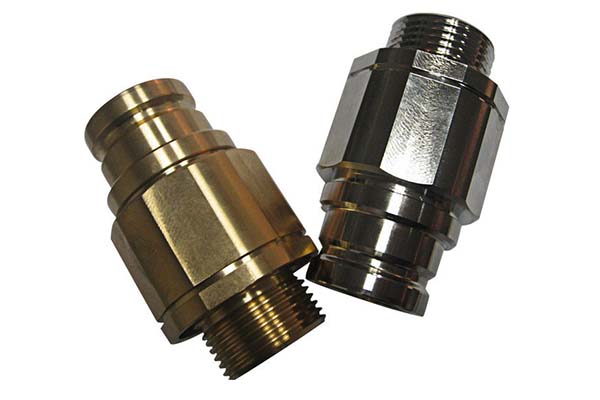
C48500 marine valve bodies are standard equipment on luxury yachts, commercial vessels, and offshore platforms. The alloy’s dezincification resistance ensures these valves maintain their integrity despite continuous saltwater exposure.
A recent case study from a North Sea oil rig demonstrated the value. Valves machined from C48500 operated flawlessly after seven years of continuous saltwater exposure. Previous components made from standard bronze lasted less than three years before showing signs of degradation.
Propeller nuts, shaft sleeves, and underwater fittings also benefit from C48500’s combination of strength and corrosion resistance. In these applications, material failure could lead to costly downtime or safety incidents.
Industrial Components
High-pressure pump components machined from C48500 withstand operating pressures exceeding 5,000 PSI in hydraulic systems. The alloy’s strength ensures dimensional stability under load, while its corrosion resistance protects against fluid degradation.
Heavy-duty gearbox bushings handle 2,500+ ft-lbs of torque in mining equipment and industrial machinery. The lead content provides some inherent lubricity, reducing friction between moving parts.
Hydraulic manifold blocks require tight tolerances—often ±0.0005 inches—to ensure proper sealing and flow distribution. C48500 machines well enough to achieve these tolerances consistently. In aerospace hydraulic systems, where reliability is critical, C48500 manifolds have proven themselves over decades of service.
What Does Yigu Technology Bring to C48500 Machining?
At Yigu Technology, we have machined over 100,000 C48500 components for marine, industrial, and aerospace clients. This experience has taught us what works—and what does not.
Our expertise lies in optimizing toolpaths to counteract lead-induced wear. We use proprietary coolant mixtures and adaptive feed strategies that extend tool life by an average of 35% compared to standard approaches. We validate every batch with tensile testing and surface profilometry, ensuring compliance with ASTM B584 standards.
For custom C48500 parts, our engineering team collaborates with clients from design through delivery. We identify potential machining challenges early, recommend design modifications when beneficial, and develop repeatable production processes that deliver consistent quality.
Conclusion
C48500 leaded high-strength brass offers a compelling combination of strength, corrosion resistance, and machinability—but only when machined correctly. Its 85–95 ksi tensile strength and dezincification-proof properties make it invaluable for marine and industrial applications where material failure is not an option.
Success with C48500 comes down to four key areas. Parameters must be optimized for the specific operation—turning, milling, or drilling. Tooling requires micro-grain carbide with TiCN coatings and high-positive rake geometries. Coolant must be applied with sufficient pressure and concentration to manage chips and heat. Post-processing—including deburring, cleaning, and surface protection—ensures finished components meet their performance requirements.
When these elements come together, C48500 machines reliably, producing components that deliver decades of service in the most demanding environments.
FAQ
What causes tool wear when machining C48500?
Lead particles in the alloy—2.5% of the composition—act as abrasives that accelerate flank wear on cutting tools. Using TiCN-coated micro-grain carbide tools and maintaining proper coolant flow mitigates this wear significantly.
Can C48500 be used in potable water systems?
No. Leaded brass is restricted in drinking water applications due to lead leaching concerns. Its use is limited to industrial and marine environments where lead exposure is controlled and regulated.
How does C48500 compare to stainless steel in marine applications?
316 stainless steel offers better corrosion resistance in some marine environments. However, C48500 machines approximately 40% faster and costs roughly 20% less than 316 stainless. For non-critical components like propeller nuts, shaft sleeves, and valve bodies, C48500 often provides the better value proposition.
What is the best coolant for machining C48500?
High-quality soluble oil coolant mixed at 5–8% concentration provides the lubricity needed for good surface finishes and the cooling required to manage heat. For high-speed operations, synthetic coolants can be used but typically offer less lubricity.
How do I prevent chip buildup during C48500 milling?
Use variable-helix endmills with polished flutes to promote chip evacuation. Maintain proper coolant flow directed at the cutting zone. Consider trochoidal milling strategies that reduce tool engagement time and produce smaller, more manageable chips.
Contact Yigu Technology for Custom Manufacturing
Need C48500 components machined to tight tolerances? Yigu Technology specializes in high-strength brass machining for marine, industrial, and aerospace applications. Our engineers optimize parameters, select the right tooling, and apply proven finishing techniques to deliver parts that meet your specifications. Contact us today to discuss your project.