Introduction
Polycarbonate (PC) has become a go-to material for precision components across electronics, automotive, and medical industries. Its combination of impact resistance, heat stability, and mechanical strength makes it ideal for demanding applications. Yet many engineers face frustrating challenges when machining it—cracking, deformation, and inconsistent accuracy.
CNC machining polycarbonate requires a different approach than metal machining. The material’s properties demand careful parameter selection, proper tooling, and specific techniques. This guide walks you through everything you need to know: material characteristics, process parameters, tool selection, industry applications, and solutions to common problems. Whether you are prototyping or scaling to production, you will leave with actionable insights to achieve precise, efficient results.
What Makes Polycarbonate Ideal for CNC Machining?
Understanding the Material’s Core Properties
Polycarbonate’s popularity in precision machining comes from its unique balance of properties. To machine it successfully, you must understand these characteristics and how they affect the cutting process.
| Property Category | Core Indicator | Standard Value | Impact on CNC Machining |
|---|---|---|---|
| Mechanical | Impact strength | 65 kJ/m² (ISO 179) | Far tougher than ABS; resists brittleness but requires controlled cutting forces |
| Tensile strength | 60 MPa (ISO 527) | Supports structural stability; suitable for load-bearing components | |
| Thermal | Heat deflection temp | 130°C (0.45 MPa) | Withstands moderate heat during machining; no complex cooling needed |
| Glass transition temp | 145°C | Avoid processing near this value to prevent deformation | |
| Processing | Melt flow index | 10 g/10min (300°C/1.2kg) | Moderate fluidity; allows precision forming and cutting |
| Water absorption | 0.3% (23°C/24h) | Requires drying before machining; otherwise bubbles and cracks appear |
Real-world lesson: An electronics manufacturer once machined undried polycarbonate sheets, ignoring the material’s water absorption rate. The result: 30% of electronic housings showed surface bubbles and internal cracks. The rework cost exceeded $14,000. After implementing a drying process—80°C for 4 hours—the issue disappeared completely.
In short, polycarbonate’s strength and toughness make it forgiving during handling, while its thermal stability prevents softening during high-speed cutting. These qualities make it a preferred material for CNC precision machining when processed correctly.
What Are the Key CNC Machining Parameters?
Optimized Cutting Parameters for Polycarbonate
Getting parameters right is the difference between success and scrap. The following starting points work well for polycarbonate using a φ10 mm end mill. Adjust based on your specific equipment and part requirements.
| Operation | Cutting Speed (m/min) | Feed Rate (mm/tooth) | Depth of Cut (mm) | Cooling Method |
|---|---|---|---|---|
| Rough milling | 120–150 | 0.15–0.25 | 1–3 | Air + micro cutting fluid |
| Finish milling | 180–220 | 0.08–0.12 | 0.2–0.5 | Air only |
| Drilling | 80–100 | 0.1–0.15 | 2–3 per pass | Intermittent feed + air |
Core principle: High speed, low load. This approach avoids material tearing from excessive feed rates while controlling cutting temperature to prevent softening and deformation.
Case study: An automotive parts manufacturer increased cutting speed from 100 m/min to 180 m/min. Machining efficiency improved by 40%, and surface roughness dropped from Ra 1.6 μm to Ra 0.8 μm—a significant quality gain with no additional cost.
Tool Selection and Cutting Techniques
Tool material: Choose carbide tools with TiAlN coating. High-speed steel tools wear too quickly, leading to accuracy loss over time. For precision plastic machining, the cutting edge should be honed with an edge radius of 0.02–0.05 mm to prevent surface scratching.
Cutting techniques that work:
- Use climb milling to reduce burrs from material rebound
- For deep cavities, use layered cutting with each layer depth no more than 1/3 of the tool diameter
- Avoid prolonged cutting at the same location to prevent localized heat buildup
Where Is CNC-Machined Polycarbonate Used?
Electronic Enclosures: Precision and Appearance
Case study: A consumer electronics brand produces laptop housings from 3 mm thick polycarbonate sheets using CNC milling and engraving.
Design considerations:
- Assembly clearance: 0.2 mm to accommodate slight material shrinkage
- Corner design: R3 mm rounded corners leverage polycarbonate’s impact resistance to improve drop protection
- Surface finish: Matte finish specified for better grip and appearance
Results: Yield rate reached 98.5%. Cycle time per part was 12 minutes. Mass production efficiency significantly exceeded traditional injection molding for this application.
Medical Device Components: Precision and Cleanliness
Case study: A medical device company produces infusion set flow controllers with CNC-machined polycarbonate spools. Medical applications demand high precision and cleanliness.
Process requirements:
- Food-grade PC raw materials
- Class 10,000 cleanroom processing environment
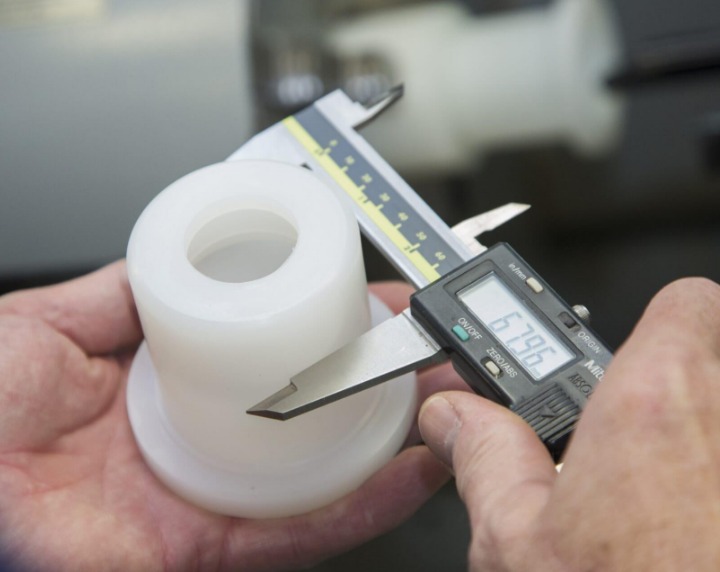
- Valve spool bore tolerance: ±0.01 mm, achieved with precision CNC turning
- Chlorine-free cutting fluids to prevent material contamination
Outcome: The component passed ISO 13485 medical certification. Annual production capacity reached 5 million units, demonstrating polycarbonate’s reliability in medical applications.
Automotive Parts: Durability Under Stress
Case study: An electric vehicle manufacturer uses polycarbonate sheets for battery pack observation windows. CNC cutting and edge chamfering produce the final parts.
Design considerations:
- Temperature range: -40°C to 85°C, requiring high-temperature modified PC
- UV-resistant coating applied to extend outdoor service life
- Countersunk mounting holes to avoid stress concentration during assembly
How Do You Finish and Treat Polycarbonate Parts?
Post-Processing Technologies
Post-processing enhances both performance and appearance. Here are the most common and effective methods.
| Process | Purpose | Key Parameters | Best For |
|---|---|---|---|
| Polishing | Improves surface finish | Wool wheel + polishing paste (W5-W10 grit); 1500–2000 rpm | Transparent parts, visible surfaces |
| Coating | Scratch and UV resistance | PU coating, 20–50 μm thickness; cure at 60°C for 30 min | Outdoor components |
| Bonding/Assembly | Joining parts | UV-cure adhesive (3–5 seconds); avoid acetone-based solvents | Precision assemblies |
Practical Tips for Post-Processing
- Avoid excessive pressure during polishing. Heat buildup can cause material yellowing.
- Clean oil residue thoroughly before coating. Contamination leads to peeling.
- Recommended sequence: Deburr → Clean → Dry → Polish → Coat → Assemble
Experience lesson: A lighting company processing polycarbonate lamp shades applied coating immediately after polishing without adequate drying. The result: pinholes in the coating. Adding a 120°C drying step for 1 hour before coating solved the problem completely.
What Problems Occur and How Do You Solve Them?
Cracking During Machining
Causes: Undried material, excessive cutting force, dull tool edges.
Solutions:
- Dry material before machining: 80°C for 4 hours, moisture content below 0.1%
- Reduce feed rate by 30% and use layered cutting
- Replace or sharpen tools to ensure sharp cutting edges
Deformation Control
Causes: High cutting temperature, excessive clamping force, poor part design.
Solutions:
- Use air cooling with intermittent cutting—avoid continuous passes
- Use vacuum chucks or soft jaws to reduce clamping stress
- Add stiffening ribs during design; avoid large thin-wall areas
Machining Accuracy Improvement
Key measures:
- Warm up the machine for 10 minutes before cutting to stabilize thermal expansion
- Pause for 30 minutes before finishing passes to let machine and part temperatures stabilize
- Use CNC equipment with closed-loop control systems and repeat positioning accuracy within ±0.005 mm
What Surface Finishes Can You Achieve?
| Requirement | Recommended Process | Expected Result |
|---|---|---|
| Basic functional surface | Finish milling with sharp tools | Ra 0.8–1.6 μm |
| Smooth appearance | Fine milling + light polishing | Ra 0.4–0.8 μm |
| Optical clarity | Diamond turning + polishing | Ra < 0.1 μm, transparent |
| Scratch resistance | PU coating after finishing | Pencil hardness 2H |
Yigu Technology’s Perspective
At Yigu Technology, we believe the core of CNC machining polycarbonate lies in matching material properties with precise process parameters. With demand for precision components growing across 3C electronics, automotive, and medical industries, polycarbonate’s combination of strength, heat resistance, and machinability makes it increasingly valuable.
Our recommendation: Consider modified PC materials such as glass-filled or flame-retardant grades for specialized applications. Combine these with automated CNC equipment to improve efficiency. Pay equal attention to post-processing—coating, bonding, and finishing can significantly expand application possibilities.
Recent example: We worked with a medical device client requiring polycarbonate components with ±0.01 mm tolerances and optical clarity. Using precision CNC turning with diamond tools and a controlled drying process, we achieved 99.2% yield across 50,000 units. The client reduced assembly time by 25% due to consistent part quality.
Deep knowledge of material behavior, careful process control, and appropriate post-processing—these three elements unlock polycarbonate’s full potential in precision machining.
Conclusion
CNC machining polycarbonate delivers precision and efficiency when you understand the material and control the process. Start with proper material drying—80°C for 4 hours is non-negotiable. Set cutting parameters for high speed and low load, using carbide tools with sharp edges. Cool with air to avoid heat buildup and material softening.
Common problems like cracking, deformation, and accuracy loss have known solutions: reduce cutting forces, manage clamping stress, and stabilize machine temperature. Post-processing—polishing, coating, bonding—adds value when done in the right sequence.
Polycarbonate’s versatility makes it suitable for electronics enclosures, medical devices, automotive components, and more. With the right approach, you can achieve tolerances of ±0.01 mm and surface finishes as smooth as Ra 0.4 μm or better.
FAQ
Which is better for CNC machining: polycarbonate or acrylic?
Polycarbonate is generally the better choice. Its impact resistance is 10 times higher than acrylic, making it less prone to cracking during machining. Polycarbonate also offers better heat resistance, which is critical for precision parts that may experience temperature variations.
When CNC machining PC materials, is cutting fluid necessary?
For roughing, a small amount of oil-based cutting fluid can be used. Avoid water-soluble fluids to prevent moisture absorption. For finishing, air cooling only is recommended to prevent fluid residue from affecting surface accuracy and optical clarity.
How can you tell if PC material is properly dried?
Check by weight: moisture content should be ≤0.1% after drying. Alternatively, observe during machining—bubbles, silver streaks, or surface imperfections indicate insufficient drying. The standard process is 80°C for 4 hours.
How accurate can polycarbonate parts be machined?
With precision CNC equipment and optimized processes, dimensional tolerances can be controlled to ±0.01 mm. Surface roughness can reach Ra ≤ 0.4 μm. For optical applications, diamond turning and polishing can achieve even finer results.
How much can scratch-resistant coating improve PC surface hardness?
PU coating increases surface hardness from HB to 2H (pencil hardness test). This provides effective resistance against daily scratches and light abrasion, significantly extending the service life of visible components.
Contact Yigu Technology for Custom Manufacturing
Ready to produce precision polycarbonate components with confidence? Yigu Technology combines deep material expertise with advanced CNC machining capabilities to deliver consistent, high-quality results.
- Machining: CNC milling (3, 4, 5-axis), CNC turning, precision drilling
- Materials: Polycarbonate (standard, glass-filled, flame-retardant, UV-stabilized), acrylic, ABS, PEEK
- Post-processing: Polishing, coating, bonding, assembly
- Quality: ISO 9001 certified; medical-grade processing available
- Volumes: Prototyping to high-volume production
Contact our engineering team to discuss your polycarbonate machining project. We will provide material recommendations, DFM feedback, and a process plan optimized for precision and efficiency. Let us help you turn polycarbonate’s potential into reliable, high-performance components.