Introduction
Walk through any modern factory floor today, and you'll notice something changing. Alongside the massive injection molding machines and rows of CNC mills, you'll likely spot a 3D printer quietly building parts. Not prototypes anymore—actual production parts that go into cars, planes, medical devices, and industrial equipment. The question isn't whether 3D printing belongs in manufacturing anymore. It's how far this technology will go.
At Yigu technology, we've spent years helping clients integrate 3D printed industrial parts into their production lines. We've seen the skepticism fade as results speak for themselves: lighter parts, faster turnaround, lower costs for small volumes, and designs that simply couldn't be made any other way. But we've also seen the limitations and learned where this technology truly shines.
In this article, we'll explore what 3D printed industrial parts really are, where they're making the biggest impact, and whether they're ready to take over from traditional manufacturing. We'll look at real applications, hard data, and practical considerations that matter when you're making parts that need to perform.
Part 1: What Exactly Are 3D Printed Industrial Parts?
How Do They Differ from Traditional Manufacturing?
The fundamental difference comes down to how material is handled. Traditional manufacturing is mostly subtractive—you start with a block of material and cut away everything that isn't the part. Think of a sculptor carving marble. The waste pile is often bigger than the final statue.
Additive manufacturing flips this completely. You start with nothing and build only the material you need, layer by layer. A digital model guides the process, whether you're printing in plastic, metal, or composite. The waste is minimal—often just support structures that get removed afterward.
Here's a quick comparison:
| Aspect | Traditional Manufacturing | 3D Printed Industrial Parts |
|---|---|---|
| Process | Remove material from larger block | Add material layer by layer |
| Design Freedom | Limited by tool access | Almost unlimited geometry |
| Setup Cost | High (tooling, molds) | Low to none |
| Lead Time | Weeks to months | Days to weeks |
| Material Waste | Up to 90% for some parts | 5–10% typical |
| Volume Economics | Better at high volumes | Better at low to medium volumes |
What Materials Can You Actually Print?
The material palette for industrial 3D printing has exploded in recent years. You're no longer limited to brittle plastics. Today's industrial printers handle:
Engineering Plastics:
- ABS - Good strength, heat resistance, used in automotive interiors
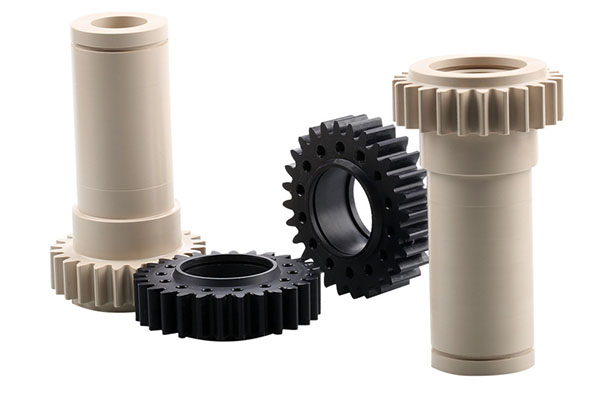
- Nylon - Tough, wear-resistant, great for gears and moving parts
- Polycarbonate - Extremely strong, impact-resistant
- PEKK/PEEK - High-performance, heat-resistant, aerospace-grade
Metals:
- Titanium - High strength-to-weight, biocompatible, aerospace and medical
- Stainless Steel - Corrosion-resistant, general industrial use
- Aluminum - Lightweight, good thermal properties
- Inconel - Superalloy for extreme heat, turbine components
Composites and Specialties:
- Carbon fiber-reinforced nylon - Lightweight, extremely stiff
- Ceramics - High-temperature, wear-resistant applications
- Bio-compatible materials - Medical implants, surgical guides
A medical device company we worked with needed titanium spinal implants that matched each patient's anatomy. Traditional machining would take weeks and cost thousands per implant. 3D printing produced patient-specific implants in days at half the cost, with porous surface structures that promoted bone growth.
Part 2: Why Are Industries Switching to 3D Printed Parts?
What's Driving the Adoption?
Several factors are pushing manufacturers toward additive manufacturing, but three stand out as game-changers:
Design Freedom That Changes Everything
Traditional manufacturing has rules. Draft angles for molds. Tool access for machining. Minimum radii for cutters. Break those rules, and your part becomes impossible or prohibitively expensive to make.
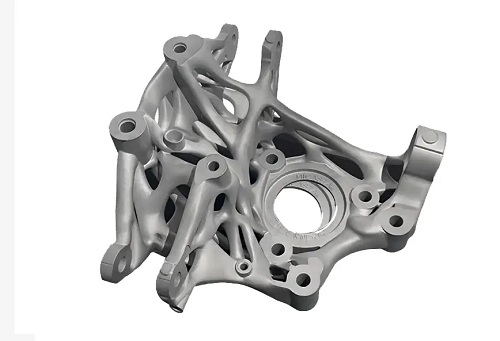
3D printing has different rules. Want internal cooling channels that follow complex curves? Easy. Need lattice structures that save weight without sacrificing strength? Done. Designing a bracket that combines five separate parts into one? No problem.
Aerospace engineers have embraced this freedom. A study by Wohlers Associates found that 3D printed parts have enabled weight reductions of up to 50% in some aircraft components. Lighter planes burn less fuel. One commercial aircraft manufacturer saved an estimated $3 million per year in fuel costs just by redesigning a single bracket family for additive manufacturing.
Speed That Transforms Development Cycles
Time is money in manufacturing. Waiting weeks for tooling means delayed products and lost revenue. 3D printing compresses timelines dramatically.
According to a Deloitte report, 3D printing has reduced prototyping time in automotive by up to 80%. What once took three months now takes three weeks. Design iterations that required new tooling now just need a new file and a print button.
A racing team we work with illustrates this perfectly. During race season, they're constantly tweaking aerodynamic components. With traditional methods, each new wing design would take two weeks and cost $5,000 in tooling. Now they design, print, test, and revise in a 48-hour cycle. They've won three championships partly because they can out-iterate competitors.
Cost Efficiency for Low Volumes
Tooling for injection molding costs $10,000 to $100,000 or more. That investment only makes sense if you're making thousands or millions of parts. For runs under a few hundred units, tooling cost per part becomes astronomical.
3D printing has no tooling cost. The first part costs about the same as the hundredth. This changes the economics of:
- Spare parts - No need to inventory parts that might never sell
- Custom products - Each one can be unique at no extra cost
- Prototypes - Test before committing to tooling
- Legacy parts - Print replacements for discontinued products
A construction equipment manufacturer came to us with a problem. They needed replacement hydraulic fittings for machines built in the 1980s. The original tooling was long gone, and minimum order quantities from suppliers were 500 units. They needed 12. We printed them in stainless steel for less than the supplier wanted for tooling setup alone.
Where Are the Biggest Success Stories?
Aerospace: Pushing the Limits
The aerospace industry has embraced 3D printed parts more aggressively than almost any other sector. The reasons are clear: weight savings matter enormously, performance requirements are extreme, and production volumes are often low enough that tooling costs don't make sense.
NASA has been a pioneer. Their 3D-printed rocket engine injectors reduced part counts from hundreds to just a few. Fewer parts mean fewer potential failure points, simpler assembly, and reduced inspection requirements. One injector that traditionally required 163 individually machined parts now prints as a single component.
GE Aviation's LEAP engine fuel nozzles are perhaps the most famous success story. Each engine uses 19 nozzles, and each nozzle was traditionally assembled from 20 separate components brazed together. The 3D-printed version is a single piece, 25% lighter, and five times more durable. GE has now printed over 100,000 of them.
Automotive: From Prototypes to Production
Automotive has used 3D printing for prototyping for decades. What's new is the shift to production parts.
BMW now produces over a million 3D-printed parts annually across their vehicle lines. These aren't just trim pieces—they include fixtures for assembly lines, custom tools for technicians, and even metal components in the new Rolls-Royce models.
Ford uses 3D printing for brake parts, suspension components, and even intake manifolds in low-volume specialty vehicles. The ability to test designs quickly and produce small runs economically lets them offer more variants without massive inventory costs.
A sports car manufacturer we consulted for needed custom intake manifolds for a limited edition model. Traditional casting would require $50,000 in tooling and 12 weeks lead time. They planned to build 25 cars. We printed the manifolds in carbon fiber-reinforced nylon in two weeks at a total cost less than the tooling alone.
Medical: Personalized Perfection
Medical applications might be where 3D printing has the most profound impact. Every patient is different, and one-size-fits-all solutions are rarely optimal.
Custom implants are now routine. Hip replacements, cranial plates, spinal cages—all can be printed to match patient anatomy exactly. A study in the Journal of Prosthetics and Orthotics found 90% patient satisfaction with 3D-printed prosthetics, largely due to the custom fit.
Surgical planning has been transformed by 3D-printed anatomical models. Surgeons at a children's hospital we work with print hearts before complex congenital surgeries. They practice on exact replicas, reducing operating time and improving outcomes. For one newborn with a rare defect, the printed model let the surgical team plan an approach that saved hours on the table.
Surgical guides ensure precision. Tumor resections, dental implants, orthopedic procedures—all benefit from guides that fit the patient's unique anatomy and direct the surgeon's tools exactly where they need to go.
Part 3: What Are the Limitations and Challenges?
Can 3D Printed Parts Match Traditional Quality?
This is the question we hear most often. The short answer: increasingly, yes. But there are nuances.
Mechanical properties of 3D-printed parts have improved dramatically. Modern metal printing can achieve 95-99% density, approaching wrought material properties. Heat treatment and hot isostatic pressing can close remaining porosity and match or exceed cast properties.
However, anisotropy remains a factor. Parts are strongest in the XY plane (along layers) and weaker in Z (between layers). Smart designers orient parts to put stress across layers, not between them. For critical applications, testing in the actual orientation matters.
Surface finish is another consideration. As-printed metal parts have a characteristic rough surface from partially fused powder. For many applications, this is fine. For others, post-processing like machining, polishing, or coating achieves the required finish.
Dimensional accuracy depends on the technology. Industrial metal printers hold ±0.1mm or better on most features. For comparison, precision machining holds ±0.025mm. The difference matters for some applications and not for others.
What About Production Volume?
This is the honest limitation: 3D printing is not competing with injection molding for million-part runs. A typical metal printer builds parts measured in hours, not seconds. Throughput is inherently lower than mass production methods.
But the economics shift as volumes decrease. Here's a rough guide:
| Volume Range | Best Approach |
|---|---|
| 1–100 parts | 3D printing almost always wins |
| 100–1,000 parts | Depends on complexity and material |
| 1,000–10,000 parts | Hybrid approaches may work |
| 10,000+ parts | Traditional methods usually better |
The crossover point varies. Complex geometries that require multiple machining setups favor 3D printing longer. Simple geometries with easy tooling favor traditional methods sooner.
A client making aerospace brackets found that 3D printing was cost-effective up to 500 units. Beyond that, machining from billet became cheaper. But when they redesigned the bracket to consolidate five parts into one, the crossover point shifted to 2,000 units.
What About Certification and Standards?
Industries like aerospace and medical have strict certification requirements. Parts must be traceable, processes must be validated, and properties must be predictable.
This has been a hurdle for 3D printing adoption. But standards are catching up. ASTM and ISO have published standards for additive manufacturing processes, materials, and testing. The FDA has cleared hundreds of 3D-printed medical devices. The FAA certifies 3D-printed aircraft parts.
The key is process control. Consistent powder, calibrated machines, monitored builds, and documented procedures make certification possible. It requires discipline, but it's being done every day.
Part 4: How Do You Get Started with 3D Printed Industrial Parts?
What Questions Should You Ask First?
Before investing in equipment or sending files to a service bureau, work through these questions:
1. Is your part geometry suitable?
The best candidates have complexity that adds value. Internal features, organic shapes, lattice structures, or consolidation opportunities make 3D printing compelling. Simple blocks are better machined.
2. What are your volume requirements?
Be honest about how many parts you need now and might need in the future. Low volumes favor printing. High volumes may favor traditional methods.
3. What material properties do you need?
Strength, temperature resistance, chemical compatibility, biocompatibility—all influence which technology and material to choose.
4. What's your timeline?
If you need parts next week, 3D printing might be the only option. If you have six months, traditional methods might work.
5. What's your budget for setup?
Zero tooling cost is attractive, but per-part cost might be higher. Run the numbers both ways.
Should You Buy or Outsource?
This is a strategic decision. Here are factors to consider:
Buy your own printer if:
- You have consistent, ongoing demand
- You need quick turnaround regularly
- You have the expertise in-house
- You can justify the equipment investment
- You want design iteration to be seamless
Outsource to a service like Yigu technology if:
- Your needs are occasional or unpredictable
- You want access to multiple technologies
- You don't want to manage maintenance and training
- You need certification and quality documentation
- You want expert input on design optimization
Most companies start with outsourcing, learn what works, and then evaluate whether bringing capability in-house makes sense.
How Do You Design for Additive Manufacturing?
Designing for 3D printing is different from designing for machining or molding. Some key principles:
Orient for strength - Consider load directions and orient parts to put stress across layers, not between them.
Design for self-supporting - Angles over 45 degrees typically need supports. Design to minimize or eliminate supports where possible.
Consolidate assemblies - Can multiple parts become one? Eliminate fasteners and joints.
Use lattices wisely - Internal lattice structures save weight and material. But they add complexity and may be unnecessary in solid regions.
Consider powder removal - For metal printing, you need escape paths for unsintered powder.
Account for post-processing - Leave stock for machining if critical surfaces need tight tolerances.
Part 5: What's Yigu Technology's Perspective?
At Yigu technology, we've watched the evolution of 3D printed industrial parts from niche experiments to mainstream production. We've helped clients in aerospace, automotive, medical, and industrial equipment navigate this transition.
What excites us most isn't the technology itself—it's what it enables. A client who couldn't find replacement parts for legacy equipment now prints them on demand. A medical device company creates implants that match each patient perfectly. A racing team iterates designs faster than competitors can even source materials.
We see challenges too. The industry needs more skilled operators. Standards need to mature. Costs need to come down for wider adoption. But the trajectory is clear: additive manufacturing will claim an increasing share of industrial production.
For companies considering this technology, our advice is simple: start. Find a part that's a good candidate—complex, low-volume, or custom—and try it. Learn the design rules. Understand the economics. Build experience on small projects before tackling critical applications.
We're eager to help clients through this journey. Our expertise in non-standard plastic and metal products gives us unique insight into where 3D printing adds value and where traditional methods still win. We don't push the technology where it doesn't belong. But where it fits, the results speak for themselves.
Conclusion
Are 3D printed industrial parts the future of manufacturing? Yes and no. They won't replace mass production for simple parts at high volumes. Injection molding and stamping will still make billions of parts efficiently. But for the growing slice of manufacturing that involves complexity, customization, low volumes, or rapid iteration, 3D printing is already the present, not just the future.
The technology has matured enough to deliver production-quality parts in engineering materials. Standards exist. Success stories multiply. Costs continue to decline. Companies that ignore additive manufacturing risk being left behind as competitors leverage its advantages.
The question isn't whether to adopt 3D printing. It's where, when, and how to integrate it into your manufacturing strategy. For the right applications, the benefits are too significant to ignore.
FAQ
Q1: What are the most common materials for 3D printed industrial parts?
The most common engineering plastics include nylon (tough, wear-resistant), ABS (good balance of properties), and polycarbonate (high strength). For metals, stainless steel (corrosion-resistant, general purpose), titanium (high strength-to-weight, biocompatible), and aluminum (lightweight, good thermal properties) lead the way. Specialty materials like PEEK (high-temperature) and Inconel (extreme environments) serve specific applications.
Q2: How accurate are 3D printed industrial parts?
Industrial-grade printers achieve ±0.1mm to ±0.2mm accuracy for most features. High-end metal printers can reach ±0.05mm on critical dimensions. For comparison, precision machining achieves ±0.025mm. The difference matters for some applications but is acceptable for many. Post-processing can improve accuracy where needed.
Q3: Can 3D printed industrial parts meet high-volume production requirements?
For volumes under about 1,000 units, 3D printing is often cost-effective. For higher volumes, traditional methods like injection molding usually win on per-part cost and speed. However, as technology improves and speeds increase, the crossover point continues to shift. For now, 3D printing excels at low-to-medium volumes, custom parts, and applications where design complexity adds value.
Q4: Are 3D printed parts strong enough for structural applications?
Yes, when properly designed and printed. Metal parts can achieve 95-99% density and mechanical properties approaching wrought materials. The key considerations are orientation (parts are strongest in the XY plane) and post-processing (heat treatment improves properties). Many aerospace, automotive, and medical applications now use 3D-printed structural parts in production.
Q5: How do I get started with 3D printed industrial parts?
Start by identifying a candidate part that's complex, low-volume, or currently problematic with traditional methods. Work with an experienced service bureau like Yigu technology to optimize the design for additive manufacturing. Learn from that experience. Evaluate whether the results justify further investment. Scale gradually as you build knowledge and confidence.
Contact Yigu Technology for Custom Manufacturing
Ready to explore how 3D printed industrial parts can improve your products and processes? At Yigu technology, we combine deep engineering expertise with production-grade additive manufacturing capabilities. We've helped clients across industries navigate the transition from traditional to digital manufacturing.
We don't just print parts. We help you optimize designs for manufacturability, select the right materials for your application, and scale from prototypes to production seamlessly. Whether you need one custom implant or a thousand aerospace brackets, we deliver quality, consistency, and performance.
Contact Yigu technology today for a free consultation. Let's discuss your project, explore possibilities, and build something extraordinary together. Visit our website, call our engineering team, or email us to start the conversation. The future of manufacturing is additive—and it starts now.