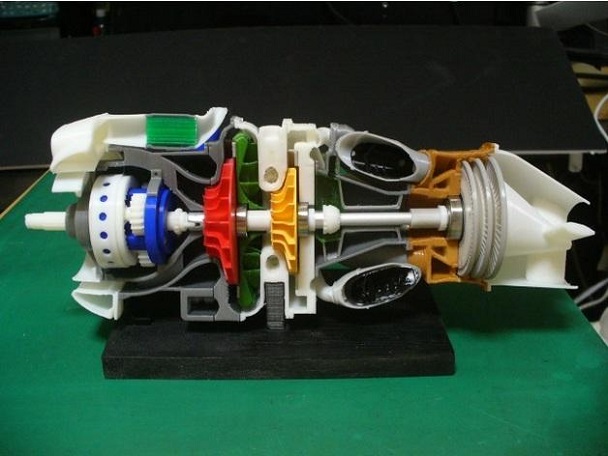
Engines are the heart of machines. They endure extreme heat, crushing pressure, and constant vibration. For over a century, engine parts have been made the same way: casting, forging, and machining. These methods work, but they limit design and waste material. Now, 3D printing offers a different path. It builds parts layer by layer, enabling internal cooling channels, complex geometries, and weight savings that traditional methods cannot achieve. This guide explores how 3D printing is being used for engine components, where it delivers value, and whether it can truly replace conventional manufacturing for these critical parts.
What Makes Engine Parts So Challenging to Manufacture?
Engine components face some of the most demanding conditions in manufacturing.
Extreme Environments
- High temperatures: Combustion chambers exceed 1,000°C. Turbine blades face continuous temperatures above 1,500°C.
- High pressures: Cylinder pressures in diesel engines can reach 200 bar or more.
- Cyclic stress: Parts undergo millions of stress cycles, requiring exceptional fatigue resistance.
Complex Geometries
Modern engines demand complex internal features—cooling channels, lattice structures, and optimized flow paths. These improve efficiency but are difficult or impossible to machine.
Material Requirements
Engine parts use high-performance alloys like titanium, Inconel, and cobalt-chrome. These materials are expensive and difficult to process with traditional methods.
How Does 3D Printing Address These Challenges?
Additive manufacturing changes the rules. Instead of starting with a block and cutting away material, it builds parts precisely where needed.
Internal Cooling Channels
Machined parts have straight cooling channels. 3D printed parts have conformal cooling channels—curved paths that follow the shape of the part. These cool more evenly, reducing thermal stress and improving component life.
Weight Reduction
Lattice structures replace solid material where strength is not required. Weight reductions of 30–50% are common without compromising structural integrity.
Part Consolidation
Assemblies of multiple machined parts can become single printed components. This eliminates fasteners, reduces assembly time, and removes potential failure points.
Material Efficiency
Traditional machining can waste 80–90% of raw material. 3D printing wastes 5–15%. For expensive alloys like titanium or Inconel, this difference is significant.
What Engine Parts Are Being 3D Printed Today?
Several components have moved from research to production. Each demonstrates different advantages.
Fuel Nozzles
Fuel nozzles require precise internal geometry to atomize fuel efficiently. General Electric prints fuel nozzles for its LEAP engines. Each engine contains 19 3D printed nozzles made from cobalt-chromium alloy.
Results:
- 25% lighter than machined counterparts
- Five times more durable
- 15% improvement in fuel efficiency for the LEAP engine
Turbine Blades
Turbine blades operate at temperatures exceeding 1,500°C. Internal cooling channels are essential. Siemens prints turbine blades with complex cooling geometries that improve heat dissipation and efficiency.
Pistons
3D printed pistons can integrate cooling ducts that would be impossible to machine. Weight reduction improves engine response and efficiency.
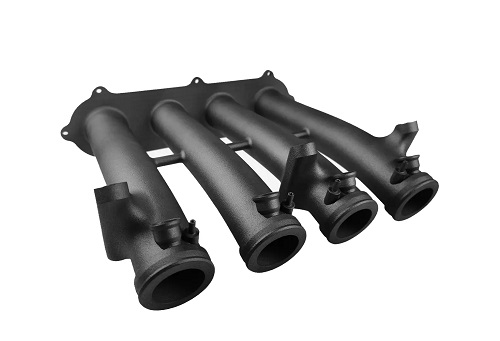
Intake Manifolds
Custom intake manifolds for high-performance engines optimize air-fuel mixture delivery. 3D printing enables rapid iteration for different engine tuning requirements.
Engine Brackets and Housings
Lattice structures reduce weight while maintaining strength. A printed bracket can be 40% lighter than a machined equivalent.
| Component | Key Benefit | Example Result |
|---|---|---|
| Fuel Nozzle | Complex internal geometry | 25% lighter, 5x more durable |
| Turbine Blade | Conformal cooling channels | Improved efficiency, longer life |
| Piston | Integrated cooling ducts | Weight reduction, better thermal management |
| Intake Manifold | Optimized flow paths | Increased power output |
| Bracket/Housing | Lattice structures | 30–50% weight reduction |
Real example: A Formula One team needed a custom intake manifold for a limited engine run. Traditional machining would take 8 weeks and cost $25,000. 3D printing delivered the manifold in 10 days for $6,000—with internal flow optimization that machining could not achieve.
What Technologies Are Used for Engine Parts?
Not all 3D printing technologies suit engine components. High-performance parts require specific processes.
Direct Metal Laser Sintering (DMLS) / Selective Laser Melting (SLM)
These are the dominant technologies for metal engine parts. A laser fully melts metal powder layer by layer, creating fully dense parts with properties comparable to wrought material.
Materials: Titanium (Ti6Al4V), Inconel 718, Inconel 625, stainless steel 316L, cobalt-chrome, aluminum (AlSi10Mg)
Best for: Fuel nozzles, turbine blades, structural components
Electron Beam Melting (EBM)
EBM uses an electron beam instead of a laser, operating in a vacuum. It produces parts with lower residual stress, suitable for large titanium components.
Best for: Aerospace structural parts, titanium components
Binder Jetting
Binder jetting prints metal parts by depositing a binder into powder layers. Parts require sintering afterward. It is faster than laser-based methods but produces parts with lower density.
Best for: Prototypes, lower-stress components
What Are the Benefits Over Traditional Manufacturing?
The advantages go beyond just making parts differently. They change how engines are designed and produced.
Design Freedom
Traditional manufacturing restricts designs to what tools can reach. 3D printing removes these constraints. Engineers can design for performance, not manufacturability.
Faster Iteration
A new engine component can go from CAD to test in days instead of months. This accelerates development cycles and allows more design iterations.
Reduced Part Count
Complex assemblies consolidate into single parts. A fuel nozzle that was once assembled from 20 individual components can print as one piece. Fewer parts mean fewer suppliers, less assembly time, and fewer failure points.
On-Demand Production
Spare parts can be printed when needed, not stocked for years. An engine manufacturer reduced spare parts inventory by 40% by switching to digital inventory and on-demand printing.
Weight Reduction
Every gram saved in an engine improves efficiency. In aerospace, weight reduction directly reduces fuel consumption. In automotive, it improves performance and handling.
Data point: A study by the University of Nottingham found that 3D printed engine components achieved 20–35% weight reduction compared to conventionally manufactured equivalents while maintaining or exceeding mechanical properties.
What Are the Limitations and Challenges?
3D printing is powerful, but it is not a universal replacement. Several challenges remain.
Production Speed
For high-volume production, traditional methods like casting and forging are faster. A printed part may take 12–72 hours. A cast part takes minutes once the tooling is made.
Material Certification
In aerospace and automotive, materials must meet strict standards. Certifying new materials and processes takes time and resources. Each new alloy or printer requires validation.
Post-Processing Requirements
Printed metal parts almost always require:
- Support removal (for laser-based methods)
- Heat treatment to relieve stress and achieve desired properties
- Hot isostatic pressing (HIP) for critical parts to eliminate internal porosity
- Machining of critical surfaces to achieve final tolerances
These steps add time and cost.
Equipment Investment
Industrial metal printers cost $200,000 to $1.5 million. This limits adoption to well-funded organizations or service bureaus.
Build Size Limitations
Most metal printers have build volumes under 500 x 500 x 500 mm. Large engine components like cylinder blocks or crankcases are not yet printable at scale.
How Do Cost and Volume Compare?
The economics of 3D printing vs. traditional manufacturing depend on volume.
| Volume | Traditional Manufacturing | 3D Printing |
|---|---|---|
| 1–50 units | High tooling cost amortized over few parts | No tooling; cost-effective |
| 50–500 units | Moderate | Competitive for complex parts |
| 500–5,000 units | Lower per-unit cost | Higher per-unit cost |
| 5,000+ units | Most cost-effective | Rarely competitive |
For complex parts where tooling would be expensive, the break-even point shifts higher. For simple parts, traditional methods win at lower volumes.
Real example: A manufacturer needed 300 titanium brackets for a limited-run aircraft. Traditional investment casting tooling cost $80,000. 3D printing at $400 per part cost $120,000 total—$40,000 more. But the printed parts were 30% lighter, and the design was optimized for performance rather than casting constraints.
What Does the Future Hold?
3D printing for engine parts is still evolving. Several trends will shape its adoption.
Multi-Laser Systems
Printers now use 4–12 lasers operating simultaneously, dramatically increasing build speed. What took 24 hours now takes 4–6 hours.
Larger Build Volumes
New machines reach 800 x 800 x 1,000 mm and larger, enabling bigger components and higher throughput.
In-Process Monitoring
Sensors and AI detect defects during printing, reducing scrap and enabling certification of critical parts.
New Alloys
Material development continues. High-temperature alloys, refractory metals, and aluminum-ceramic composites expand printable options.
Hybrid Manufacturing
Combining 3D printing with CNC machining in one machine. Print near-net shape, then machine critical surfaces to final tolerance. This combines the best of both worlds.
Yigu Technology’s Perspective
As a custom manufacturer, Yigu Technology sees 3D printing as a complement to traditional methods, not a replacement. We use metal 3D printing for:
- Complex prototypes: Validating designs before tooling
- Low-volume production: 10–500 units where tooling is cost-prohibitive
- Performance-critical parts: Weight reduction and internal features
- Spare parts: Digital inventory for discontinued components
For high-volume production, we transition clients to investment casting, forging, or CNC machining. The goal is always to match the technology to the volume, complexity, and performance requirements.
In our experience, the most successful engine part projects start with 3D printing for development and early production. As volumes grow, we help clients scale to traditional methods. This hybrid approach minimizes risk and capital investment.
Conclusion
3D printing is revolutionizing engine parts manufacturing—but not by replacing all traditional methods. It adds new capabilities: complex internal geometries, significant weight reduction, part consolidation, and rapid iteration. These advantages make it invaluable for low-volume, high-performance applications like aerospace engines, racing engines, and specialized industrial equipment.
For high-volume production, traditional methods remain more cost-effective. The future lies in hybrid manufacturing: using 3D printing where it adds value and traditional methods where they excel. Together, they deliver better engines than either could alone.
FAQ
What types of engine parts can be 3D printed?
Common parts include fuel nozzles, turbine blades, pistons, intake manifolds, brackets, and housings. Fuel nozzles benefit from complex internal channels. Turbine blades gain conformal cooling. Pistons integrate cooling ducts. Brackets achieve weight reduction through lattice structures.
How does the cost of 3D printed engine parts compare to traditional manufacturing?
For small batches (1–500 units), 3D printing often costs less due to zero tooling. For high-volume production (thousands of units), traditional methods like casting and forging have lower per-unit costs. Complex parts shift the break-even point to higher volumes.
What materials are used for 3D printed engine parts?
Common materials include titanium (Ti6Al4V), Inconel 718 and 625, stainless steel 316L, cobalt-chrome, and aluminum (AlSi10Mg). These alloys offer high strength, heat resistance, and fatigue performance required for engine applications.
What are the quality standards for 3D printed engine parts?
Quality standards include material performance (tensile strength, fatigue resistance, hardness) and dimensional accuracy (typically ±0.1–0.2 mm for metal prints). Certification follows industry standards like AS9100 for aerospace or ISO 13485 for medical. Post-processing includes heat treatment, hot isostatic pressing (HIP), and machining of critical surfaces.
Can 3D printed engine parts be used in production aircraft?
Yes. General Electric produces 3D printed fuel nozzles for its LEAP engines, which power Airbus A320neo and Boeing 737 MAX aircraft. Other manufacturers use printed components in production engines. All parts undergo rigorous certification before flight approval.
Contact Yigu Technology for Custom Manufacturing
Yigu Technology specializes in non-standard plastic and metal custom manufacturing, including 3D printed engine components. Whether you need prototype parts, low-volume production, or help transitioning to high-volume manufacturing, our engineering team delivers precision and performance. Contact us today to discuss your next engine component project.