Introduction
PMMA injection molding—using polymethyl methacrylate, better known as acrylic—promises crystal-clear parts with light transmission up to 93%. Yet achieving that flawless finish feels like chasing a mirage for many manufacturers. A single speck of moisture creates haze. A slightly off temperature turns clear parts yellow. Even the mold’s surface can leave visible scratches on the final product.
This guide addresses those exact pain points. Drawing from real production experience, we’ll walk through PMMA’s unique properties, the precise process controls required, and practical solutions to common defects. Whether you’re molding lenses, display covers, or automotive lighting, you’ll leave with actionable insights to produce consistently clear, durable parts.
What Makes PMMA a Unique Material?
Optical Clarity That Rivals Glass
PMMA transmits 92–93% of visible light—actually higher than standard glass in some cases. This exceptional transparency makes it the go-to choice for applications where seeing through the part matters most. Think eyeglass lenses, smartphone display covers, and medical device windows.
Weather Resistance That Lasts Outdoors
Unlike many plastics that yellow under sunlight, PMMA resists UV damage exceptionally well. A polycarbonate part may show discoloration after a few years outdoors. A PMMA part stays clear. This weatherability makes it ideal for skylights, automotive exterior lenses, and outdoor signage that must maintain its appearance for years.
Thermal and Chemical Limitations
PMMA handles moderate heat well, with a glass transition temperature of 105°C. However, it softens above 80°C in continuous use. Chemically, it resists water and weak acids but can be damaged by alcohols and solvents—a crucial consideration for cleaning or assembly processes.
Why Does PMMA Injection Molding Require Precision?
The Moisture Problem
PMMA absorbs moisture from the air slowly but relentlessly. That trapped moisture turns to steam during injection. The result? Cloudiness, bubbles, and surface defects that destroy optical clarity.
Drying requirements are strict: 80–90°C for 2–4 hours, targeting moisture content below 0.02%. Skip this step, and no amount of post-processing will restore clarity.
The Temperature Balancing Act
Melt temperature must stay within a narrow window: 210–240°C. Drop below 210°C, and the material flows poorly, causing short shots or flow lines. Exceed 250°C, and degradation begins—yellowing or haze that ruins the part’s transparency.
One manufacturer producing automotive interior lenses learned this the hard way. A batch showed slight yellowing that passed initial inspection but failed under customer’s light-box testing. The cause? A faulty thermocouple reported 235°C when actual melt temperature hit 255°C.
Pressure and Speed: Finding the Sweet Spot
Injection pressure typically runs 80–120 MPa. Complex geometries need higher pressure to fill completely without voids. Injection speed should be moderate—40–60 mm/s—fast enough to prevent premature cooling but slow enough to avoid flow marks.
Too fast creates shear heating, which can degrade the material. Too slow leaves visible flow lines that appear as streaks in the final part.
How Should You Design a Mold for PMMA?
Surface Finish Is Everything
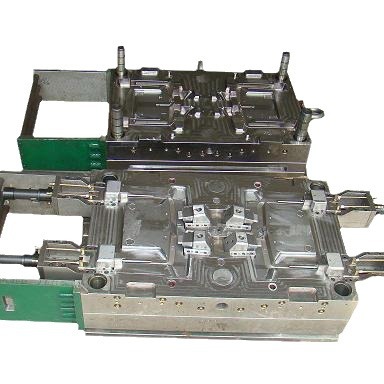
The mold surface transfers directly to the PMMA part. A scratched mold produces scratched parts. A dull polish creates hazy surfaces.
For optical-grade parts, P20 steel with diamond polish (Ra < 0.02 μm) is standard. This mirror-like finish replicates perfectly onto the molded part, giving that high-gloss, crystal-clear appearance customers expect.
Flow Analysis Prevents Hidden Defects
Mold flow analysis isn’t optional for PMMA—it’s essential. Air traps and weld lines appear as visible haze or streaks in the final part. Simulation software identifies these issues before steel is cut, saving significant rework costs.
A consumer electronics company once skipped flow analysis for a smartwatch display cover. The first mold produced parts with visible weld lines across the viewing area. The fix required redesigning gate locations and adding vents—adding weeks to the timeline and thousands in rework costs.
Cooling and Venting: The Details Matter
Cooling channel layout must be uniform, with channels placed 8–12 mm from the cavity. Uneven cooling causes warpage and internal stresses that show as optical distortion.
Vents—tiny channels 0.01–0.02 mm deep—at flow ends allow trapped air to escape. Without them, air bubbles become visible voids in the final part.
| Mold Feature | Requirement | Why It Matters |
|---|---|---|
| Surface finish | Ra < 0.02 μm, diamond polish | Transfers clarity to part |
| Cooling channels | 8–12 mm from cavity | Prevents warpage |
| Vent depth | 0.01–0.02 mm | Eliminates air bubbles |
| Draft angle | 0.5–1° per side | Protects surface during ejection |
| Ejector design | Large flat pins or stripper plates | Avoids visible marks |
What Defects Occur in PMMA Molding and How Do You Fix Them?
PMMA’s transparency makes every flaw visible. Here are the most common issues and their solutions:
Cloudiness or Haze
Cause: Moisture in the material or melt temperature too high.
Solution: Verify drying process (80–90°C for 2–4 hours). Check that moisture content stays below 0.02%. Lower melt temperature if degradation is suspected.
Flow Lines
Cause: Slow injection speed or uneven material flow.
Solution: Increase injection speed to 40–60 mm/s. Optimize gate location to ensure balanced filling.
Voids or Bubbles
Cause: Trapped air or insufficient packing pressure.
Solution: Add vents at flow ends. Increase hold pressure and duration to compact the material fully.
Warpage
Cause: Uneven cooling or residual internal stress.
Solution: Balance cooling channel temperatures. Consider annealing parts at 80–90°C for 1–2 hours to relieve stress.
Surface Scratches
Cause: Rough mold finish or rough handling during ejection.
Solution: Re-polish mold to mirror finish. Use cleanroom handling protocols for optical parts.
Yellowing
Cause: Melt temperature too high or prolonged residence time in barrel.
Solution: Reduce barrel temperature. Minimize cycle delays to prevent material degradation.
How Do You Inspect and Control Quality?
Visual and Optical Testing
LED light boxes reveal haze that might pass under standard lighting. Spectrophotometers measure light transmission, with clear parts targeting >90%.
For optical components like lenses, polariscopes check for birefringence—internal stress that distorts light passing through the part. Even slight stress makes a lens unusable for precision applications.
Statistical Process Control (SPC)
Monitor key variables continuously. Allowable deviations are tight:
- Melt temperature: ±5°C
- Injection pressure: ±10 MPa
- Cooling time: ±2 seconds
When these parameters drift, defects follow. SPC systems catch the drift before parts go out of spec.
Dimensional Accuracy
Coordinate measuring machines (CMMs) verify critical dimensions. For precision optical parts, tolerances often fall at ±0.03 mm. A part that measures correct but has internal stress can still fail—which is why stress testing matters as much as dimensional inspection.
Where Is PMMA Injection Molding Used?
Optical Components
Eyeglass lenses, camera viewfinders, and fiber optic connectors rely on PMMA’s clarity and low optical distortion. For these applications, even microscopic defects are unacceptable.
Lighting Fixtures
LED covers and light diffusers use PMMA for its ability to transmit light evenly. UV resistance ensures they stay clear, not yellowed, after years of exposure.
Automotive Lenses
Interior lighting lenses and instrument clusters need gloss retention and color stability. PMMA delivers both at a lower cost than glass.
Medical Devices
Diagnostic equipment covers and sample containers use PMMA for clarity and compatibility with ethylene oxide sterilization. The material’s dimensional stability ensures consistent fit for assemblies.
Consumer Electronics
Smartwatch displays, smartphone camera lenses, and AR/VR headset components use PMMA as a cost-effective alternative to glass. Hard coatings often enhance scratch resistance for these touch-intensive applications.
Design for Manufacturing Tips
- Wall thickness: Keep uniform at 2–4 mm to prevent sink marks
- Corners: Use rounded corners to reduce stress concentrations that cause haze
- Outdoor parts: Specify UV-stabilized grades for enhanced weatherability
What Post-Processing Options Improve PMMA Parts?
Surface Coatings
Hard coatings—silicone dioxide or acrylic-based—significantly boost scratch resistance. This is standard for eyewear and display covers that face daily handling.
Bonding and Assembly
Optically clear adhesives (OCA) bond lens assemblies without visible glue lines. For permanent assembly, ultrasonic welding creates strong joints without affecting clarity.
Stress Relief
Annealing at 80–90°C for 1–2 hours relieves residual stress. This reduces warpage over time and improves dimensional stability—critical for parts that must maintain alignment in assemblies.
Machining
When secondary operations are needed, use sharp carbide tools at low speeds to prevent chipping. Precision lenses often require final machining to meet tight tolerances.
Conclusion
PMMA injection molding delivers parts with unmatched optical clarity when done correctly. But success requires discipline at every stage—from drying material to designing molds with mirror finishes to controlling process parameters within narrow windows. Moisture must stay below 0.02%. Melt temperature must hold between 210–240°C. Mold surfaces must achieve Ra < 0.02 μm polish.
When these requirements are met, the results speak for themselves: crystal-clear parts that resist yellowing, maintain dimensional stability, and perform reliably across automotive, medical, and consumer electronics applications. When they aren’t, defects become visible to the naked eye.
Understanding these challenges—and the solutions that address them—separates manufacturers who consistently deliver quality from those who chase it batch by batch.
FAQ
What is the difference between PMMA and acrylic?
They are the same material. PMMA (polymethyl methacrylate) is the scientific name; acrylic is the common trade name. Both refer to the same transparent plastic known for optical clarity and UV resistance.
Can PMMA be used for outdoor applications?
Yes. PMMA offers excellent weatherability and UV resistance, making it suitable for outdoor signage, skylights, and automotive exterior lenses. Specify UV-stabilized grades for extended outdoor use.
How do you prevent haze in PMMA injection molding?
Haze typically comes from moisture or degradation. Dry material at 80–90°C for 2–4 hours to achieve below 0.02% moisture content. Maintain melt temperature between 210–240°C to prevent degradation. Use mold surfaces polished to Ra < 0.02 μm.
Is PMMA impact resistant?
PMMA has moderate impact resistance (2–4 kJ/m² notched Izod). It is less impact-resistant than polycarbonate but more shatter-resistant than glass, making it suitable for non-safety applications like display covers and lighting fixtures.
What is the maximum operating temperature for PMMA?
PMMA has a continuous use temperature of 80°C. Short-term exposure up to 100°C is possible, but prolonged heat above 80°C can cause warping or slight yellowing.
Contact Yigu Technology for Custom Manufacturing
At Yigu Technology, we specialize in precision PMMA injection molding. Our molds achieve mirror-finish surfaces with Ra < 0.02 μm. Our process controls maintain melt temperatures within ±5°C and moisture content below 0.02%. We’ve delivered thousands of optical-grade parts for automotive, medical, and consumer electronics clients who demand clarity and consistency. Whether you need prototypes or high-volume production, we bring the expertise to get your PMMA parts right—the first time. Contact us today to discuss your project.