Introduction
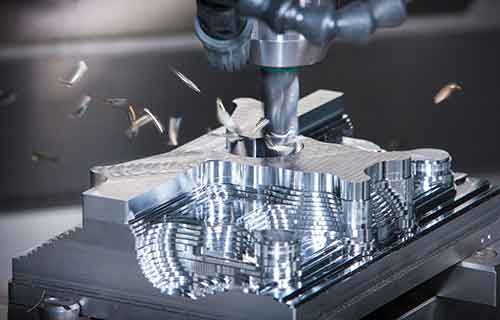
In modern manufacturing, the pursuit of enhanced efficiency, precision, and versatility is unceasing. One technology that has emerged as a game-changer is 4-axis machining. This advanced process represents a significant leap forward from traditional methods, offering capabilities that revolutionize how complex parts are produced. 4-axis machining uses CNC machines that move along four axes simultaneously. Standard three-axis machining operates along X, Y, and Z linear axes. Adding a rotational axis (A or B) enables continuous machining around a part’s circumference—creating intricate geometries previously unattainable. This guide explores the advantages of 4-axis machining, comparing it with 3-axis and 5-axis methods, and highlighting applications across aerospace, automotive, medical, and electronics industries.
How Does 4-Axis Machining Increase Efficiency and Productivity?
Efficiency and productivity are cornerstones of manufacturing success. 4-axis machining offers a significant edge over traditional 3-axis methods.
| Factor | 3-Axis Machining | 4-Axis Machining |
|---|---|---|
| Setups for complex parts | 3–5 setups; each 30–60 minutes | Single setup |
| Production time per unit | 8 hours (example) | 5 hours (example) |
| Output increase | Baseline | 30–40% within same timeframe |
Real-world example: An automotive parts manufacturer switched from 3-axis to 4-axis machining for a transmission part. Production time per unit dropped from 8 hours to 5 hours because the 4-axis machine accessed multiple sides without re-clamping. The additional rotational axis enabled continuous machining around the part’s circumference—allowing features on different surfaces to be created in one go.
How Does 4-Axis Machining Improve Accuracy and Precision?
Demand for high-precision components is at an all-time high, especially in aerospace, medical, and electronics. 4-axis machining meets these stringent requirements.
| Industry | Component | Tolerance Achieved |
|---|---|---|
| Aerospace | Turbine blades | ±0.005 mm |
| Medical | Hip implants | Tight tolerances for perfect fit |
| General | Complex geometries | Far beyond traditional methods |
Aerospace example: Turbine blades require extremely tight tolerances. A slight deviation can reduce engine efficiency or cause catastrophic failure. 4-axis machining creates complex curves and contours crucial for aerodynamic performance. The ability to move along multiple axes simultaneously ensures each cut is executed with exact precision.
Medical example: Hip implants need to fit perfectly into a patient’s body. 4-axis machining enables complex geometries tailored to individual anatomy—ensuring surface finish and dimensional accuracy of the highest quality, reducing rejection risk and improving patient outcomes.
How Does 4-Axis Machining Reduce Labor Costs and Lead Times?
Automation directly impacts labor costs and lead times.
| Metric | Improvement |
|---|---|
| Labor cost reduction | 20–30% for complex parts |
| Lead time reduction | 50% (example: 10 days to 5 days) |
Labor cost impact: Traditional machining requires skilled operators to oversee multiple setups and manual adjustments. 4-axis machining reduces manual intervention—a single operator can manage multiple 4-axis machines simultaneously, compared to one or two traditional machines.
Lead time impact: An electronics company switched to 4-axis machining for circuit board housings. Lead time was cut in half—from 10 days to 5 days —allowing faster time to market and improved competitiveness.
How Does 4-Axis Machining Enhance Flexibility and Versatility?
4-axis machining provides flexibility unmatched by traditional methods.
| Capability | Description |
|---|---|
| Material range | Metals (aluminum, titanium, stainless steel), plastics, composites |
| Complex features | Undercuts, internal cavities, angled surfaces, angled holes |
| Single-setup production | Multiple sides accessed without re-clamping |
Consumer electronics example: High-end plastic enclosures with intricate details—undercuts and internal cavities—are created efficiently using 4-axis machining.
Custom mechanical component example: A part with multiple angled surfaces and holes would require multiple setups and specialized fixtures with traditional machining. A 4-axis machine produces it in a single setup—simplifying the process and reducing error risk.
How Does 4-Axis Machining Compare with Other Methods?
| Comparison Items | 3-Axis Machining | 4-Axis Machining | 5-Axis Machining |
|---|---|---|---|
| Processing precision | ±0.05 – 0.1 mm | ±0.005 – 0.01 mm | ±0.001 – 0.005 mm |
| Efficiency | Multiple setups; 30–60 min each | Single setup; 30–50% time reduction | Most efficient for highly complex parts; longer programming |
| Suitable scenarios | Simple parts: flat surfaces, basic drilling | Complex parts needing multi-sided machining | Extremely complex 3D shapes: turbine blades, high-precision molds |
| Cost | Lowest equipment cost | Moderate; labor savings offset expense | Highest equipment, maintenance, operating costs |
Key takeaway: 4-axis machining strikes a balance between 3-axis simplicity/cost-effectiveness and 5-axis high-end precision/complexity. It offers a cost-efficient solution for manufacturing complex parts with high precision.
Where Is 4-Axis Machining Applied?
Aerospace and Defense
| Application | Benefit |
|---|---|
| Turbine blades | Complex airfoil shapes; ±0.005 mm tolerances; internal cooling channels |
| Structural components | Weight reduction through precise material removal |
Result: Reduced fuel consumption, increased engine efficiency, improved aircraft performance.
Automotive and Transportation
| Application | Benefit |
|---|---|
| Engine blocks | Setups reduced from 5–7 to 2–3; improved hole/passage accuracy |
| Suspension components | Complex shapes; high-volume production efficiency |
Result: Better engine performance, reliability, and efficient production.
Medical and Dental
| Application | Benefit |
|---|---|
| Hip implants | Patient-specific geometries; precise fit; reduced rejection risk |
| Dental crowns/bridges | Tight tolerances; functional and aesthetically pleasing |
Result: Improved patient outcomes and long-term implant success.
Electronics and Semiconductor
| Application | Benefit |
|---|---|
| Microchip molds | ±0.001 – 0.003 mm tolerances; high-quality pattern replication |
| Circuit board housings | Complex shapes; optimized heat dissipation; easy assembly access |
Result: High-quality electronic components with efficient manufacturing.
Conclusion
4-axis machining delivers significant advantages over traditional 3-axis methods. It increases efficiency with single-setup production —reducing production time by 30–40% for complex parts. It improves precision to ±0.005 mm tolerances—critical for aerospace and medical applications. It reduces labor costs by 20–30% and lead times by up to 50% . Versatility spans metals, plastics, and composites—enabling complex features like undercuts, internal cavities, and angled surfaces. Compared to 3-axis machining, 4-axis offers higher precision and efficiency; compared to 5-axis, it provides cost-effective complexity for most applications. Industries from aerospace (turbine blades, ±0.005 mm) to medical (patient-specific implants) to electronics (microchip molds) benefit from this balanced, versatile technology.
FAQs
What is the difference between 4-axis machining and 3-axis machining?
The primary difference is the additional rotational axis (A or B) in 4-axis machining. 3-axis machining operates on X, Y, Z linear axes—suitable for flat surfaces, basic drilling, and simple 2.5D operations. 4-axis machining adds rotation, enabling angled holes, multi-sided features, and complex geometries in a single setup—reducing setups and cumulative errors.
When should I choose 4-axis over 5-axis machining?
Choose 4-axis for parts requiring multi-sided machining but not the full complexity of 5-axis operations—such as engine components with angled surfaces, custom mechanical parts, or parts needing 3+ sides machined in one setup. Choose 5-axis for extremely complex 3D shapes like turbine blades, high-precision molds, or parts requiring simultaneous movement across all five axes for optimal tool orientation.
What materials can be machined with 4-axis technology?
4-axis machining handles a wide range of materials: metals (aluminum, titanium, stainless steel), plastics (ABS, nylon, polycarbonate), and composites. Material selection depends on application requirements—strength, weight, corrosion resistance, thermal properties.
Contact Yigu Technology for Custom Manufacturing
At Yigu Technology , we leverage 4-axis machining to deliver precision components for demanding applications. Our 4-axis CNC mills and lathes achieve tolerances as tight as ±0.005 mm —ideal for aerospace, automotive, medical, and electronics components. We work with aluminum, titanium, stainless steel, and engineering plastics. From turbine blades to custom implants, we provide DFM feedback to optimize your designs for manufacturability.
Ready to harness the advantages of 4-axis machining for your next project? Contact Yigu Technology today for a free consultation and quote. Let us help you achieve efficiency, precision, and versatility in every component.