Introduction
Traditional 3-axis milling has served manufacturers well for decades. But as parts become more complex and tolerances tighten, the limitations of three-axis machining become apparent. Complex geometries require multiple setups. Each setup introduces alignment errors. And every repositioning adds hours to production time. 5-axis milling changes this equation. By adding two rotary axes, it allows the cutting tool to approach the workpiece from virtually any angle in a single setup. This capability transforms how complex parts are made. This guide explores the benefits of 5-axis milling—efficiency, precision, flexibility, and long-term cost-effectiveness—and explains why it has become essential for modern manufacturing.
What Exactly Is 5-Axis Milling?
Moving Beyond Three Axes
A standard 3-axis milling machine moves the cutting tool along three linear axes: X (left-right), Y (front-back), and Z (up-down). The workpiece remains fixed in one orientation. This works well for parts with features accessible from a single direction.
5-axis milling adds two rotational axes—typically A (rotation around X) and B (rotation around Y), or A and C (rotation around Z). These additional axes allow either the cutting tool or the workpiece to tilt and rotate during machining.
How It Differs from 3-Axis Machining
| Feature | 3-Axis Milling | 5-Axis Milling |
|---|---|---|
| Tool approach | Fixed orientation | Multiple angles |
| Setups per part | Often 3–6 setups | Typically 1 setup |
| Complex geometry | Limited | Full access |
| Risk of error | Accumulates across setups | Minimized |
| Programming complexity | Lower | Higher |
Example: A turbine blade has curved airfoil surfaces, a root, and cooling holes. With 3-axis milling, this part might require 4–5 separate setups. Each repositioning risks alignment errors. With 5-axis milling, the machine tilts the part or the tool to access every feature in one continuous operation.
How Does 5-Axis Milling Boost Efficiency?
Fewer Setups, Less Downtime
Setup time is non-productive time. Each time an operator repositions a workpiece, the machine stops cutting. For complex parts, setup time can account for 30–40% of total production time on 3-axis machines.
5-axis milling reduces setups dramatically. A part that required five setups on a 3-axis machine may require only one setup on a 5-axis machine.
Real-world impact:
A manufacturer of aerospace structural components reported:
- Setup time per part reduced from 3 hours to 45 minutes
- Total cycle time reduced by 55%
- Annual production capacity increased by 40% without adding machines
Faster Cycle Times
Beyond setup reduction, 5-axis milling allows more efficient toolpaths. The ability to tilt the tool maintains optimal cutting conditions across complex surfaces. Shorter tools can reach deep features without excessive overhang, allowing higher speeds and feeds.
Typical improvements:
- Cycle time reduction: 50–70% for complex parts
- Tool life improvement: 20–40% due to better cutting angles
Comparison Data
| Metric | 3-Axis Milling | 5-Axis Milling |
|---|---|---|
| Setup time per complex part | 2–3 hours | 0.5–1 hour |
| Cycle time per complex part | 8–10 hours | 3–5 hours |
| Scrap rate | 10–15% | 3–5% |
These numbers represent typical improvements. Actual results depend on part complexity and process optimization.
How Does 5-Axis Milling Improve Precision?
Eliminating Setup Errors
Every time a workpiece is moved between setups, alignment errors can occur. Even with precision fixtures, repositioning introduces cumulative error—small misalignments that add up across multiple operations.
5-axis milling machines complex parts in one setup. The workpiece is loaded once, and all features are machined relative to the same reference point. This eliminates alignment errors between features that must meet tight tolerances.
Example: A medical implant with multiple curved surfaces and mounting holes must have all features positioned within ±0.02 mm. On a 3-axis machine with three setups, the cumulative error could approach 0.05 mm. On a 5-axis machine with one setup, the same part achieves ±0.02 mm consistently.
Better Surface Finish
5-axis machining maintains the cutting tool at an optimal angle relative to the surface. This avoids the “heel drag” that occurs when a ball end mill approaches a surface from a poor angle on a 3-axis machine.
Surface finish improvement:
- 3-axis: Often requires hand finishing on complex surfaces
- 5-axis: Achieves Ra 0.4–0.8 μm directly, reducing or eliminating hand work
Shorter Tools, Higher Rigidity
When machining deep cavities with 3-axis machines, long tools are often required. Long tools deflect under cutting forces, reducing accuracy and finish quality.
5-axis capability: The machine tilts the part or tool so a shorter, more rigid tool can reach deep features. Shorter tools:
- Deflect less (improves accuracy)
- Run at higher speeds (faster cycle times)
- Last longer (reduced tooling costs)
What Complex Geometries Can 5-Axis Create?
Undercuts and Deep Cavities
Undercuts are features where the tool must reach behind an overhanging surface. On a 3-axis machine, these often require special tools or multiple setups. On a 5-axis machine, tilting the part exposes the undercut for standard tool access.
Application: Mold cavities for consumer electronics often have undercuts that form snap-fit features. 5-axis machining creates these in one setup with standard end mills.
Contoured Surfaces
Aerodynamic surfaces, medical implants, and artistic designs require smooth, continuous contours. 5-axis machining follows the surface normal, maintaining consistent chip load and producing superior surface finish.
Example: A prosthetic knee implant requires curved bearing surfaces that must be smooth to minimize wear. 5-axis milling produces these surfaces directly, reducing polishing time by 50–70% compared to 3-axis machining.
Impellers and Blisks
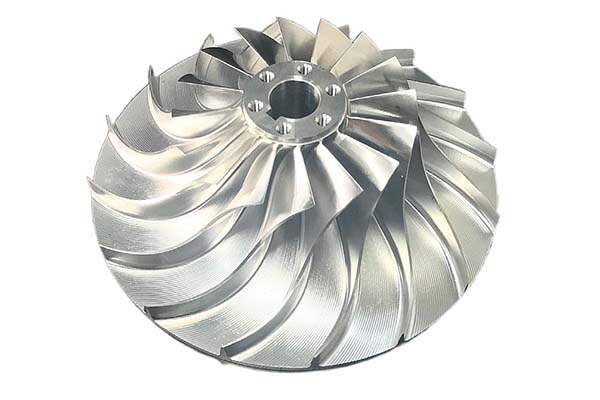
Impellers and blisks (bladed disks) are among the most complex machined components. They feature twisted blades with tight clearances between them. 5-axis machining is essential for these parts—3-axis machines cannot access the blade surfaces without colliding with adjacent blades.
What Materials Work with 5-Axis Milling?
5-axis milling handles the full range of engineering materials. The addition of rotary axes does not limit material compatibility—it expands it by allowing optimal tool angles for difficult materials.
| Material | Common 5-Axis Applications | Why 5-Axis Helps |
|---|---|---|
| Aluminum | Aerospace structural parts, automotive components | High-speed machining with optimal tool angles |
| Stainless steel | Medical devices, precision industrial parts | Maintains tool engagement, reduces work hardening |
| Titanium | Aerospace engine parts, medical implants | Manages cutting forces, extends tool life |
| Inconel | Jet engine components, turbine parts | Allows shorter tools, reduces deflection |
| Plastics | Prototyping, complex enclosures | Prevents melting with efficient chip evacuation |
| Composites | Aerospace wings, automotive body panels | Enables complex shapes without delamination |
Case example: A manufacturer of titanium aerospace brackets switched from 3-axis to 5-axis machining. Results:
- Tool life increased by 40% (better tool engagement)
- Cycle time reduced by 35%
- Scrap rate dropped from 12% to 4%
Is 5-Axis Milling Cost-Effective?
Initial Investment vs. Long-Term Savings
The upfront cost of a 5-axis machine is higher than a 3-axis machine. A mid-range 3-axis mill costs $50,000–$100,000. A comparable 5-axis machine starts at $150,000 and can exceed $500,000.
But long-term cost savings often justify the investment:
Reduced labor costs:
- Fewer setups means less operator time
- Faster cycle times increase output per labor hour
- Reduced scrap lowers rework costs
Lower tooling costs:
- Shorter tool life cycles
- Standard tools (rather than custom form tools) for many applications
Reduced work-in-progress inventory:
- Completing parts in one operation instead of moving between multiple machines
- Less capital tied up in partially finished parts
Break-Even Analysis Example
A manufacturer producing complex aerospace components analyzed their costs:
3-axis production:
- Machine cost: $80,000
- Setup time per part: 2.5 hours
- Cycle time per part: 9 hours
- Scrap rate: 12%
- Annual production: 500 parts
5-axis production:
- Machine cost: $250,000
- Setup time per part: 0.75 hours
- Cycle time per part: 4 hours
- Scrap rate: 4%
- Annual production: 500 parts
Annual savings:
- Labor savings: 1,625 hours @ $50/hour = $81,250
- Scrap savings: 40 parts @ $500 = $20,000
- Tooling savings: $15,000
- Total annual savings: $116,250
The additional $170,000 investment paid back in 18 months.
What Programming Challenges Come with 5-Axis?
CAM Software Requirements
5-axis machining requires advanced CAM (Computer-Aided Manufacturing) software. Not all CAM packages support full 5-axis simultaneous motion. The software must:
- Generate collision-free toolpaths
- Account for machine kinematics
- Simulate the entire cutting process
Investment: Professional 5-axis CAM software typically costs $10,000–$20,000 per license, plus annual maintenance.
Skilled Programming
5-axis programming requires more skill than 3-axis programming. The programmer must understand:
- Tool orientation relative to surfaces
- Machine travel limits
- Collision avoidance
- Proper use of tilt angles to avoid tool center point (TCP) issues
Training: Operators and programmers need specialized training. Many machine tool manufacturers offer 5-axis certification programs.
Simulation Is Essential
Unlike 3-axis machining, where most collisions are obvious, 5-axis machines can have tool-holder-workpiece collisions that are not visible in standard programming. Simulation software verifies toolpaths before metal is cut, preventing costly crashes.
A Real-World 5-Axis Success Story
A medical device manufacturer produced spinal implants from titanium. Original process using 3-axis machining:
- 8 operations across multiple machines
- 12 hours total cycle time
- 15% scrap rate from alignment errors and tool marks
- Extensive hand finishing
After switching to 5-axis machining:
- 1 setup on a 5-axis mill
- 3.5 hours cycle time
- 3% scrap rate
- Hand finishing reduced by 80%
The company increased production capacity by 200% without adding floor space. The 5-axis machine paid for itself in 14 months.
Conclusion
5-axis milling delivers transformative benefits for manufacturers of complex, precision parts. It reduces setups and cycle times, improving efficiency by 50–70% in many applications. It eliminates alignment errors, achieving tighter tolerances and better surface finishes. It enables complex geometries—undercuts, contoured surfaces, deep cavities—that are impossible or impractical with 3-axis machining. And despite higher initial investment, it reduces labor, tooling, and scrap costs, achieving payback in months rather than years. For manufacturers facing demands for greater complexity, tighter tolerances, and faster delivery, 5-axis milling is not just an option—it is a competitive necessity.
FAQs
What is the difference between 3-axis and 5-axis milling?
3-axis milling moves the cutting tool along X, Y, and Z linear axes. The workpiece remains fixed in one orientation. 5-axis milling adds two rotary axes (typically A and B), allowing either the tool or the workpiece to tilt and rotate. This enables machining complex geometries in a single setup, whereas 3-axis often requires multiple setups.
How much does a 5-axis milling machine cost?
Entry-level 5-axis machines start around $150,000. High-end machines with advanced features, larger work envelopes, and higher precision can exceed $500,000. This compares to $50,000–$100,000 for a comparable 3-axis machine.
What industries benefit most from 5-axis milling?
Aerospace, medical device manufacturing, automotive, and mold-making benefit most. These industries produce complex parts with tight tolerances—turbine blades, implants, engine components, and injection molds—where 5-axis capabilities are essential.
Is 5-axis milling difficult to learn?
5-axis programming and operation require more training than 3-axis. CAM software is more complex, collision risks are higher, and machine kinematics must be understood. Most machine manufacturers offer training programs, and experienced 3-axis programmers typically require 3–6 months to become proficient.
Can I run 3-axis programs on a 5-axis machine?
Yes. Most 5-axis machines can operate in 3-axis mode. This allows you to use the machine for simpler parts while building 5-axis capabilities. However, to realize the full benefits of 5-axis, you must use its simultaneous motion capabilities.
Contact Yigu Technology for Custom Manufacturing
At Yigu Technology, we leverage 5-axis milling to produce complex, precision components across aerospace, medical, and industrial sectors. Our 5-axis machining centers complete parts in single setups, eliminating alignment errors and reducing cycle times. Our programming team uses advanced CAM software with full simulation to ensure collision-free toolpaths. We work with materials from aluminum and stainless steel to titanium and Inconel, achieving tight tolerances and superior surface finishes. Whether you need prototypes or production quantities, we deliver complex geometries with the precision your application demands. Contact us to discuss your 5-axis milling project.