Introduction
Imagine a tiny bone screw for spinal surgery—thinner than a toothpick yet holding tolerances tighter than a human hair. Or a connector pin inside your smartphone, machined so precisely that millions of them fit perfectly without a single failure. These parts share a common origin: Swiss turning.
Born in 19th-century Swiss watchmaking workshops, Swiss turning has evolved into the gold standard for manufacturing miniature, high-precision components. While a traditional lathe struggles with parts longer than 10 times their diameter, Swiss turning handles length-to-diameter ratios exceeding 20:1 with ease. It routinely achieves ±0.001mm accuracy—about 1/70th the thickness of a sheet of paper.
This guide walks you through how Swiss turning works, why it outperforms conventional methods, and where it delivers the most value. Whether you're sourcing medical implants, electronics components, or aerospace parts, you'll leave with a clear understanding of when—and why—this technology matters.
How Did Swiss Turning Begin?
From Watchmaking Roots
Swiss turning traces directly to the rise of Swiss watchmaking in the 1870s. Watchmakers needed tiny gears, shafts, and pins—components so small that conventional lathes simply couldn't hold them steady. The problem was simple: when a workpiece extends too far from the chuck, cutting forces cause vibration and deflection.
Swiss engineers solved this with a radical idea. Instead of moving the cutting tool toward a fixed workpiece, they made the headstock move while holding the workpiece firmly through a guide bushing. This small shift eliminated vibration and allowed machinists to create slender parts with unprecedented accuracy. The sliding headstock lathe was born, and Switzerland's reputation in precision manufacturing was secured.
Three Waves of Innovation
1920s: Electrification
Manual operation gave way to electric drives and standardized components. Production speeds increased, and repeatability improved dramatically.
1970s: CNC Integration
Numerical control transformed Swiss turning from a skilled trade into a fully automated process. CNC Swiss lathes could now combine multiple operations—turning, milling, drilling—in a single setup.
2000s and Beyond: Multi-Axis Mastery
Modern Swiss turning machines feature 8 to 12 axes of simultaneous control. A single machine now does what once required three or four separate operations. Machining efficiency has risen by over 300% compared to early CNC models.
Why Does Swiss Turning Achieve Such High Precision?
The Core Principle Explained
At its heart, Swiss turning reimagines how a lathe should work. In a traditional lathe, the spindle is fixed and the tool moves. The workpiece extends from the chuck, unsupported except at the clamping point. The longer the part, the more it deflects under cutting forces.
Swiss turning flips this model. The headstock moves along the machine bed, and the workpiece passes through a guide bushing located immediately behind the cutting tools. The guide bushing supports the workpiece at the exact point of machining—leaving only 1 to 2mm of unsupported material at any time.
This means cutting forces are absorbed by the bushing, not the workpiece. Vibration disappears. Deflection becomes negligible. Accuracy soars.
Guide Bushing: The Precision Guardian
The guide bushing is not a simple sleeve. It is a precision-ground component with an inner diameter matched to the workpiece within 0.002 to 0.005mm clearance. Think of it as a custom bearing that travels with the part.
What does the guide bushing actually do?
- Supports continuously—the workpiece never experiences bending forces
- Isolates cutting forces—the spindle sees only rotational loads
- Directs coolant—cutting fluid reaches the tool tip precisely
- Stabilizes chip formation—consistent support means consistent cutting
Without the guide bushing, Swiss turning would be just another lathe. With it, the technology achieves what conventional machines cannot.
Swiss Turning vs. Traditional Turning
| Feature | Swiss Turning | Traditional Turning |
|---|---|---|
| Spindle movement | Headstock moves with workpiece | Spindle fixed, tool moves |
| Workpiece support | Guide bushing + spindle chuck | Spindle chuck only |
| Typical part diameter | Up to 20mm (32mm on special machines) | Unlimited |
| Length-to-diameter ratio | 20:1 or higher | Usually 10:1 or less |
| Typical accuracy | ±0.001mm | ±0.01mm |
| Setup complexity | One clamping for complex parts | Multiple clampings often required |
| Automation level | High—multiple processes in one cycle | Medium—often requires operator intervention |
What Equipment Makes Swiss Turning Work?
Anatomy of a Swiss Lathe
A modern Swiss-type CNC lathe combines several key components:
Sliding Headstock
The headstock holds the spindle and moves along the machine's Z-axis. It feeds the workpiece through the guide bushing at controlled rates. Servo motors drive this movement with sub-micron resolution.
Guide Bushing Assembly
Located immediately in front of the cutting tools, the guide bushing contains precision bearings and a cooling system. The clearance between bushing and workpiece is critical—too tight causes galling, too loose sacrifices support.
Tool Holder System
Swiss lathes typically have multiple tool positions arranged radially around the guide bushing. Fixed tool holders handle turning operations. Power tool holders add milling, drilling, tapping, and slotting capabilities, with spindle speeds often exceeding 10,000 RPM.
Sub-Spindle
The sub-spindle sits opposite the main spindle. It can:
- Receive parts directly from the main spindle for back-side machining
- Complete operations on both ends without manual handling
- Eliminate accuracy errors from secondary clamping
CNC Control System
Mainstream Swiss lathes use Fanuc, Siemens, or Mitsubishi controls. High-axis-count machines (8 to 12 axes) coordinate simultaneous movements across multiple tool stations and spindles.
How One Clamping Changes Everything
The combination of guide bushing, sliding headstock, and sub-spindle enables complete machining in one setup. A complex part—say, a medical implant with threads, cross-holes, and a contoured profile—might require:
- Turning the outer diameter
- Milling a flat surface
- Drilling a cross-hole
- Tapping threads
- Cutting off the finished part
- Back-side chamfering
On a traditional lathe, this means multiple machines or multiple setups. On a Swiss lathe, it happens in a single, uninterrupted cycle. Setup errors disappear. Cycle times drop by 30 to 60%. Scrap rates fall.
Where Is Swiss Turning Used?
Three Types of Parts Swiss Turning Excels At
Micro Parts (0.1mm to 5mm diameter)
These are components smaller than a grain of rice. Electronic probes, micro gears, and catheter connectors fall into this category. Swiss turning handles them with the same precision as larger parts.
Slender Shaft Parts (length-to-diameter ratio 10:1 to 50:1)
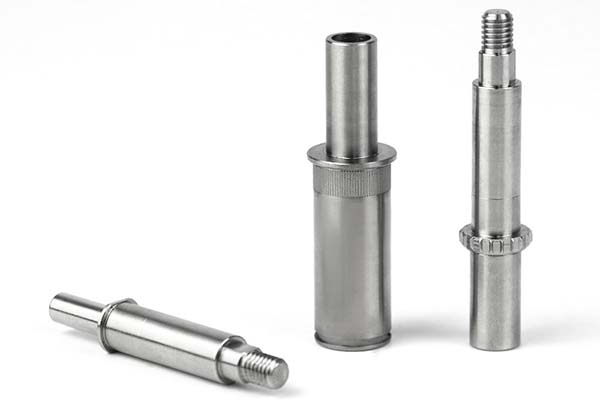
Printer drum shafts, precision motor shafts, and surgical guide wires require exceptional straightness. The guide bushing ensures these parts remain straight even at extreme ratios.
Complex Precision Parts
Parts requiring multiple features—keyways, threads, slots, cross-holes, contoured surfaces—benefit from Swiss turning's ability to combine turning and milling in one setup.
Real-World Applications by Industry
Medical Industry
A manufacturer of orthopedic implants needed titanium bone screws with thread tolerances of ±0.003mm. Traditional turning produced inconsistent results due to workpiece deflection. Swiss turning delivered consistent accuracy, with the added benefit of machining both ends of each screw in a single cycle. Scrap dropped from 12% to under 2%.
Typical medical parts: Surgical instruments, dental implants, pacemaker electrode shafts, biopsy needles, spinal fixation components.
Watch Industry
High-end mechanical watches contain gears and pinions measured in millimeters but machined to micron-level tooth profiles. A 3mm-diameter gear for a luxury timepiece requires tooth profile accuracy of 0.002mm. Swiss turning with precision milling achieves this consistently.
Typical watch parts: Movement gears, crown stems, analog shafts, barrel arbors, balance staffs.
Electronics Industry
5G communication equipment uses miniature connector pins—10mm long, 0.8mm in diameter, with straightness critical for reliable connections. Swiss turning produces these pins with surface finishes below Ra 0.2μm, ensuring consistent electrical performance across millions of units.
Typical electronic parts: Connector pins, sensor probes, miniature motor shafts, fiber optic components, micro switches.
Material Compatibility
Swiss turning adapts to a wide range of materials. Here's how common materials behave:
| Material | Characteristics | Machining Considerations | Typical Applications |
|---|---|---|---|
| Stainless steel | High hardness, tough | Coated carbide tools, moderate speeds | Medical devices, electronic housings |
| Titanium alloy | High strength, corrosion-resistant | Low speeds, high feed rates, flood coolant | Aerospace components, implants |
| Aluminum alloy | Lightweight, good thermal conductivity | High speeds, sharp tools to prevent built-up edge | Electronics housings, automotive parts |
| Medical-grade plastics (PEEK, PTFE) | Biocompatible, stable | Sharp tools, controlled temperatures | Catheters, implant components |
| Brass | Easy to cut, conductive | High speeds, excellent chip formation | Connectors, watch parts |
| Tool steel | Hard, wear-resistant | Rigid setups, coated tools | Mold components, precision fixtures |
What Does the Future Hold for Swiss Turning?
Industry trends point toward three directions: higher precision, greater efficiency, and smarter operation.
Precision continues to push boundaries. Machines now routinely hold ±0.001mm. The next generation targets ±0.0005mm—entering the realm of what was once only possible with grinding or EDM.
Efficiency gains come from process integration. Today's Swiss lathes combine turning, milling, grinding, and even laser marking in a single machine. Each added capability eliminates a separate operation, reducing handling and improving quality.
Intelligence is the emerging frontier. Real-time monitoring systems now detect tool wear and adjust feeds automatically. Digital twins simulate machining before cutting begins. AI-powered vision systems inspect parts as they are produced, enabling 24-hour unattended operation.
For manufacturers, adopting Swiss turning technology increasingly means gaining a competitive edge. It's not just about making smaller parts—it's about making complex parts better, faster, and more consistently than any alternative method.
Conclusion
Swiss turning began as a solution for watchmakers struggling with tiny, delicate components. Today, it has become an essential manufacturing technology for industries where precision is non-negotiable.
The secret lies in the guide bushing—a simple but brilliant innovation that eliminates vibration and deflection by supporting the workpiece exactly where cutting happens. Combined with sliding headstock design, multi-axis control, and sub-spindle automation, Swiss turning delivers accuracy and efficiency that conventional lathes cannot match.
If your components are small (under 20mm diameter), slender (length-to-diameter ratio above 10:1), or complex (requiring multiple operations), Swiss turning likely offers the most reliable, cost-effective path to production. The technology has matured from its watchmaking origins into a versatile platform that handles medical implants, electronics connectors, aerospace components, and countless other precision parts.
Choosing Swiss turning means choosing one-clamping completeness, micron-level accuracy, and repeatability you can count on—part after part, shift after shift.
FAQ
How much more expensive is Swiss turning compared to traditional turning?
Initial equipment investment runs 30–50% higher than conventional CNC lathes. However, total production costs often decrease by 20–30% for suitable parts. Why? Fewer setups mean less labor. One-clamping machining eliminates positioning errors and reduces scrap. For high-volume production, the per-part cost advantage becomes substantial.
What is the largest diameter Swiss turning can handle?
Mainstream Swiss-type lathes accept bar stock up to 20mm diameter. Specialized machines extend this to 32mm or occasionally larger. Beyond this range, traditional turning or multi-tasking machines become more appropriate. The technology's sweet spot remains parts under 20mm—where its precision advantages matter most.
How do I choose the right Swiss lathe for my parts?
Focus on three specifications:
- Axis count: 8-axis or more provides the flexibility for complex parts requiring milling, drilling, and back-side operations
- Guide bushing accuracy: Look for ≤0.002mm clearance for precision work
- Power tool speed: Higher RPM (10,000+) enables faster milling and better surface finishes
Also consider whether your parts require a sub-spindle for back-side machining—most complex parts do.
Are Swiss turning cycles shorter than traditional turning?
For simple cylindrical parts, cycle times may be comparable. For complex parts requiring multiple operations, Swiss turning typically reduces cycle time by 30–60%. The savings come from eliminating multiple setups, reducing handling time, and performing operations simultaneously where machine architecture permits.
What materials are difficult for Swiss turning?
Very hard materials like tungsten carbide or ceramics exceed the capability of most Swiss lathes. Gummy materials like pure copper or soft aluminum can cause chip packing issues, though proper tooling and coolant strategies address this. The technology works best with materials that machine predictably—stainless steels, titanium, brass, and engineering plastics all perform well.
Contact Yigu Technology for Custom Manufacturing
Looking for precision-machined components you can trust? Yigu Technology brings deep expertise in Swiss turning and precision manufacturing to every project. Our facility features advanced CNC Swiss lathes with multi-axis capabilities, handling materials from titanium and stainless steel to PEEK and medical-grade plastics.
We understand what matters: tight tolerances, consistent quality, and reliable delivery. Whether you need medical implants, electronic connectors, or custom precision components, our team works with you from design through production to ensure results that meet your specifications.
Ready to discuss your project? Contact Yigu Technology today for a consultation or quote. Let our precision machining experience work for you.