
Introduction
Look around you. The phone in your hand, the car you drive, the medical devices that keep people healthy—all made from parts manufactured somewhere. For decades, making those parts meant the same thing: machines cutting, stamping, or molding materials into shape. But a new approach has emerged. 3D printing builds parts layer by layer from digital files, offering possibilities that traditional methods cannot match. The question is no longer whether 3D printing works—it clearly does. The question is whether it will become the primary way we make production parts. This article explores the current state of 3D printing for production, its capabilities, limitations, and where it fits in the future of manufacturing.
What Is 3D Printing for Production Parts?
Definition and Basic Concept
3D printing for production parts means using additive manufacturing to create end-use components—not just prototypes, but parts that go into products people actually use. Unlike traditional methods that cut away material from larger blocks (subtractive manufacturing) or force material into molds (formative manufacturing), 3D printing adds material only where needed.
The process starts with a digital 3D model created in CAD software or captured by 3D scanning. Specialized slicing software cuts this model into hundreds or thousands of thin layers. The 3D printer then deposits material—plastic, metal, ceramic, or composite—layer by layer until the complete part forms.
This approach enables:
- Complex geometries: Internal cavities, lattice structures, organic shapes
- On-demand production: Print only what you need, when you need it
- Customization: Each part can be different without tooling changes
- Reduced waste: Material goes into the part, not the scrap bin
Key Elements of Production 3D Printing
Digital files serve as the blueprint. They contain all geometric information—shape, size, internal features. For production, these files must be precise and validated.
3D printers are the physical machines. Production-grade printers differ from desktop hobbyist machines in precision, reliability, and throughput. They run longer, print larger, and produce consistent results.
Materials determine part properties. Production parts require materials that meet engineering specifications—strength, temperature resistance, chemical compatibility. The material palette has expanded dramatically, from engineering plastics to high-performance metals.
What Technologies Enable Production 3D Printing?
Several main technologies serve production applications, each with strengths and trade-offs.
Fused Deposition Modeling (FDM)
How it works: A thermoplastic filament feeds into a heated nozzle. The nozzle melts the filament and deposits it layer by layer on a build platform.
Advantages:
- Relatively inexpensive equipment
- Wide range of available materials
- Clean, safe operation
- Large build volumes possible
Disadvantages:
- Rough surface finish
- Relatively slow printing
- Support structures needed for overhangs
- Anisotropic strength—parts weaker in Z direction
Suitable materials: PLA, ABS, PETG, Nylon, Polycarbonate, TPU, and engineering grades like PEEK and ULTEM
Production role: Functional prototypes, jigs and fixtures, low-volume production of large parts, custom tooling
Stereolithography (SLA)
How it works: A UV laser traces each layer on the surface of liquid photopolymer resin. The resin solidifies where the light hits. The build platform lowers, and a new layer of resin flows over the cured layer.
Advantages:
- High precision and excellent surface quality
- Fine details and smooth finishes
- Good for visual prototypes and patterns
Disadvantages:
- Equipment and materials relatively expensive
- Resin requires careful handling (toxic)
- Printed parts may be brittle
- Limited mechanical strength compared to engineering thermoplastics
Suitable materials: Various photopolymer resins—standard, tough, flexible, castable, dental, biocompatible
Production role: Jewelry patterns, dental models, investment casting patterns, visual prototypes, some end-use parts where aesthetics matter more than strength
Selective Laser Sintering (SLS)
How it works: A high-power laser sinters powdered material—typically nylon—fusing particles together. The unsintered powder supports overhangs, eliminating support structures.
Advantages:
- No support structures needed
- Good mechanical properties
- Wide material range including engineering polymers
- Durable, functional parts
Disadvantages:
- Equipment expensive
- Process can be time-consuming
- Surface finish rough, often needs post-processing
- Powder handling requires care
Suitable materials: Nylon (PA11, PA12), glass-filled nylon, TPU, some metals and ceramics
Production role: Functional end-use parts, complex geometries, small to medium batch production, ductwork, housings, moving parts
Powder Bed Fusion (Metal)
How it works: A laser or electron beam melts metal powder layer by layer. The process happens in a controlled atmosphere to prevent oxidation.
Advantages:
- Produces dense, strong metal parts
- Complex geometries possible
- Material properties near wrought equivalents
Disadvantages:
- Very expensive equipment
- Slow build rates
- Requires support structures
- Post-processing usually needed
Suitable materials: Stainless steel, titanium, aluminum, cobalt-chrome, Inconel, tool steels
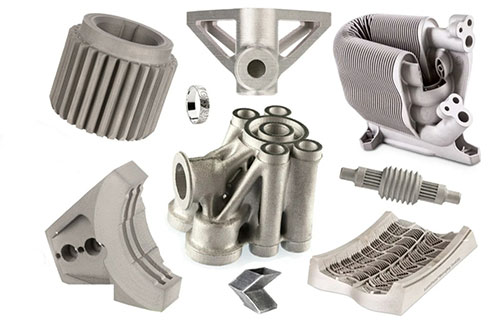
Production role: Aerospace components, medical implants, automotive parts, any application requiring metal with complex geometry
Binder Jetting
How it works: A print head deposits liquid binder onto powder layers, bonding particles. The "green" part then undergoes sintering to fuse metal particles into a dense solid.
Advantages:
- Fast printing—entire layer deposited at once
- No supports needed
- Large build volumes possible
- Lower cost than laser powder bed fusion
Disadvantages:
- Requires sintering furnace
- Shrinkage during sintering must be compensated
- Porosity possible without infiltration
Suitable materials: Stainless steel, bronze, iron, some ceramics
Production role: Medium-volume metal parts, automotive components, consumer goods, applications where cost matters more than absolute density
Where Is 3D Printing Used for Production Today?
Automotive Industry
Automakers were early adopters of 3D printing for prototyping. Now they use it for production parts.
Tesla integrated 3D printing into manufacturing of the Model Y. The technology enabled combining 70 separate parts into a single component. Fewer parts mean simpler assembly, lower costs, and improved reliability.
BMW has used 3D printing for 30 years. In 2023 alone, they produced over 400,000 parts globally through additive manufacturing. Robot grippers in their factories—3D printed—weigh 20–30% less than previous versions. Lighter grippers move faster, consume less energy, and reduce production line cycle times.
Production applications:
- Custom assembly tools
- End-use brackets and mounts
- Spare parts for legacy vehicles
- Small series production of specialty components
Aerospace Industry
Aircraft and spacecraft demand lightweight, high-strength parts. 3D printing delivers both.
Airbus uses 3D printed components throughout their aircraft. Cabin brackets, air ducts, and structural parts benefit from weight reduction. Every kilogram saved reduces fuel consumption over the aircraft's life.
GE Aviation pioneered metal 3D printing for production. Their LEAP engine fuel nozzle—previously welded from 20 parts—now prints as one piece. Weight dropped 25% . Durability increased fivefold. Over 100,000 nozzles printed to date.
Space applications: Rocket engines use 3D printed combustion chambers and injectors. Complex internal cooling channels optimize performance. SpaceX, Rocket Lab, and others rely on additive manufacturing for production hardware.
Production applications:
- Brackets and structural components
- Ducting and air management systems
- Engine components
- Custom tooling for composite layup
Medical Field
Medicine demands customization. Every patient's anatomy differs. 3D printing delivers personalized solutions.
Implants: Hip replacements, spinal cages, and cranial plates print in titanium or biocompatible polymers. CT scans guide design. The implant fits perfectly, reducing surgery time and improving recovery.
Prosthetics: Organizations like E-nable have donated hundreds of 3D printed prosthetics worldwide since 2013. Each customized to the recipient, produced at a fraction of traditional cost.
Surgical guides: Doctors practice on 3D printed models before complex surgeries. Guides ensure precise implant placement. Outcomes improve. Complications decrease.
Research breakthrough: University of California, San Diego researchers implanted 3D printed spinal scaffolds loaded with neural stem cells into rats with spinal cord injuries. The rats recovered motor function. Human applications may follow.
Production applications:
- Custom implants
- Surgical instruments
- Anatomical models for planning
- Prosthetic sockets and components
Consumer Goods
Brands use 3D printing for customization and small-batch production.
Eyewear: Custom frames printed to match individual face measurements. Unique designs impossible with traditional molding.
Footwear: Adidas and other brands experiment with 3D printed midsoles customized to each runner's foot. While not yet mass production, the capability exists.
Jewelry: Castable resins and direct metal printing enable complex designs. Each piece can be unique without tooling costs.
Production applications:
- Custom-fit products
- Limited edition items
- Complex geometries for aesthetics
- On-demand spare parts
How Does 3D Printing Compare to Traditional Manufacturing?
| Factor | 3D Printing | Traditional Manufacturing |
|---|---|---|
| Design Freedom | Almost unlimited—complexity is free | Constrained by tool access, draft angles, etc. |
| Setup Cost | Low—no tooling required | High—molds, dies, fixtures cost thousands to millions |
| Per-Part Cost | Higher for simple parts, lower for complex | Lower for high volumes, higher for complexity |
| Lead Time | Days to weeks | Weeks to months |
| Material Options | Growing, but still limited | Vast—thousands of alloys, grades, formulations |
| Surface Finish | Variable—often needs post-processing | Excellent—as-molded or machined finishes |
| Mechanical Properties | Good, but can be anisotropic | Consistent, predictable |
| Batch Size Economy | Ideal for 1–1,000 parts | Ideal for 10,000+ parts |
| Waste | Minimal—material only where needed | Can be substantial—machining waste up to 90% |
When 3D Printing Wins
- Complex geometry: Internal channels, lattices, organic shapes
- Low volume: No tooling amortization needed
- Customization: Each part different without cost penalty
- Speed to market: No waiting for tooling
- Supply chain simplification: Print on demand, no inventory
When Traditional Wins
- High volume: Millions of parts amortize tooling cost
- Simple geometry: No benefit from additive complexity
- Established materials: Exotic alloys may not be printable
- Surface finish critical: Mirror finishes need machining
- Cost sensitive at scale: Injection molding cents per part
What Are the Limitations of 3D Printing for Production?
Speed
3D printing is slow. A small part might take hours. A large, detailed part can take days. For mass production, injection molding produces parts in seconds.
However, for complex parts produced in low volumes, the total time including tooling can favor 3D printing. No waiting for molds means parts exist days after design completion.
Cost per Part
For simple parts at high volumes, 3D printing cannot compete with traditional methods. A molded plastic part might cost $0.50. The same part printed might cost $5.00.
But for complex parts or low volumes, the equation flips. A machined titanium bracket costing $500 might print for $200. The breakeven point depends on geometry, material, and quantity.
Material Properties
Not all engineering materials exist in printable form. Some alloys are difficult to process. Printed parts can have anisotropic properties—weaker in one direction. Quality control requires understanding these characteristics.
Size Constraints
Most 3D printers have limited build volumes. Large parts must be printed in sections and assembled. Industrial-scale printers exist but cost millions.
Post-Processing
Printed parts rarely go straight to use. Support removal, surface finishing, heat treatment, and inspection add time and cost. For some applications, post-processing dominates total lead time.
What Does the Future Look Like?
Technology Improvements
Printers get faster, larger, and more precise each year. Multi-laser systems increase throughput. Better process control improves consistency. New materials expand applications.
Hybrid Manufacturing
Machines that combine printing and machining in one platform will become common. Print near-net shape, then machine critical surfaces—all in one setup. This combines the best of both worlds.
Supply Chain Transformation
Digital inventory replaces physical stock. Need a spare part? Download the file and print locally. No warehouses. No shipping delays. No obsolescence.
Mass Customization
Products tailored to individual preferences become economical. Shoes that fit your exact feet. Eyeglass frames matching your face. Medical devices designed for your anatomy.
Sustainability
Less waste. Local production reducing shipping. On-demand manufacturing eliminating overproduction. 3D printing aligns with circular economy principles.
How Does Yigu Technology Approach Production 3D Printing?
As a non-standard plastic and metal products custom supplier, Yigu Technology treats 3D printing as one tool among many. We don't advocate it for every project—but when it fits, the results speak.
Our Experience in Action
Automotive: A client needed 200 custom brackets with complex internal channels for fluid distribution. Traditional machining: 8 weeks, $12,000. 3D printing: 2 weeks, $4,500. Parts passed all tests. The client now specifies printing for similar components.
Medical: A device company required patient-specific surgical guides. Each unique, each needed quickly. Traditional fabrication impossible within timeline. We printed all 50 guides in three days. Surgeons reported perfect fit.
Industrial: A factory needed replacement parts for aging machinery—no longer available from the original manufacturer. We scanned a worn part, reverse-engineered the design, and printed replacements. Machine back in service within a week.
Matching Process to Need
Our engineers evaluate each project:
- What volumes?
- What geometry complexity?
- What material properties?
- What timeline?
- What budget?
If 3D printing fits, we use it. If traditional methods serve better, we recommend them. This honesty builds trust.
Material and Technology Range
We maintain capabilities across multiple technologies:
- FDM for large parts and engineering thermoplastics
- SLS for durable nylon components
- SLA for high-detail patterns and prototypes
- Metal printing for production-grade metal parts
- Binder jetting for cost-effective medium volumes
This range lets us match technology to application precisely.
Conclusion
Is 3D printing the future for production parts? Yes and no.
For complex, customized, low-volume parts, 3D printing is already the present. Aerospace components, medical implants, custom consumer goods—these are production parts made additively today. The technology enables what traditional methods cannot.
For simple, high-volume, commodity parts, traditional manufacturing will remain dominant for the foreseeable future. Injection molding, stamping, and casting produce parts faster and cheaper at scale.
The future lies in hybrid approaches—using each technology where it serves best. 3D printing for complexity and customization. Traditional methods for volume and economy. Smart manufacturers will employ both.
As technology improves—faster printers, better materials, lower costs—the boundary will shift. More parts will become economical to print. More industries will adopt additive for production. But replacement of traditional methods entirely? Unlikely. The future is coexistence and complementarity, not conquest.
For designers and engineers, the message is clear: 3D printing is a production tool, not just a prototyping curiosity. Learn when to use it. Design for its strengths. Combine it with traditional methods for optimal results. The future of manufacturing belongs to those who master all the tools.
Frequently Asked Questions
Q1: What materials can be used for 3D printing production parts?
A wide range: plastics (ABS, PLA, nylon, polycarbonate, PEEK), metals (stainless steel, titanium, aluminum, Inconel), ceramics, and composites. Material selection depends on required mechanical properties, environment, and cost constraints.
Q2: How accurate is 3D printing for production parts?
Accuracy ranges from ±0.1–0.4 mm for common technologies like FDM to ±0.01 mm for high-end systems like SLA or precision metal printing. Production applications requiring tight tolerances may need post-process machining.
Q3: Can 3D printing replace traditional manufacturing methods?
Not completely. 3D printing excels at complexity, customization, and low volumes. Traditional methods excel at high volumes and low per-part cost. The future is complementary—using each where it serves best.
Q4: How much does 3D printing cost for production parts?
Cost varies dramatically by size, complexity, material, and quantity. Simple plastic parts: $5–$50. Complex metal parts: $200–$2,000. Always request quotes with detailed specifications. Consider total cost including design, printing, and post-processing.
Q5: Is 3D printing suitable for mass production?
For millions of identical simple parts, no—injection molding is faster and cheaper. For millions of customized parts, possibly—if each requires unique geometry, 3D printing may be the only option. The breakeven point shifts as technology improves.
Q6: How strong are 3D printed production parts?
Properly processed 3D printed parts match or exceed traditionally manufactured ones. Metal parts can achieve wrought properties. Polymer parts can approach injection-molded strength. Design orientation and post-processing affect final properties.
Q7: What industries use 3D printing for production most?
Aerospace (lightweight complex parts), medical (custom implants), automotive (low-volume components, tooling), and consumer goods (customized products) lead adoption. Industrial equipment, energy, and defense follow closely.
Contact Yigu Technology for Custom Manufacturing
Ready to explore 3D printing for production parts? At Yigu Technology, we combine additive expertise with broader manufacturing capabilities. Our team helps you evaluate whether 3D printing fits your application, select the right technology and materials, and deliver quality parts on schedule.
Visit our website to see our capabilities. Contact us today for a free consultation and quote. Let's build the future of your production together.


