You have seen the headlines: lighter aerospace parts, custom medical implants, complex automotive components that machining cannot produce. 3D printing metals promises to transform manufacturing. But when you try it, the results can be costly failures—cracks, weak parts, rough surfaces, and wasted powder that costs hundreds per kilogram. Metal 3D printing is not plastic 3D printing scaled up. It demands expertise in materials, processes, and post-processing. This guide explains how it works, what materials to choose, and how to achieve parts that are stronger, lighter, and more complex than traditional methods allow.
What Makes Metal 3D Printing Different?
Metal additive manufacturing builds parts layer by layer from metal powder or wire, using lasers or electron beams to fuse material. Unlike subtractive manufacturing—which cuts away 80–90% of raw material—metal 3D printing uses only the material that becomes the part. Excess powder is recycled.
But the differences go deeper. Metal printing requires:
- Controlled atmospheres (inert gas or vacuum) to prevent oxidation
- High-energy sources (lasers up to 1,000 W, electron beams)
- Extensive post-processing (heat treatment, machining, testing)
- Rigorous quality control (non-destructive testing, mechanical validation)
Mistakes are expensive. A failed metal print can waste £500–£5,000 in material and machine time.
What Metal Materials Can You 3D Print?
Different metals suit different applications. Material selection drives cost, performance, and printability.
Aluminum
Aluminum alloys like AlSi10Mg are lightweight (2.7 g/cm³) and strong (tensile strength 300–400 MPa).
| Property | Value |
|---|---|
| Density | 2.7 g/cm³ |
| Tensile Strength | 300–400 MPa |
| Melting Point | ~660°C |
| Best For | Aerospace brackets, drone frames, automotive components |
| Limitations | Low heat resistance; limited to applications below 200°C |
Stainless Steel
Stainless steel is the workhorse of industrial metal printing. Two grades dominate.
| Grade | Properties | Applications |
|---|---|---|
| 316L | Corrosion-resistant, 500–600 MPa tensile strength | Chemical equipment, marine components, food processing |
| 17-4 PH | Heat-treatable to 1,100 MPa, high strength | Industrial tooling, high-stress parts, aerospace |
Titanium
Titanium (Ti6Al4V) offers an exceptional strength-to-weight ratio and biocompatibility.
| Property | Value |
|---|---|
| Density | 4.5 g/cm³ |
| Tensile Strength | 900–1,100 MPa |
| Cost | £100–200 per kg powder |
| Best For | Medical implants, aerospace components, high-performance parts |
| Key Advantage | Biocompatible (ISO 10993), corrosion-resistant |
Specialized Alloys
| Alloy | Key Property | Applications |
|---|---|---|
| Inconel 718 | Withstands 1,200°C | Gas turbines, rocket engines, aerospace |
| Cobalt-Chrome (CoCrMo) | Wear-resistant, biocompatible | Dental crowns, joint replacements |
| Copper | Thermal conductivity 401 W/m·K | Heat sinks, cooling channels |
Data point: Titanium Ti6Al4V printed via SLM achieves 1,100 MPa tensile strength—higher than cast titanium (900 MPa) and comparable to wrought.
What Processes Are Used for Metal 3D Printing?
Several technologies transform metal powder into solid parts. Each has strengths and trade-offs.
Selective Laser Melting (SLM)
SLM is the most common metal printing process. A high-power laser fully melts metal powder layer by layer.
| Parameter | Typical Range |
|---|---|
| Laser Power | 100–1,000 W |
| Scan Speed | 500–2,000 mm/s |
| Layer Thickness | 20–50 μm |
| Density | 99.5%+ |
| Supports | Required (same metal) |
Best for: Aerospace components, medical implants, high-precision parts
Limitations: Requires support removal via CNC machining; slower than other processes
Electron Beam Melting (EBM)
EBM uses an electron beam in a vacuum. It handles high-temperature alloys well and produces parts with fine grain structure.
| Parameter | Typical Range |
|---|---|
| Layer Thickness | 50–100 μm |
| Density | 99.5%+ |
| Supports | Minimal (powder bed supports) |
| Surface Finish | Rougher than SLM |
Best for: Titanium, Inconel; aerospace components
Limitations: Higher surface roughness; slower cooling can affect fine features
Binder Jetting
A liquid binder is deposited onto metal powder, forming a “green part.” The part is then sintered in a furnace to fuse powder.
| Parameter | Typical Range |
|---|---|
| Print Speed | Faster than SLM/EBM |
| Shrinkage | 15–20% during sintering |
| Supports | Not required |
| Density | 95–98% |
Best for: Medium-volume production, dental restorations, stainless steel parts
Limitations: Lower density; dimensional accuracy harder to achieve due to shrinkage
What Post-Processing Is Required?
Metal prints are rarely finished when they come off the printer. Post-processing is essential for strength, accuracy, and surface finish.
Support Removal
Supports are cut or machined off. For complex parts, CNC machining is often required. Poor support design can leave marks or damage delicate features.
Heat Treatment
Heat treatment relieves internal stress, improves mechanical properties, and refines grain structure.
| Treatment | Purpose |
|---|---|
| Stress Relief | Reduces warping, prevents cracking |
| Annealing | Softens for machining |
| Aging | Hardens precipitation-hardening alloys (17-4 PH, Inconel) |
| Hot Isostatic Pressing (HIP) | Eliminates internal porosity; critical for aerospace |
Machining
Critical surfaces (threads, mating faces) are machined to final tolerance. Metal printed parts typically achieve ±0.1 mm accuracy; machining improves to ±0.01 mm.
Surface Finishing
- Polishing: Smooths surfaces, reduces roughness
- Bead blasting: Creates uniform matte finish
- Electropolishing: Removes surface layer for improved corrosion resistance
What Are the Key Applications?
Metal 3D printing serves industries where performance, complexity, and customization justify the cost.
Aerospace
Aerospace leads in metal 3D printing adoption. Parts are 30–50% lighter than machined versions.
| Component | Benefit |
|---|---|
| Fuel nozzles | Part consolidation (20 parts → 1); 25% lighter |
| Turbine blades | Internal cooling channels; improved efficiency |
| Brackets | Lattice structures; weight reduction |
Example: A jet engine manufacturer reduced fuel nozzle weight by 25% and increased durability fivefold using 3D printed Inconel.
Medical and Dental
Metal printing enables patient-specific implants and devices.
| Application | Benefit |
|---|---|
| Hip implants | Custom fit to patient anatomy |
| Spinal cages | Porous structures for bone integration |
| Dental crowns | Same-day production; precise fit |
Example: A hospital used 3D printed titanium spinal cages with lattice structures that promoted bone growth—impossible to manufacture with traditional methods.
Automotive
Automotive uses metal printing for lightweighting and performance.
| Application | Benefit |
|---|---|
| Engine components | Complex internal geometries |
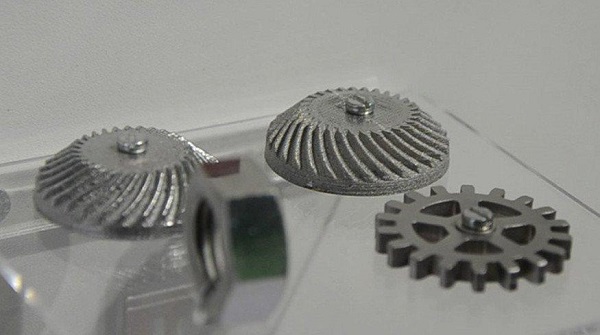
| Gears | Optimized tooth profiles |
| Custom parts | Low-volume production without tooling |
Industrial Tooling
Conformal cooling channels in injection molds reduce cycle times by 20–50%.
What Are the Challenges and How Do You Solve Them?
Metal 3D printing has unique failure modes. Understanding them prevents costly mistakes.
Cracking
Cause: Thermal stress from rapid heating and cooling.
Solution: Reduce laser power by 5–10%; increase scan speed; use proper support structures; post-print heat treatment (annealing).
Porosity
Cause: Moisture in powder; insufficient laser energy.
Solution: Dry powder before use (vacuum oven); optimize laser parameters; post-print HIP eliminates residual porosity.
Poor Surface Finish
Cause: Large layer height; insufficient post-processing.
Solution: Use smaller layer thickness (20 μm); specify post-processing (polishing, bead blasting).
Dimensional Inaccuracy
Cause: Thermal distortion; incorrect shrinkage compensation.
Solution: Use simulation software to predict distortion; adjust scaling; machine critical surfaces post-print.
Anisotropic Strength
Cause: Parts are stronger along layer direction than across layers.
Solution: Orient parts to place critical stress direction along layer plane; post-process heat treatment improves isotropy.
How Does Metal 3D Printing Compare to Traditional Methods?
| Aspect | Metal 3D Printing | Casting | Machining |
|---|---|---|---|
| Complexity | Unlimited | Limited by mold | Limited by tool access |
| Material Waste | 5–10% | 10–30% | 80–90% |
| Lead Time | Days to weeks | Weeks to months | Days to weeks |
| Tooling Cost | None | High (molds) | Moderate (fixtures) |
| Per-Unit Cost (Low Volume) | Low | High | Moderate |
| Per-Unit Cost (High Volume) | High | Low | Moderate |
| Strength | Comparable to wrought | Lower | Highest |
Data point: For production runs under 100 units, metal 3D printing is often more cost-effective than casting or forging due to zero tooling costs.
Yigu Technology’s Perspective
As a custom manufacturer, Yigu Technology specializes in metal 3D printing for clients who need complex, high-performance parts. We offer:
- SLM and binder jetting capabilities
- Titanium, stainless steel, aluminum, Inconel materials
- In-house post-processing: heat treatment, CNC machining, surface finishing
- Quality control: mechanical testing, CT scanning, material traceability
We guide clients through material selection, design optimization, and process parameters to ensure successful prints. In our experience, the most common mistake is treating metal printing like plastic printing. Metal requires design for additive manufacturing (DfAM) —considering thermal stress, support placement, and post-processing from the start.
Conclusion
3D printing metals forges a new path in industrial manufacturing. It enables complex geometries, lightweight structures, and customization that traditional methods cannot match. Titanium, stainless steel, aluminum, and superalloys serve aerospace, medical, automotive, and industrial applications.
But metal printing demands expertise. Material selection, process parameters, support design, and post-processing must be carefully managed. Mistakes are costly—but with the right approach, 3D printed metal parts deliver strength, precision, and performance that justify the investment.
FAQ
Why is my 3D printed metal part cracking?
Cracking typically results from thermal stress during printing. Reduce laser power by 5–10%, increase scan speed, and ensure proper support structures. Post-print annealing relieves internal stress. Check powder moisture—wet powder causes porosity that can lead to cracks.
How does 3D printed metal compare to cast or machined metal?
3D printed metal (SLM/EBM) achieves strength comparable to wrought (machined) metal and exceeds cast metal due to finer grain structure. Fatigue resistance may be lower than wrought unless heat-treated. The main advantage is geometric complexity—internal channels, lattice structures, and part consolidation that casting or machining cannot achieve.
Is metal 3D printing cost-effective for small production runs?
Yes. For 1–100 parts, metal 3D printing often costs less than casting or forging because there are no tooling costs. For runs above 1,000 parts, traditional methods become more cost-effective unless parts are highly complex. Binder jetting offers a lower-cost alternative for medium volumes.
What metals can be 3D printed?
Common metals include titanium (Ti6Al4V) , stainless steel (316L, 17-4 PH) , aluminum (AlSi10Mg) , Inconel 718, cobalt-chrome, and copper. Each has specific properties suited to different applications. Material availability varies by service provider.
How accurate is metal 3D printing?
Typical dimensional accuracy is ±0.1 mm for small to medium parts. High-end systems achieve ±0.05 mm. Critical surfaces (threads, mating faces) require post-print CNC machining to achieve tighter tolerances (±0.01 mm). Surface finish ranges from 10–50 μm Ra as-printed, improved via polishing to 0.8 μm Ra.
Contact Yigu Technology for Custom Manufacturing
Yigu Technology specializes in non-standard plastic and metal custom manufacturing, including metal 3D printing for high-performance applications. Whether you need titanium medical implants, stainless steel industrial components, or aluminum aerospace brackets, our engineering team delivers precision and quality. Contact us today to discuss your metal 3D printing project.