Introduction
Fan blades are everywhere. In your computer, keeping it cool. In industrial ventilation systems, moving air through factories. In aircraft engines, pushing planes through the sky.
They seem simple—just spinning blades moving air. But their design profoundly affects efficiency, noise, and performance.
Traditional manufacturing limits what's possible. Casting, forging, and machining restrict shapes to what can be made with molds and tools. Complex aerodynamic curves? Difficult. Internal cooling channels? Nearly impossible.
3D printing changes this. Layer by layer, it builds geometries that were previously impossible. Optimized airfoils. Variable-pitch designs. Lightweight lattices.
Early tests show 3D printed fan blades can reduce energy consumption by up to 20% compared to traditional designs.
At Yigu technology, we've seen how 3D printing transforms fan blade design. This guide explores how they're made, how they compare to traditional blades, and whether they're truly the future of efficiency.
What Are 3D Printed Fan Blades?
The Basic Idea: Building Blades Layer by Layer
3D printed fan blades are exactly what they sound like—fan blades created through additive manufacturing. Instead of casting metal in a mold or machining from solid stock, they're built layer by layer from a digital file.
This approach unlocks designs that were previously impossible:
- Complex aerodynamic shapes optimized for efficiency
- Internal channels for cooling or weight reduction
- Lattice structures that maintain strength while saving weight
- Variable-pitch geometries that adjust to conditions
- Integrated features that would require assembly
How They're Made
1. Digital Design
Everything starts with a 3D model in CAD software. Engineers design every curve, every surface, every internal feature.
For a fan blade, the design determines:
- Airfoil shape: How air flows over the blade
- Pitch angle: How aggressively it moves air
- Twist: How angle changes from hub to tip
- Internal structure: Solid, hollow, or lattice
2. Material Selection
Choice depends on application:
| Material | Properties | Best For |
|---|---|---|
| ABS | Strong, heat-resistant | General-purpose, industrial fans |
| PLA | Easy to print, biodegradable | Low-stress applications, prototypes |
| Carbon-fiber reinforced polymer | Very strong, lightweight | High-performance, aerospace |
| Aluminum alloy | Lightweight, thermally conductive | Heat-focused applications |
| Titanium alloy | Extremely strong, heat-resistant | Aerospace, extreme conditions |
3. Slicing
The model is sliced into thin layers—typically 0.1 mm to 0.4 mm thick. Each layer becomes instructions for the printer.
4. Printing
Different technologies print in different ways:
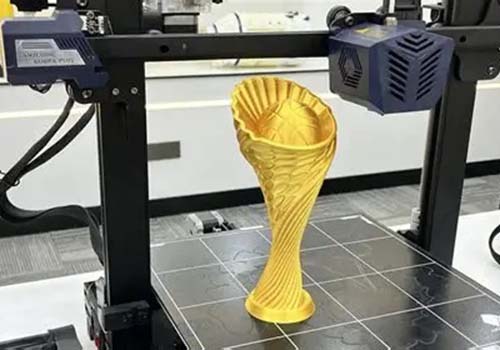
- FDM (Fused Deposition Modeling): Heated nozzle extrudes melted plastic layer by layer. Good for plastics, composites.
- SLA (Stereolithography): UV laser cures liquid resin. Excellent detail, smooth surfaces.
- SLS (Selective Laser Sintering): Laser fuses powder (nylon, metal). No supports needed, strong parts.
- DMLS/SLM (Direct Metal Laser Sintering/Selective Laser Melting): Laser melts metal powder. Fully dense metal parts.
5. Post-Processing
After printing:
- Support removal (if any)
- Sanding for smoother surfaces
- Heat treatment (for metals)
- Inspection to verify dimensions and quality
How Do 3D Printed Fan Blades Compare to Traditional Ones?
Materials
| Aspect | Traditional Fan Blades | 3D Printed Fan Blades |
|---|---|---|
| Material options | Limited by casting/forging processes—common metals (aluminum, steel), some plastics | Wide range—engineering plastics, carbon-fiber composites, metal alloys |
| Material tailoring | Same material throughout | Can vary properties in different regions |
| Material waste | High—machining wastes up to 80% | Low—additive process, minimal waste |
Traditional blades are limited to materials that can be cast or forged. 3D printing opens up advanced materials—carbon-fiber composites, high-performance polymers, specialty alloys.
Manufacturing Process
| Aspect | Traditional Manufacturing | 3D Printing |
|---|---|---|
| Tooling required | Yes—molds for casting, dies for forging | No—print directly from digital file |
| Setup time | Weeks to months for tooling | Hours to days for file preparation |
| Batch size flexibility | Economical only at high volumes | Economical from 1 to thousands |
| Design changes | Costly—new molds required | Free—update digital file |
| Complexity | Limited by tool access | Unlimited—any geometry possible |
Traditional methods win for high-volume, simple designs. 3D printing wins for complexity, customization, and low volumes.
Performance
| Aspect | Traditional Fan Blades | 3D Printed Fan Blades |
|---|---|---|
| Aerodynamic optimization | Limited by manufacturing constraints | Optimized shapes possible |
| Internal features | Difficult or impossible | Channels, lattices easily integrated |
| Weight | Limited by material and process | Optimized—lighter without sacrificing strength |
| Efficiency | Good | Tests show up to 20% energy reduction |
The key advantage: 3D printing allows designs optimized for airflow, not for manufacturing. Every curve can be exactly what aerodynamics demands, not what a mold can produce.
Cost
| Volume | Traditional Manufacturing | 3D Printing |
|---|---|---|
| Prototype (1-10) | Very high—tooling cost per part | Low—no tooling |
| Small batch (10-100) | High—tooling amortized over few parts | Moderate—economical |
| Medium batch (100-1,000) | Moderate—tooling cost spread | Moderate—competitive for complex parts |
| High volume (1,000+) | Low—economies of scale | Higher—slower per part |
3D printing is most cost-effective for prototypes, small batches, and complex designs. Traditional manufacturing wins for high-volume simple parts.
Where Are 3D Printed Fan Blades Used?
Aerospace
Aircraft engines demand the highest performance. Fan blades must be:
- Incredibly strong
- Lightweight
- Heat-resistant
- Aerodynamically optimized
3D printing enables:
- Complex internal cooling channels that keep blades cool at high temperatures
- Optimized airfoils for maximum efficiency
- Lightweight lattices that reduce weight without sacrificing strength
Titanium alloy fan blades printed for jet engines can withstand extreme conditions while saving weight.
Industrial Cooling
Large industrial fans move massive amounts of air. Efficiency matters—energy costs add up.
3D printed blades can be optimized for:
- Maximum airflow at minimum energy
- Reduced noise through optimized shapes
- Durability in harsh environments
Tests show energy savings of up to 20% compared to traditional designs.
Automotive
Engine cooling fans, HVAC systems, radiator fans—all benefit from optimized designs.
3D printing enables:
- Custom fans for specific vehicle models
- Lightweight designs that reduce overall weight
- Optimized blade shapes for quieter operation
Consumer Electronics
Computer cooling fans are tiny but critical. 3D printing allows:
- Micro-scale features for precise airflow
- Custom designs for specific devices
- Low-noise profiles for quiet operation
HVAC Systems
Heating, ventilation, and air conditioning fans run constantly. Efficiency gains compound over time.
3D printed fan blades can be tailored to:
- Specific duct geometries
- Pressure requirements
- Noise constraints
What Are the Advantages of 3D Printed Fan Blades?
Aerodynamic Optimization
Traditional blades are limited by what molds can produce. 3D printing removes those limits.
Designers can create:
- Complex airfoil shapes that maximize lift and minimize drag
- Variable twist that optimizes angle from hub to tip
- Swept blades that reduce noise
- Winglets that improve efficiency
Every curve can be exactly what physics demands.
Weight Reduction
Lighter blades mean:
- Less energy to spin up
- Lower stresses on bearings and supports
- Faster response to speed changes
Lattice structures and hollow cores reduce weight without sacrificing strength. Weight savings of 30-50% are possible.
Internal Features
Traditional blades are solid or hollow—that's it. 3D printed blades can have:
Cooling channels: Internal passages that carry coolant or air. Critical for high-temperature applications.
Reinforcement ribs: Strategically placed where stresses are highest.
Vibration dampening structures: Internal features that reduce noise and fatigue.
Design Iteration
With traditional manufacturing, changing a blade design means new molds—weeks of time, thousands of dollars.
With 3D printing, changes are free. Update the digital file, print a new blade. Iterate daily instead of monthly.
Customization
Each blade can be different at no extra cost. For applications where blades need to be matched to specific conditions—different duct geometries, different pressure requirements—this is huge.
What Are the Challenges?
Surface Finish
As-printed surfaces are rough. For fan blades, smooth surfaces matter—roughness creates turbulence, reducing efficiency.
Post-processing (sanding, polishing) is often required. For internal channels, this is difficult.
Material Properties
While improving, 3D-printed materials don't always match traditionally manufactured ones. Anisotropy (different strength in different directions) can be an issue.
For critical applications, testing is essential.
Size Limitations
Most metal printers have build volumes under 400 x 400 x 400 mm. Large fan blades must be printed in sections and joined.
Speed for High Volumes
3D printing is fast for one blade, slow for a thousand. For high-volume applications, traditional methods remain faster.
Cost for Simple Designs
If you need thousands of simple blades, traditional manufacturing is cheaper. 3D printing's advantage is complexity, not simplicity.
Yigu Technology's Perspective
At Yigu technology, we've worked with clients across industries to create 3D printed fan blades for specific applications. Here's what we've learned:
Efficiency gains are real. Optimized designs consistently outperform traditional ones. Energy savings of 10-20% are achievable.
Material choice matters. Carbon-fiber composites for lightweight strength. Aluminum for thermal conductivity. Titanium for extreme conditions. Match material to application.
Design for the process. Lattice structures, internal channels, and optimized aerodynamics don't happen by accident. Design with manufacturing in mind.
Test before committing. Print prototypes, test performance, refine designs. Iterate until it's right.
Applications we serve:
- Industrial cooling fans with optimized aerodynamics
- Aerospace prototypes for testing
- Custom automotive fans for specific vehicles
- HVAC components for efficiency upgrades
3D printed fan blades aren't just a novelty—they're a practical solution for demanding applications.
Conclusion
3D printed fan blades offer compelling advantages over traditional designs:
- Aerodynamic optimization: Complex shapes that maximize efficiency
- Weight reduction: Lattice structures and hollow cores save weight
- Internal features: Cooling channels, reinforcement ribs, vibration dampening
- Design iteration: Changes are free and fast
- Customization: Each blade tailored to specific needs
Compared to traditional blades, 3D printed versions can:
- Reduce energy consumption by up to 20%
- Weigh 30-50% less
- Include features impossible to manufacture any other way
Applications across aerospace, industrial cooling, automotive, consumer electronics, and HVAC prove the value.
Challenges remain—surface finish, material properties, size limits, speed for high volumes. But for the right applications, the benefits far outweigh the limitations.
For efficiency-critical applications, 3D printed fan blades aren't just the future—they're the present.
FAQ
What materials can be used for 3D printed fan blades?
Common materials include:
- Plastics: ABS (strength, heat resistance), PLA (easy printing, biodegradable)
- Composites: Carbon-fiber reinforced polymers (lightweight, very strong)
- Metals: Aluminum alloys (lightweight, thermally conductive), titanium alloys (extreme strength, heat resistance)
Choice depends on application requirements—strength, temperature, weight, cost.
How accurate are 3D printed fan blades?
Accuracy depends on technology:
- FDM: Layer height 0.1-0.4 mm—good for functional parts, visible layer lines
- SLA: Layer height down to 0.05 mm—excellent detail, smooth surfaces
- SLS: Good accuracy, slightly grainy surface
- Metal printing: ±0.1-0.2 mm typical
High-accuracy blades closely match designed aerodynamic profiles, improving performance.
Can 3D printed fan blades be repaired?
Yes, in many cases:
- Plastic blades: Small cracks can be welded with plastic welding techniques. Damaged areas can be built up with additional material.
- Metal blades: Metal deposition welding can repair minor defects.
For severe damage, printing a new blade is often more practical, especially given the low cost of small-batch 3D printing.
How efficient are 3D printed fan blades compared to traditional ones?
Tests show energy savings of up to 20% in some applications. The improvement comes from:
- Optimized aerodynamic shapes
- Reduced weight
- Better surface characteristics
- Integrated features that improve performance
Efficiency gains depend on how much the original design was constrained by traditional manufacturing.
Are 3D printed fan blades cost-effective?
For prototypes and small batches, yes—no tooling costs make them economical. For high-volume production of simple designs, traditional methods remain cheaper. The sweet spot is complex, optimized designs where performance justifies cost.
How long does it take to 3D print a fan blade?
Print time depends on size and complexity:
- Small plastic blade: 1-4 hours
- Medium metal blade: 10-20 hours
- Large, complex blade: 24-48+ hours
Compare to weeks for tooling with traditional methods. For prototyping, this speed is transformative.
Contact Yigu Technology for Custom Manufacturing
Ready to explore 3D printed fan blades for your application? Yigu technology specializes in custom manufacturing with all major 3D printing technologies.
We offer:
- Free quotes within 24 hours—just send your CAD file
- Design for performance—optimizing aerodynamics and efficiency
- Wide material selection—plastics, composites, metals
- Printing—on industrial equipment with strict quality control
- Post-processing—finishing, heat treatment, inspection
- Testing support—verify performance before full production
Contact us to discuss your project. Tell us what you're making and what it needs to do. We'll help bring your efficient design to life.