Introduction
Trains have moved people and goods for nearly 200 years. The basic formula has not changed much: heavy metal components assembled from hundreds of parts. Manufacturing a locomotive takes months. Tooling costs millions. Design changes require new molds.
3D printed locomotives challenge this model. Additive manufacturing builds parts layer by layer from digital files. It enables complex geometries that reduce weight. It consolidates assemblies into single components. It eliminates tooling costs.
The rail industry is watching. Major manufacturers are already using 3D printing for spare parts. Some are printing entire components. But can this technology truly revolutionize how we build trains? In this article, we will explore the potential, the challenges, and the path forward.
How Does 3D Printing Differ from Traditional Locomotive Manufacturing?
The Traditional Approach
Building a locomotive is a massive undertaking. The process involves:
- Casting – Large components like engine blocks and frame elements
- Forging – High-strength parts like axles and couplings
- Machining – Precision components from metal blocks
- Assembly – Thousands of parts bolted, welded, or riveted together
Each step requires tooling. Molds for casting cost hundreds of thousands of dollars. Fixtures for machining add more. Changes to the design mean new tooling.
The Additive Alternative
3D printing builds parts directly from digital files. No molds. No tooling. The printer deposits material layer by layer, creating shapes that traditional methods cannot.
The comparison table below highlights the key differences.
| Aspect | Traditional Manufacturing | 3D Printing |
|---|---|---|
| Initial Tooling | $500,000–$5 million | Near zero |
| Material Waste | 30–70% | 5–15% |
| Part Count | Thousands of components | Consolidated assemblies |
| Design Changes | Weeks, new tooling | Hours, update CAD file |
| Lead Time | 6–18 months | 1–3 months |
What Are the Key Benefits of 3D Printing for Locomotives?
Weight Reduction
Every kilogram saved on a locomotive reduces fuel consumption and track wear. 3D printing enables topology optimization—software that removes material where it is not needed.
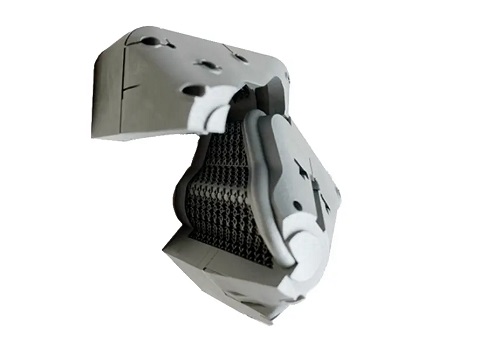
Real-world example: A train manufacturer redesigned a suspension bracket using 3D printing. The new design used a lattice structure inside. The part was 40 percent lighter than the forged original while maintaining strength.
Key fact: A 10 percent weight reduction on a freight locomotive can save 10,000 to 20,000 liters of fuel per year.
Part Consolidation
Traditional locomotives use thousands of parts. Each connection is a potential failure point. Each fastener adds assembly time.
3D printing consolidates assemblies into single components.
| Component | Traditional | 3D Printed |
|---|---|---|
| Fuel injector | 20+ parts | 1 part |
| Hydraulic manifold | Multiple blocks, seals, fasteners | 1 piece |
| Door latch assembly | 15 parts | 1 part |
Real-world example: A manufacturer consolidated a locomotive door latch from 15 parts to one 3D printed component. Assembly time dropped from two hours to five minutes. The part had fewer failure points and weighed less.
On-Demand Spare Parts
Locomotives stay in service for decades. Suppliers stop making parts. Warehouses hold obsolete inventory.
3D printing changes this. A digital file can be stored forever. Parts are printed when needed, not years in advance.
Key fact: The rail industry spends an estimated $50 billion annually on spare parts inventory. On-demand 3D printing could reduce this by 30 to 50 percent.
Complex Internal Geometries
3D printing creates internal structures that traditional methods cannot. Cooling channels can follow curved paths. Lattice structures can be embedded inside solid parts.
Real-world example: A locomotive brake caliper was redesigned with internal cooling channels. The 3D printed version ran 15 percent cooler during heavy braking, extending pad life.
What Materials Are Used for 3D Printed Locomotive Parts?
Metals
| Material | Properties | Applications |
|---|---|---|
| Aluminum (AlSi10Mg) | Lightweight, good thermal conductivity | Brackets, housings, heat exchangers |
| Stainless Steel (17-4 PH) | High strength, corrosion resistant | Structural components, fasteners |
| Titanium (Ti-6Al-4V) | Highest strength-to-weight, corrosion resistant | High-stress components, engine parts |
| Inconel | High-temperature strength | Exhaust components, turbocharger parts |
High-Performance Plastics
| Material | Properties | Applications |
|---|---|---|
| PEEK | High strength, heat resistant, chemical resistant | Gears, bearings, electrical components |
| ULTEM (PEI) | Flame retardant, high strength | Interior components, electrical housings |
| Nylon (PA12) | Tough, durable, lightweight | Ducts, clips, non-structural parts |
| Carbon-fiber reinforced nylon | High stiffness, low weight | Structural brackets, covers |
Key fact: PEEK components can withstand continuous use at 250°C, making them suitable for engine compartment applications.
What Are the Challenges?
Certification
The rail industry has strict safety standards. Components must meet specifications like EN 15085 for welding or EN 45545 for fire safety. 3D printed parts must prove they meet the same requirements.
The challenge: Certification processes were designed for traditional manufacturing. Each new material and process requires validation. This takes time and money.
Progress: Agencies like the Federal Railroad Administration (FRA) and European Union Agency for Railways (ERA) are developing guidelines for additive manufacturing in rail.
Scale and Speed
3D printing is fast for one part. It is slow for hundreds. A locomotive might need 50 identical brackets. Printing them one by one takes longer than casting.
The solution: Use 3D printing where it adds value—complex parts, low-volume spares, and optimized designs. Use traditional methods for high-volume, simple parts.
Material Qualification
Not all materials are available for 3D printing. Exotic alloys used in locomotives may not have proven printability. Material suppliers must provide data on fatigue, corrosion, and long-term performance.
Key fact: A rail component might be subject to 10 million stress cycles over its lifetime. Fatigue data for 3D printed materials is still being collected.
Size Constraints
Industrial 3D printers have build volumes measured in meters. The largest systems can print parts up to 1 meter in size. But locomotive components like frames and bogies are much larger.
The solution: Print smaller components. Print in sections and assemble. Or use 3D printing for tooling that produces larger parts.
How Is 3D Printing Being Used in Rail Today?
Spare Parts
This is the most mature application. Rail operators are printing spare parts for aging fleets.
Case Study: Deutsche Bahn
The German rail operator has a digital warehouse of thousands of 3D printable parts. When a part is needed, they print it locally. Lead times dropped from weeks to days. Inventory costs dropped significantly.
Tooling and Fixtures
Manufacturing plants use 3D printing for custom tools.
Real-world example: A railcar manufacturer needed custom fixtures for assembling door systems. Traditional machining would have taken six weeks and cost $10,000. 3D printing produced the fixtures in one week for $1,500.
Prototyping
Designers use 3D printing to test new concepts.
Real-world example: A design team wanted to test a new driver’s console layout. They 3D printed the console in ABS. Drivers tested the layout and provided feedback. The team made changes and printed a new version in days. The process would have taken months with traditional methods.
End-Use Components
Some rail operators are moving to production parts.
Case Study: UK Rail Network
A UK rail operator 3D printed armrests for train seats. The original supplier had stopped production. Printing the armrests locally kept trains in service. The parts passed fire safety tests and have been in service for over three years.
What Does the Future Look Like?
Distributed Manufacturing
Instead of central factories shipping parts worldwide, 3D printers at maintenance depots will print parts on demand. Digital files travel instantly. Physical parts appear locally.
Key benefit: Reduced shipping costs. Faster response to failures. Less inventory.
Optimized Designs
As designers learn to design for additive manufacturing, components will become lighter and more efficient. Lattice structures will replace solid sections. Internal channels will improve cooling and fluid flow.
Hybrid Manufacturing
The future is not 3D printing replacing all traditional methods. It is using each where it excels.
| Method | Best For |
|---|---|
| 3D Printing | Complex geometry, low volume, spare parts, optimization |
| Casting | Large parts, medium to high volume |
| Machining | High precision, simple geometries |
| Forging | High strength, simple shapes |
Yigu Technology’s View
At Yigu Technology, we see 3D printing as a transformative tool for rail manufacturing. We have worked on projects ranging from spare parts to complex assemblies.
Case Study: Locomotive Brake Component
A rail operator needed a replacement for a discontinued brake component. The original supplier had stopped production. We reverse-engineered the part from a surviving example. We printed it in stainless steel using SLM.
The part passed all functional tests. The operator now has a digital file that can produce more parts whenever needed. The cost was 60 percent lower than sourcing from a specialty supplier.
Case Study: Custom Tool for Assembly
A railcar manufacturer needed a custom tool to align door mechanisms during assembly. The tool had complex contours that matched the door profile.
We printed the tool in carbon-fiber reinforced nylon using SLS. The tool was lightweight, durable, and cost $800. Machining would have cost $4,000. The tool has been in daily use for two years.
Our Perspective
3D printing will not replace all locomotive manufacturing. But it will become an essential tool. For spare parts, it eliminates inventory. For custom components, it enables cost-effective production. For new designs, it unlocks weight savings and performance gains.
The rail industry moves slowly. Certification takes time. But the direction is clear. 3D printing is here to stay.
Conclusion
3D printed locomotives are not science fiction. Components are already in service. Spare parts are being printed on demand. New designs are being optimized for additive manufacturing.
The benefits are real. Weight reduction improves fuel efficiency. Part consolidation simplifies assembly. On-demand production eliminates inventory. Design freedom enables performance gains.
Challenges remain. Certification processes need to adapt. Material data must be collected. Scale and speed need improvement.
But the trajectory is clear. 3D printing will revolutionize how we build and maintain trains—not overnight, but steadily. The rail industry that emerges will be more efficient, more flexible, and better equipped to serve the future.
FAQ
What are the most common materials used for 3D printed locomotives?
Metals like aluminum alloys (AlSi10Mg) for lightweight brackets and housings, stainless steel for structural components, and titanium for high-stress parts. High-performance plastics like PEEK for gears and bearings, ULTEM for flame-retardant interior components, and carbon-fiber reinforced nylon for lightweight structural parts are also common.
How does the performance of 3D printed locomotives compare to traditional ones?
3D printed components can match or exceed traditional performance. Optimized lattice structures achieve the same strength with 40 percent less weight. Internal cooling channels improve thermal performance. However, long-term fatigue data for 3D printed materials is still being collected. Traditional manufacturing has a century of proven reliability. The two approaches will likely coexist.
Are 3D printed locomotives suitable for high-speed rail operations?
Potentially, yes. The design freedom of 3D printing allows for aerodynamic shapes that reduce drag. Lightweight components improve energy efficiency. However, high-speed rail demands extreme reliability. Extensive testing is required to validate 3D printed components under high-stress, high-frequency conditions. Certification for high-speed applications will take time, but the potential is significant.
Contact Yigu Technology for Custom Manufacturing
Need 3D printed components for rail applications? Yigu Technology offers additive manufacturing services for metals and high-performance plastics. We work with rail operators, manufacturers, and suppliers to deliver quality parts.
Contact us today to discuss your project. From spare parts to optimized designs, we help you leverage 3D printing for rail.