If you have ever driven a car, used a smartphone, or flown on an airplane, you have relied on components made through metal stamping. This versatile manufacturing process shapes flat metal sheets into precise parts using dies and punches. It is known for its efficiency, accuracy, and cost-effectiveness, especially for high-volume production. This guide covers the types of stamping processes, common materials, and the industries that depend on this critical technology.
What Are the Main Types of Metal Stamping?
Blanking and Piercing
Blanking and piercing are the most fundamental stamping operations.
- Blanking: Cuts a specific shape from a metal sheet to create a “blank” that will be further processed. This is how simple parts like washers and brackets begin.
- Piercing: Creates holes or openings in the metal sheet. It is used for everything from mounting holes to ventilation slots.
These processes are essential for producing basic components efficiently.
Drawing and Embossing
- Drawing: Stretches the metal sheet over a die to form hollow parts like cups, cans, or deep enclosures. This requires precise control to prevent tearing or thinning.
- Embossing: Creates raised or recessed designs on the metal surface. It is used for decorative features, logos, or functional text.
Drawing is common in automotive body panels and fuel tanks. Embossing appears on nameplates and electronic enclosures.
Coining and Forming
- Coining: Compresses the metal to create detailed, high-relief designs or to flatten surfaces. It achieves very tight tolerances and smooth finishes.
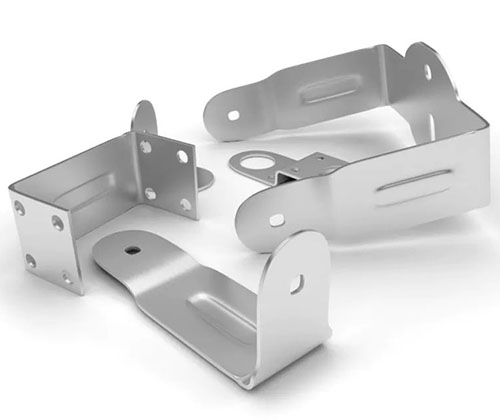
- Forming: Bends or shapes the metal without significantly changing its thickness. This includes simple bends, complex curves, and edge treatments.
Coining is used for electronic connectors and precision contacts. Forming appears in brackets, clips, and structural parts.
Progressive Die Stamping
Progressive die stamping is the most efficient method for complex, high-volume parts. A metal strip moves through a series of dies in one press. Each die performs a specific operation—punching, bending, coining, or cutting. By the time the strip exits the press, a finished part is complete.
This process reduces handling, minimizes labor, and ensures consistent quality. It is ideal for automotive connectors, electronic terminals, and appliance components.
What Materials Are Used in Metal Stamping?
| Material | Key Properties | Common Applications |
|---|---|---|
| Steel | High strength, durability, versatile | Automotive frames, industrial brackets, structural parts |
| Aluminum | Lightweight, corrosion-resistant, high strength-to-weight | Aerospace components, electronics enclosures, heat sinks |
| Brass | Good conductivity, corrosion-resistant, aesthetic | Plumbing fixtures, decorative parts, electrical terminals |
| Copper | Excellent electrical and thermal conductivity | Electrical contacts, connectors, heat exchangers |
| Stainless Steel | Corrosion-resistant, durable, maintains properties at high temperatures | Medical devices, food processing equipment, automotive trim |
Steel
Steel is the most widely used material for stamping. Carbon steel offers strength and affordability for structural parts. Alloy steel provides enhanced properties for demanding applications like gears and engine components.
Aluminum
Aluminum’s lightweight nature makes it ideal for aerospace and automotive parts. It also resists corrosion and conducts heat well, making it suitable for electronics enclosures and heat sinks.
Brass and Copper
These materials are chosen for their conductivity. Brass balances strength with corrosion resistance. Copper offers the highest conductivity for electrical components. Both are also used for decorative applications due to their attractive finishes.
Stainless Steel
Stainless steel combines strength with excellent corrosion resistance. It is used in medical devices, food processing equipment, and outdoor components. Its ability to withstand high temperatures also makes it suitable for aerospace and automotive applications.
Where Is Metal Stamping Used?
Automotive Industry
The automotive sector is one of the largest users of stamped components.
- Engine Parts: Pistons, connecting rods, cylinder heads
- Body Panels: Doors, hoods, fenders
- Transmission Components: Gears, housings
- Safety Systems: Brake components, airbag housings
Stamped parts must meet stringent safety and performance standards. High-volume production demands consistent quality and tight tolerances.
Aerospace and Defense
Aerospace applications require components that are strong, lightweight, and reliable under extreme conditions.
- Structural Components: Wing spars, fuselage frames, landing gear parts
- Engine Parts: Turbine blades, combustion chamber components
- Avionics Housings: Enclosures for sensitive electronic systems
These parts must meet industry standards like AS9100 and undergo rigorous testing.
Electronics and Telecommunications
Electronics rely on stamped components for functionality and miniaturization.
- Connectors and Contacts: For circuit boards and wiring
- Heat Sinks: For thermal management in devices
- Enclosures: Cases for smartphones, laptops, and networking equipment
Aluminum and stainless steel are common choices due to their conductivity and corrosion resistance.
Medical Devices
The medical industry demands precision, cleanliness, and biocompatibility.
- Surgical Instruments: Scalpels, forceps, clamps
- Implants: Orthopedic and dental components
- Diagnostic Equipment: Parts for MRI machines and X-ray equipment
Stainless steel and titanium are frequently used for their durability and compatibility with sterilization processes.
What Custom Solutions Are Available?
Design Flexibility and Scalability
Metal stamping offers significant design flexibility. Engineers can create parts with complex geometries and tight tolerances. The process scales easily—from small batch runs to high-volume production. CAD/CAM software and simulation tools allow designers to optimize part geometry, reduce material usage, and improve production efficiency.
Material Choices and Finishes
Manufacturers can select from a wide range of materials, each offering unique properties. Secondary operations add value:
- Plating: Zinc, nickel, or tin for corrosion resistance
- Coating: Powder coating for durability and appearance
- Heat Treating: Annealing or hardening to achieve desired mechanical properties
Short Run and Prototype Production
Metal stamping is not limited to high volumes. Many stamping companies offer prototyping and short-run production using simplified tooling. This allows manufacturers to test and refine designs before committing to high-volume tooling costs.
Conclusion
Metal stamping is a foundational manufacturing process that shapes flat metal sheets into precise, durable components. Key processes include blanking, piercing, drawing, embossing, coining, forming, and progressive die stamping. Materials range from steel and aluminum to brass, copper, and stainless steel—each selected for specific properties like strength, conductivity, or corrosion resistance. Applications span automotive, aerospace, electronics, medical devices, and telecommunications. With design flexibility, scalability, and a wide range of material and finish options, metal stamping remains an essential solution for producing high-quality parts efficiently.
FAQ
What are the main advantages of metal stamping?
Metal stamping offers high efficiency, accuracy, and cost-effectiveness for high-volume production. It produces parts with consistent quality and tight tolerances. The process also provides design flexibility and works with a wide range of materials.
Which industries commonly use metal stamping?
Metal stamping is widely used in automotive, aerospace, electronics, telecommunications, and medical industries. These sectors require durable, strong, and reliable components that meet stringent quality standards.
What types of materials are used in metal stamping?
Common materials include steel, aluminum, brass, copper, and stainless steel. Each offers unique properties—strength, conductivity, corrosion resistance, or lightweight—suitable for different applications.
What is progressive die stamping?
Progressive die stamping uses a series of dies in a single press to perform multiple operations—cutting, bending, forming—in one continuous process. It is ideal for high-volume production of complex parts, reducing handling and ensuring consistent quality.
Can metal stamping be used for low-volume production?
Yes. Many stamping companies offer prototyping and short-run production using simplified tooling or flexible processes. This allows manufacturers to test designs and validate parts before investing in high-volume tooling.
Contact Yigu Technology for Custom Manufacturing
Metal stamping requires expertise in process selection, tooling design, and material handling. At Yigu Technology, we specialize in custom stamping for automotive, aerospace, electronics, medical, and industrial clients. We work with a wide range of materials—from steel and aluminum to brass, copper, and stainless steel—and deliver parts that meet your exact specifications.
Our capabilities include progressive die stamping, prototyping, and secondary operations like plating and heat treating. Whether you need high-volume production or a custom prototype, we provide reliable, high-quality results.
Contact Yigu Technology today to discuss your metal stamping project.