Die stamping is one of the most widely used manufacturing processes in the world. Yet many people outside the industry do not fully understand how it works or why it matters. At its core, die stamping uses precision tools called dies to shape metal sheets into finished parts. The process is fast, repeatable, and cost-effective at scale. A single press can produce thousands of identical parts per hour. From the washers in your plumbing to the body panels on your car, die-stamped components are everywhere. This guide explains the different types of die stamping, how dies are made, and where the process is used. You will learn why this technology remains essential to modern manufacturing.
How Does Die Stamping Work?
Die stamping starts with a flat metal sheet or coil. The sheet feeds into a press that houses a die set. The die set consists of two parts: the punch (the upper part) and the die (the lower part). When the press closes, the punch forces the metal into the die, shaping it into the desired form.
The process can be as simple as cutting a round washer or as complex as forming a deep automotive panel. Each press stroke produces one part—or, in progressive dies, multiple operations on one part.
What Are the Main Types of Die Stamping?
Blanking and Piercing
Blanking and piercing are the most basic stamping operations. They are often the first steps in creating a part.
Blanking cuts a specific shape from a metal sheet. The cut-out piece is the blank, which will be further processed. The surrounding material is scrap.
Piercing creates holes or openings in the metal. It is essentially blanking, but the cut-out piece is the scrap, and the surrounding material is the part.
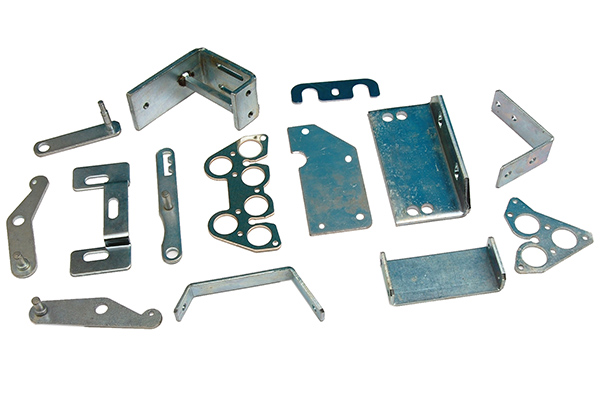
These operations are used for simple components like washers, brackets, and small housings. A single die can combine blanking and piercing to produce finished blanks with holes in one stroke.
Drawing
Drawing shapes flat metal into hollow, cup-like forms. The metal is stretched over a die while a punch pushes it into the cavity. Drawing is used for:
- Automotive body panels
- Fuel tanks
- Kitchen sinks
- Battery enclosures
Deep drawing is a specialized form where the part depth exceeds its diameter. This requires multiple press strokes or progressive dies with intermediate annealing steps to prevent tearing.
Bending and Forming
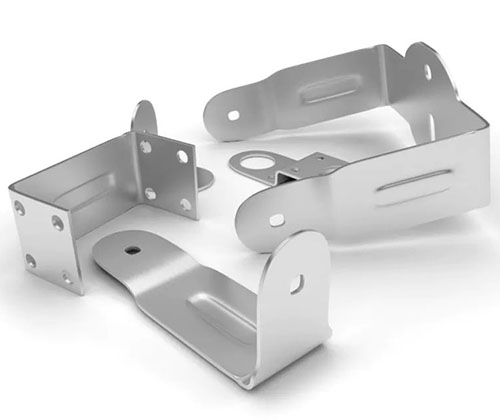
Bending creates angles and curves in flat metal. Unlike drawing, bending does not significantly change the material thickness. The metal simply folds along a straight or curved line.
Forming is a broader term that includes bending, embossing, and other shape changes. It creates features like ribs, dimples, and flanges without cutting the material.
Common applications:
- Brackets and frames
- Electronic enclosures
- Decorative trim
Embossing and Coining
Embossing creates raised or recessed designs on the metal surface. The material thickness remains largely unchanged. Embossing is used for:
- Logos and text
- Decorative patterns
- Functional features like grip textures
Coining is similar but involves compressing the metal to create high-relief details. It actually changes the material thickness in localized areas. Coining is used for:
- Coins and medallions
- Precision electrical contacts
- Detailed hardware components
Progressive Die Stamping
Progressive die stamping is the most efficient method for high-volume production. A single die set contains multiple stations. As a metal strip moves through the press, each station performs a different operation. The part is completed in a continuous sequence.
| Station | Operation |
|---|---|
| 1 | Pierce pilot holes for alignment |
| 2 | Blank outer shape |
| 3 | Form bends |
| 4 | Draw cup shape |
| 5 | Trim excess material |
| 6 | Separate finished part from strip |
A progressive die can produce hundreds of parts per minute. Each part is identical to the last because the tooling controls every operation. This method is used for:
- Electrical terminals
- Automotive brackets
- Electronic connectors
What Goes Into Die Design and Manufacturing?
The die is the heart of the stamping process. A well-designed die produces consistent parts for hundreds of thousands of strokes. A poorly designed die causes defects, downtime, and high costs.
Die Materials
The choice of die material affects tool life and part quality.
| Material | Properties | Best For |
|---|---|---|
| Tool steel (D2, A2) | High strength, good wear resistance | General-purpose stamping |
| High-speed steel (M2, M4) | Excellent cutting performance | Punches, blanking dies |
| Tungsten carbide | Superior wear resistance | High-volume, precision applications |
Tool steel dies are common for production runs up to 500,000 parts. Carbide dies cost more upfront but can run for millions of strokes with minimal wear.
Heat Treatment
Die materials are heat-treated after machining. Hardening increases hardness and wear resistance. Tempering reduces brittleness. A typical tool steel die is hardened to HRC 58 to 62. Carbide dies are already hard and require no heat treatment.
Die Geometry
Die design starts with CAD software. Engineers create 3D models of the part and the tooling that will form it. Key design factors include:
- Clearance: The gap between punch and die. Too little causes excessive force. Too much creates burrs. For steel, clearance is typically 5% to 10% of material thickness.
- Radii: Sharp corners concentrate stress. Use radii on all forming surfaces to prevent cracking.
- Draft angles: For drawn parts, a slight taper helps the part release from the die.
Simulation
Before cutting any steel, designers use simulation software to test the die virtually. The software models material flow, stress, and springback. It catches problems like wrinkling or tearing before they appear on the shop floor.
A manufacturer stamping a deep-drawn automotive part found through simulation that the initial design would tear at a specific radius. They increased the radius by 1 mm in the model. The actual die worked on the first try, saving weeks of rework.
What Presses Are Used for Die Stamping?
Mechanical Presses
Mechanical presses use a flywheel and clutch to deliver force. They are fast and efficient for simple stamping operations. Speeds can reach 500 to 1,000 strokes per minute for small parts.
Hydraulic Presses
Hydraulic presses use fluid pressure to deliver force. They offer full control over speed and pressure throughout the stroke. They are better for deep drawing and complex forming where material flow must be managed.
Servo Presses
Servo presses use electric motors to drive the ram. They combine the speed of mechanical presses with the control of hydraulic systems. The ram speed can vary within a single stroke, allowing optimization for each operation.
Where Is Die Stamping Used?
Automotive Industry
Automotive manufacturing is the largest user of die stamping. A single vehicle contains hundreds of stamped parts. These include:
- Body panels (doors, hoods, fenders)
- Chassis components
- Engine parts (pistons, connecting rods)
- Transmission components
- Safety systems (brake components, airbag housings)
Aerospace and Defense
Aerospace demands components with high strength, low weight, and extreme reliability. Stamped parts include:
- Structural brackets and ribs
- Engine components
- Avionics housings
- Landing gear parts
Electronics and Telecommunications
Electronics need precise, lightweight components that also provide shielding. Stamped parts include:
- Smartphone and laptop enclosures
- Heat sinks
- Connectors and terminals
- 5G infrastructure components
Consumer Products and Appliances
Everyday items rely on stamped parts. Examples include:
- Appliance panels (refrigerators, washing machines)
- Kitchenware
- Hardware (screws, nuts, brackets)
- Tools
How Is Quality Controlled in Die Stamping?
First Article Inspection
When a new die is set up, the first parts are measured thoroughly. Coordinate measuring machines (CMMs) verify all critical dimensions. The part must meet the print before production begins.
In-Process Monitoring
Modern presses use sensors to monitor:
- Punch force
- Material thickness
- Die temperature
- Part ejection
If any variable moves outside control limits, the press stops automatically.
Statistical Process Control
Statistical process control (SPC) tracks key parameters over time. Operators chart measurements and look for trends. A gradual increase in punch force might indicate a dull tool. Catching it early allows tool change before defects occur.
Tool Maintenance
Dies are inspected and maintained on a schedule. Punches are sharpened. Die surfaces are cleaned and lubricated. A well-maintained die set can run for millions of strokes.
Conclusion
Die stamping is a foundational manufacturing process. It takes flat metal and turns it into complex, precise parts at speeds that other processes cannot match. Blanking cuts shapes. Drawing forms hollow parts. Bending creates angles. Progressive dies combine multiple operations into one continuous flow.
The technology behind die stamping continues to evolve. Advanced die materials extend tool life. Simulation software catches problems before steel is cut. Servo presses offer new levels of control. But the core principle remains the same: use precision tooling to shape metal efficiently and repeatably.
From the car you drive to the phone in your pocket, die-stamped parts surround you. Understanding how they are made helps you appreciate the engineering that goes into everyday products—and make better decisions when you need stamped components for your own projects.
FAQ About Die Stamping
What is the primary advantage of die stamping in manufacturing?
Die stamping offers high efficiency, cost-effectiveness, and the ability to produce large volumes of parts with high accuracy and repeatability. Once the die is made, each press stroke produces a part. The cost per part drops significantly with volume.
Which industries commonly use die stamping?
Die stamping is used in automotive, aerospace, electronics, telecommunications, consumer products, and appliance industries. Any sector that needs high-volume, precise metal parts relies on stamping.
How does die stamping ensure high precision and repeatability?
Precision comes from the die itself. The die defines the exact geometry of the part. Modern CNC machining creates dies with tolerances measured in microns. Repeatability comes from the press. Each stroke delivers the same force, in the same position, every time.
What is the difference between blanking and piercing?
Blanking cuts a shape from the sheet, and the cut-out is the part. Piercing cuts holes, and the cut-out is scrap. Many dies combine both operations. The blank is cut, and holes are pierced in the same stroke.
How long do stamping dies last?
Die life depends on material, part complexity, and maintenance. Tool steel dies for simple parts in mild steel can last 500,000 to 1,000,000 strokes. Carbide dies for high-volume work can exceed 5,000,000 strokes. Regular sharpening and cleaning extend life significantly.
Contact Yigu Technology for Custom Manufacturing
Die stamping requires precision tooling, the right presses, and deep process knowledge. At Yigu Technology, we specialize in custom metal stamping for automotive, electronics, and industrial clients. Our team designs and builds dies tailored to your part geometry. We run parts on modern mechanical, hydraulic, and servo presses. Our quality control includes CMM inspection, in-process monitoring, and statistical process control. Whether you need simple blanks or complex progressive-die parts, we have the capabilities to deliver. Contact us today to discuss your project.