
Introduction
You spend hours machining a cast aluminum part. It meets every specification. Then it warps. Dimensions shift. The part is unusable. This frustration is common with conventional cast aluminums. But MIC-6 is different.
MIC-6 aluminum alloy is engineered for stability. Its stress-relief treatment eliminates the residual stresses that cause warping. Its fine-grained, low-porosity microstructure machines cleanly. The result is a material that holds tight tolerances—even in large parts—and maintains dimensional stability over time and temperature changes.
This guide covers CNC machining MIC-6 cast aluminum. You will learn about material properties, stress-relief treatment, machining processes, applications, and quality control. By the end, you will understand how to achieve consistent, high-precision results with this premium cast aluminum.
What Makes MIC-6 Unique Among Cast Aluminums?
Material and Casting Characteristics
MIC-6 is a premium cast aluminum alloy engineered for dimensional stability. Its specialized sand casting process and tight production controls minimize defects.
| Property | MIC-6 | A380 (Die Cast) | 356 (Sand Cast) |
|---|---|---|---|
| Porosity | <0.5% | 1–3% | 2–4% |
| Thermal expansion | Low | Moderate | Moderate |
| Dimensional stability | Excellent | Good | Fair |
| Machinability | Excellent | Good | Fair |
Alloy composition – Predominantly aluminum with 0.2–0.6% silicon, 0.3–0.8% iron, and trace elements. This balance provides strength while maintaining machinability.
Mechanical properties – Tensile strength: 165 MPa. Yield strength: 110 MPa. Hardness: 60–70 HB. Softer than 7075 but ideal for precision parts where stability matters more than ultimate strength.
Thermal properties – Excellent thermal conductivity (180 W/m·K) and low thermal expansion make MIC-6 perfect for heat-sensitive applications like electronics enclosures.
As-cast microstructure – Fine-grained and uniform, with minimal porosity (<0.5% by volume) compared to standard die-cast alloys.
What Is the Stress-Relief Treatment and Why Does It Matter?
The stress-relief treatment is what elevates MIC-6 from a good cast alloy to a great one. Residual stresses from casting can cause warping during machining. MIC-6’s process eliminates this.
| Process | Temperature | Duration | Purpose |
|---|---|---|---|
| Thermal stress relief | 120–150°C | 8–12 hours | Reduces residual stresses; slow cooling (50°C per hour) to room temperature |
| Annealing (optional) | 340°C | 2 hours | Extra stability for critical applications |
Results:
- Residual stress reduced by 80–90%
- Prevents dimensional changes during or after machining
- Grain refinement further enhances dimensional stability
Important: Unlike post-machining stress relief (which can alter finished dimensions), MIC-6’s treatment is done before machining , ensuring parts stay true to spec.
How Do You CNC Machine MIC-6?
Cutting Tools and Materials
| Tool Type | Recommendation | Reason |
|---|---|---|
| Carbide | High-volume work | Superior wear resistance |
| High-speed steel (HSS) | Low-volume jobs | MIC-6’s softness allows cost-effective HSS use |
| End mills | 2–4 flute, sharp edges (rake angle 10–15°) | Improves chip flow, reduces tool wear |
| Drills/reamers | Twist drills with 118° point angle | Prevents “walking” on smooth cast surface |
Machining Parameters
| Parameter | Milling | Turning | Notes |
|---|---|---|---|
| Cutting speed | 200–300 m/min | 250–400 m/min | Faster than 7075 due to lower hardness |
| Feed rate (roughing) | 0.15–0.25 mm/rev | 0.15–0.25 mm/rev | Aggressive material removal |
| Feed rate (finishing) | 0.05–0.1 mm/rev | 0.05–0.1 mm/rev | Achieves Ra 0.8–1.6 μm finish |
| Depth of cut (roughing) | Up to 3 mm | Up to 3 mm | Uniformity allows aggressive removal |
| Depth of cut (finishing) | 0.1–0.3 mm | 0.1–0.3 mm | Precision finishing |
Key Advantages in Machining
| Advantage | Benefit |
|---|---|
| Machinability | Fine grain structure produces clean chips; reduces clogging and tool wear |
| Precision | Tight machining tolerances (±0.002 mm per inch) achievable even in large parts |
| Reduced waste | Minimal porosity and surface defects mean fewer scrapped parts |
Where Does MIC-6 Excel in Applications?
| Industry | Applications | Why MIC-6 |
|---|---|---|
| High-precision | Optical instrument bases, metrology fixtures | Dimensional stability |
| Electronics | Heat sinks, server racks | Thermal conductivity, stability |
| Industrial machinery | Guides, ways, tooling plates | Flatness, rigidity |
| Aerospace | Non-structural components (sensor mounts) | Low weight, stability |
| Medical devices | Imaging equipment housings, precision trays | Tight tolerance requirements |
| Automotive | Dashboard frames, sensor brackets | Maintains shape under temperature fluctuations |
| Consumer products | High-end audio equipment, camera bodies | Smooth surface finish, stability |
How Is Quality Ensured?
Dimensional Accuracy
| Method | Application | Capability |
|---|---|---|
| Laser interferometers | Verify flatness | Within 0.05 mm/m |
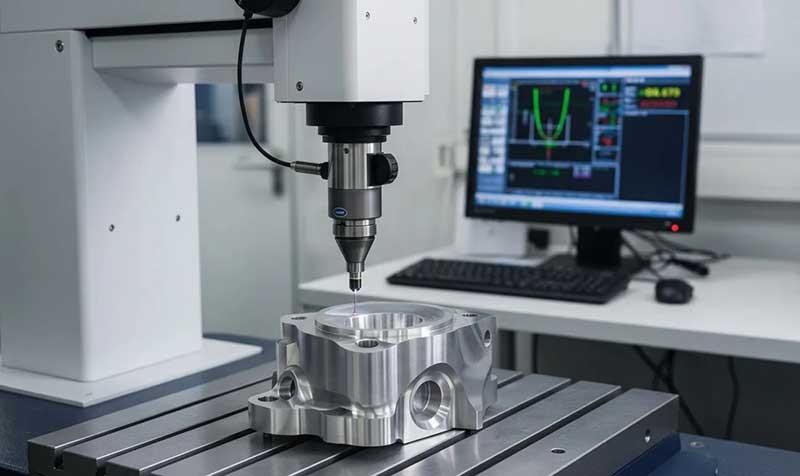
| CMM (Coordinate Measuring Machine) | Verify linear dimensions | ±0.001 mm |
Residual Stress Measurement
| Method | Purpose | Target |
|---|---|---|
| X-ray diffraction | Confirm stress relief effectiveness | Residual stress <50 MPa |
| Hole-drilling | Measure residual stress distribution | Confirm <50 MPa |
Non-Destructive Testing (NDT)
| Method | Application |
|---|---|
| Ultrasonic testing | Checks internal porosity |
| Dye penetrant testing | Inspects surface defects |
Quality Standards
| Standard | Scope |
|---|---|
| ASTM B26 | Cast aluminum specifications |
| ISO 9001 | Quality management systems |
Surface Integrity
Profilometers verify surface finish (Ra <1.6 μm) for sealing or bearing surfaces.
Fatigue performance – Testing under cyclic loads (10⁶ cycles at 50 MPa) confirms durability for moving parts.
What Do Industry Examples Demonstrate?
Electronics Enclosure Manufacturer
A manufacturer producing server racks switched from standard cast aluminum to MIC-6. Results:
- Post-machining warpage reduced by 90%
- Flatness maintained within 0.05 mm/m across 1-meter parts
- Scrap rate dropped from 8% to <1%
Medical Imaging Equipment
A medical device company required housings for MRI equipment that maintained tolerances despite temperature changes. MIC-6’s low thermal expansion and dimensional stability enabled:
- Consistent fit across production runs
- No post-machining distortion
- Compliance with medical equipment standards
Conclusion
MIC-6 cast aluminum offers advantages that make it the preferred choice for high-precision, dimensionally stable components. Its stress-relief treatment reduces residual stresses by 80–90% , eliminating the warping that plagues conventional cast aluminums. Its fine-grained, low-porosity microstructure (<0.5% porosity) machines cleanly and achieves tight tolerances.
Machining parameters leverage MIC-6’s excellent machinability. Cutting speeds of 200–300 m/min (milling) and 250–400 m/min (turning) are faster than harder alloys like 7075. Finishing feeds of 0.05–0.1 mm/rev achieve surface finishes of Ra 0.8–1.6 μm . Depth of cut up to 3 mm for roughing is possible due to material uniformity.
Quality control ensures consistency. Laser interferometers verify flatness within 0.05 mm/m. CMM inspection verifies linear dimensions. NDT methods check for porosity and surface defects. Residual stress measurement confirms stress relief effectiveness (<50 MPa).
Applications span industries requiring stability. Electronics enclosures leverage thermal conductivity (180 W/m·K) and low thermal expansion. Medical imaging equipment housings maintain tolerances despite temperature changes. Industrial tooling plates achieve flatness within 0.1 mm/m even at lengths up to 3 meters.
From optical instrument bases to server racks, from aerospace sensor mounts to high-end audio equipment, MIC-6 delivers the stability, machinability, and precision that demanding applications require.
FAQ
Why is MIC-6 preferred over other cast aluminums for high-precision parts?
MIC-6’s stress-relief treatment and low porosity (<0.5%) minimize post-machining warping, allowing tighter tolerances (±0.002 mm per inch ) than standard cast alloys like A380. Its dimensional stability ensures parts maintain accuracy over time and temperature changes.
Can MIC-6 be welded or joined to other materials?
Yes, but its low alloy content requires care. TIG welding with 4043 filler rod works best. Welding may introduce minor stresses that require re-relief if the part must maintain the same dimensional stability as the base material.
What is the maximum size of MIC-6 parts that can be machined without warping?
MIC-6’s stability allows machining of large parts up to 3 meters in length with flatness maintained within 0.1 mm/m . This makes it ideal for industrial tooling plates, machine bases, and large electronics enclosures where stability across size is critical.
What surface finish can MIC-6 achieve?
With finishing feeds of 0.05–0.1 mm/rev and sharp tools, MIC-6 achieves surface finishes of Ra 0.8–1.6 μm . For applications requiring smoother finishes (sealing surfaces, bearings), additional processes like grinding or polishing can achieve Ra <0.4 μm.
How does MIC-6 compare to 7075 aluminum for machining?
MIC-6 is softer (60–70 HB vs. 7075’s 150 HB), allowing higher cutting speeds (200–300 m/min vs. 100–150 m/min) and longer tool life. 7075 offers higher strength (tensile 572 MPa vs. MIC-6’s 165 MPa) but lacks MIC-6’s dimensional stability. Choose MIC-6 when stability matters; choose 7075 when ultimate strength is the priority.
Contact Yigu Technology for Custom Manufacturing
At Yigu Technology, we specialize in CNC machining MIC-6 cast aluminum for high-precision applications. Our expertise leverages MIC-6’s machinability with optimized cutting parameters—using carbide tools for fast, clean cuts while maintaining tight tolerances.
We validate every batch with NDT (ultrasonic testing, dye penetrant) and dimensional checks (CMM, laser interferometers) , ensuring your parts meet the stability requirements for electronics enclosures, medical devices, industrial tooling, and aerospace applications.
Contact us today to discuss your MIC-6 machining project. Let our expertise help you achieve the stability, precision, and reliability your application demands.


