Introduction
You look at a car door, a laptop casing, or an aircraft wing. They all share something: they started as flat sheets of metal. But how do flat sheets become complex, curved, three-dimensional shapes?
Sheet metal 3D is the answer. It is the process of taking thin, flat metal and transforming it into functional, three-dimensional parts. Bending, stamping, and forming techniques turn simple sheets into everything from structural frames to sleek consumer electronics.
This guide covers the principles behind sheet metal 3D, where it is used, and what you need to know to work with it effectively. Whether you are designing a new product or sourcing fabricated components, you will understand how flat metal becomes 3D form.
What Is Sheet Metal 3D?
From Flat Sheets to Three Dimensions
Sheet metal starts as flat material—typically steel, aluminum, or stainless steel—in thicknesses ranging from thin foil to several millimeters. Sheet metal 3D refers to the set of processes that give these flat sheets volume, shape, and structure.
The transformation happens through controlled deformation. Unlike machining, which removes material, forming preserves the material while changing its shape. This makes sheet metal fabrication efficient: you start with a flat sheet and end with a part, with minimal waste.
Key Principles of Metal Forming
Metals have two properties that make 3D forming possible:
- Malleability: The ability to be hammered or pressed into shape without cracking.
- Ductility: The ability to stretch or elongate without breaking.
When you bend a sheet, the material on the outside of the bend stretches. The material on the inside compresses. A well-designed bend balances these forces so the metal does not tear or buckle.
Critical factors in forming include:
- Bend radius: Smaller radii concentrate stress. A general rule: inside bend radius should be at least one material thickness for most steels.
- Material thickness: Thicker sheets require more force and larger bend radii.
- Grain direction: Metal rolled into sheets has a grain. Bending across the grain reduces cracking risk.
Real-World Example: A manufacturer tried bending 3 mm stainless steel with a tight 2 mm radius. Cracks appeared along the bend line. After adjusting the design to a 6 mm radius and bending across the grain, the parts formed cleanly with no defects.
What Processes Create Sheet Metal 3D?
Bending: The Most Common Method
Bending uses a press brake to apply force along a straight line, creating angular shapes. The material is placed between a punch (top tool) and a die (bottom tool). As the punch descends, it forces the metal into the die, creating the bend.
Common bend types:
- V-bending: The most common. The sheet is pressed into a V-shaped die.
- Air bending: The punch does not fully seat the material into the die. This allows flexibility—one tool set can create multiple angles by adjusting punch depth.
- Bottoming: The punch forces the material fully into the die, creating a precise, repeatable angle.
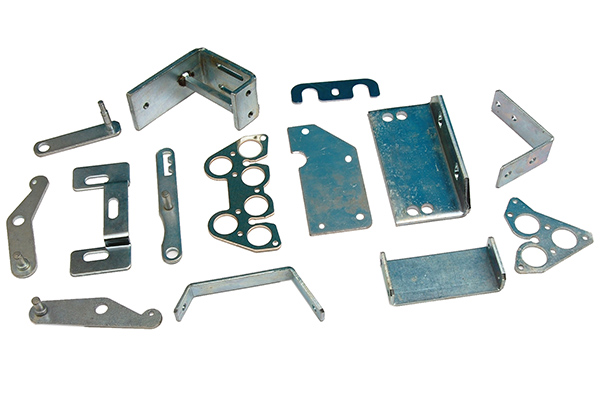
Bending transforms flat sheets into channels, boxes, brackets, and enclosures. It is fast, repeatable, and produces strong, continuous forms.
Stamping: High-Volume Complex Shapes
Stamping uses a die and a press to shape sheet metal. The die contains the negative shape of the desired part. When the press closes, the sheet metal is forced into the die cavity, taking its form.
Stamping is ideal for high-volume production. A single stamping operation can create complex curves, ribs, and features in one stroke. Car body panels—hoods, doors, fenders—are classic stamping applications.
Progressive stamping uses a series of stations in one die. The sheet moves through each station, with operations like punching, bending, and cutting happening sequentially. This produces finished parts in seconds.
Deep Drawing: Creating Hollow Forms
Deep drawing pulls sheet metal into a die cavity using a punch, creating hollow shapes like cups, cylinders, and enclosures. The material stretches as it is drawn inward.
Common applications:
- Sinks and basins
- Fuel tanks
- Battery casings
- Cookware
Case Study: A customer needed 500 cylindrical battery housings. Machining from solid bar would have been slow and wasteful. Deep drawing produced each housing in seconds, using exactly the material needed and no more. Cost per part dropped by 75% compared to machining.
What Industries Rely on Sheet Metal 3D?
Automotive: Strength and Aerodynamics
The automotive industry is one of the largest users of sheet metal 3D. Over 70% of a typical car’s body surface consists of formed sheet metal parts. Doors, hoods, fenders, roof panels, and structural reinforcements all start as flat sheets.
Modern stamping presses can produce complex shapes with integrated features like reinforcement ribs and mounting points. These parts contribute to:
- Aerodynamics: Smooth curves reduce drag.
- Safety: Formed structures absorb and distribute impact energy. Crash tests show well-designed sheet metal components can improve occupant protection by managing crush zones.
- Weight reduction: High-strength steels and aluminum allow thinner sheets without sacrificing strength.
Aerospace: Lightweight Precision
In aerospace, every gram counts. Sheet metal 3D produces wing skins, fuselage panels, and engine components from materials like aluminum and titanium. These parts combine high strength-to-weight ratios with complex aerodynamic shapes.
The use of formed sheet metal in aircraft structures has contributed to weight reductions of up to 20% in some programs. Less weight means lower fuel consumption and longer range.
Electronics: Compact Enclosures
Electronic devices demand precise, compact housings. Smartphones, laptops, servers, and medical equipment use sheet metal 3D to create:
- Outer casings (often aluminum)
- Internal frames and brackets
- Heat sinks and thermal management components
The precision of modern forming allows for tight tolerances—critical when components must fit in increasingly slim packages. A well-formed aluminum laptop chassis provides both structural rigidity and a premium finish.
Construction: Architectural Elements
Architectural features like metal facades, decorative screens, and roof panels use sheet metal 3D. Complex curves and patterns can be formed off-site, then installed quickly. This reduces on-site labor and improves consistency.
What Materials Work for Sheet Metal 3D?
Different materials behave differently during forming. The table below summarizes common options.
| Material | Formability | Common Applications |
|---|---|---|
| Low-carbon steel | Excellent | Automotive panels, brackets, enclosures |
| Stainless steel (304) | Good (work-hardens) | Food equipment, architectural trim |
| Aluminum (5052) | Excellent | Marine parts, fuel tanks, deep-drawn shapes |
| Aluminum (6061) | Fair (heat-treatable) | Structural components, aerospace |
| Copper | Excellent | Electrical components, decorative work |
| Titanium | Fair (requires specialized equipment) | Aerospace, medical implants |
Pro Tip: Aluminum 5052 is highly formable and resists cracking during deep drawing. Aluminum 6061 is stronger but less formable—better for structural parts with simple bends.
How Do You Ensure Quality in Sheet Metal 3D?
Design for Manufacturability
Good 3D sheet metal designs follow basic rules:
- Maintain uniform wall thickness (sheet thickness)
- Use bend radii at least one material thickness
- Avoid sharp internal corners—they concentrate stress
- Place holes and features away from bend lines (at least 2–3 times material thickness)
Process Control
Precision starts with accurate equipment. CNC-controlled press brakes and stamping presses repeat the same motion thousands of times with minimal variation. Backgauges position material accurately. Tooling must be maintained for sharpness and alignment.
Inspection
Quality checks should occur throughout production:
- First article inspection: Verify the first part meets all dimensions before running the full order.
- In-process checks: Sample parts at regular intervals.
- Final inspection: Verify dimensions, surface finish, and any special requirements.
Tools include calipers, height gauges, optical comparators, and 3D scanners for complex surfaces.
Conclusion
Sheet metal 3D transforms flat sheets into functional, three-dimensional parts across industries. Bending creates angular forms efficiently. Stamping produces complex shapes at high volumes. Deep drawing forms hollow enclosures.
Success depends on understanding material properties, designing for manufacturability, and controlling the forming process. When done well, sheet metal 3D delivers strong, lightweight, cost-effective components that form the backbone of modern manufacturing.
FAQs
What are the typical materials used in sheet metal 3D?
Common materials include low-carbon steel (cost-effective, formable), stainless steel (corrosion-resistant, used in food and medical applications), aluminum (lightweight, high strength-to-weight ratio), and copper (conductive, malleable). Titanium is used in aerospace and medical applications where weight and strength are critical.
How do you ensure the quality of sheet metal 3D products?
Quality starts with material inspection before production. During fabrication, precision control of bending and stamping equipment ensures consistent dimensions. Regular in-process checks catch deviations early. Final inspection may include dimensional checks, surface finish verification, and non-destructive testing for critical applications.
Is sheet metal 3D suitable for small-batch production?
Yes. While high-volume stamping requires expensive tooling, bending and laser cutting have minimal setup costs. CNC press brakes can be programmed for different parts without changing tooling. This makes sheet metal 3D ideal for prototypes, custom parts, and small production runs. Lead times are short, and design changes are easy to implement.
What is the difference between bending and stamping?
Bending uses a press brake to create straight-line angles—channels, brackets, boxes. It is flexible and suitable for low to medium volumes. Stamping uses a die to create complex shapes in one stroke. It is efficient for high volumes but requires dedicated tooling. Many projects use both: stamping for complex features, bending for final form.
Contact Yigu Technology for Custom Manufacturing
At Yigu Technology, we specialize in turning flat sheet metal into precision 3D components. Our capabilities include CNC bending, stamping, deep drawing, and laser cutting. We work with steel, stainless steel, aluminum, copper, and specialty alloys. Whether you need a prototype or a production run, we help you design for manufacturability and deliver consistent quality. Contact us to discuss your next sheet metal project—we will help you bring your 3D designs to life.