Introduction
You need stainless steel parts. They must resist corrosion, hold tight tolerances, and come in volume. But you also need to keep production moving. You cannot afford tools that wear out every few parts or cycle times that stretch into hours.
SS303 stainless steel was made for this. It is a free-machining version of the popular 304 grade, with added sulfur that transforms how it cuts. Chips break cleanly. Cutting forces drop. Speeds increase. Production times shrink by 30–40% compared to machining 304.
But SS303 is not without trade-offs. The sulfur that makes it machine so well also slightly reduces corrosion resistance. And in high-volume runs, the same sulfur can be abrasive, accelerating tool wear if you are not careful.
At Yigu Technology, we machine SS303 daily for automotive, industrial, and food processing clients. This guide covers the material’s properties, machining strategies, tool selection, and the post-processing needed to get the most from this efficient stainless steel.
What Makes SS303 Different?
A Free-Machining Stainless Steel
SS303 is an austenitic stainless steel—the same family as 304—but with a critical addition: 0.15–0.35% sulfur. This sulfur is not a contaminant. It is deliberately added to improve machinability.
| Element | Composition | Role |
|---|---|---|
| Chromium | 17–19% | Corrosion resistance |
| Nickel | 8–10% | Austenitic structure; toughness |
| Sulfur | 0.15–0.35% | Chip breaking; reduces cutting forces |
| Iron | Balance | Base material |
The sulfur forms small manganese sulfide inclusions. These inclusions act as chip breakers. Instead of long, stringy chips that wrap around tools, SS303 produces short, curly chips that evacuate easily. Cutting forces drop. Tool life improves.
Mechanical Properties
| Property | Value | Implication |
|---|---|---|
| Tensile Strength | 515 MPa | Good strength for most applications |
| Yield Strength | 205 MPa | Moderate; design accordingly |
| Hardness | 18–22 HRC (annealed) | Softer than hardened steel; machines well |
| Elongation | 40–50% | Ductile; forms chips cleanly |
Corrosion Resistance
SS303 offers good corrosion resistance in mild environments—air, fresh water, steam, and many chemicals. However, it is slightly less corrosion-resistant than 304. The sulfur inclusions can create localized sites where corrosion can initiate if the surface is not properly treated.
For applications in harsh environments (marine, chemical processing), 304 or 316 may be better choices. For indoor, industrial, or food processing applications (with proper passivation), SS303 performs well.
Non-Magnetic Properties
Like other austenitic stainless steels, SS303 is non-magnetic in the annealed condition. Cold working—bending, forming, or heavy machining—can induce slight magnetism. For applications requiring strict non-magnetic properties, specify annealed material and minimize cold working.
How to Machine SS303 Effectively?
Milling
SS303 mills beautifully. Its chip-breaking behavior allows faster speeds and feeds than other stainless grades.
| Parameter | Recommended Range | Notes |
|---|---|---|
| Cutting speed (carbide) | 150–300 m/min | Higher speeds for production |
| Feed per tooth | 0.15–0.3 mm/tooth | Moderate feeds for chip control |
| Depth of cut | 1–5 mm | Aggressive roughing possible |
Milling strategies:
- Conventional milling works well, though climb milling reduces tool wear for finishing passes
- 2-flute or 4-flute end mills both work; 2-flute for roughing, 4-flute for finishing
Turning
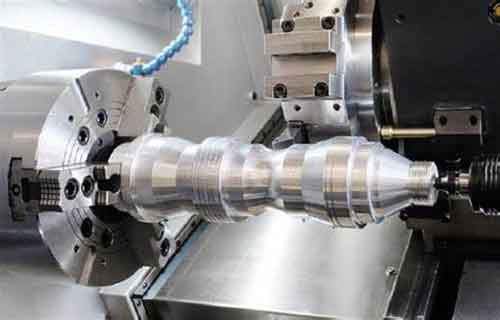
Turning SS303 is where its free-machining nature really shines. High speeds and feeds are possible with good chip control.
| Parameter | Recommended Range | Notes |
|---|---|---|
| Cutting speed (carbide) | 200–400 m/min | Fast turning possible |
| Feed rate | 0.2–0.4 mm/rev | Higher feeds for roughing |
| Depth of cut | 2–6 mm | Aggressive roughing |
Turning strategies:
- Use inserts with chip breakers to maintain chip control at high feeds
- Positive rake angles (5–10°) reduce cutting forces
- Flood coolant is recommended for production runs
Drilling and Boring
Drilling SS303 is less demanding than drilling 304. The sulfur additives reduce the tendency for chips to pack in flutes.
| Parameter | Recommended Range | Notes |
|---|---|---|
| Cutting speed (HSS) | 60–120 m/min | Carbide allows higher speeds |
| Feed rate | 0.1–0.2 mm/rev | Moderate feeds |
| Peck depth | 2–3 mm | Peck drilling for deep holes |
Coolant requirement: Minimal compared to 304. Flood coolant or even mist systems often suffice, though high-pressure coolant helps with deep holes.
What Tools Work Best for SS303?
Tool Materials
| Tool Material | Suitability | Life Expectancy |
|---|---|---|
| HSS (High-Speed Steel) | Low-volume, prototypes | Adequate; cost-effective |
| Carbide | High-volume production | 2–3× longer than HSS |
| Coated carbide | Extended life, high speeds | 30–50% longer than uncoated |
HSS tools are viable for small runs and prototypes. They are less expensive and perform adequately at moderate speeds. For production runs exceeding 100 parts, carbide tools pay for themselves through longer life and consistent quality.
Tool Coatings
| Coating | Benefit | Life Extension |
|---|---|---|
| TiN (Titanium Nitride) | Reduces friction; general purpose | 20–30% |
| TiAlN (Titanium Aluminum Nitride) | Heat resistance; high-speed applications | 30–50% |
TiAlN coatings are particularly effective for SS303 at higher cutting speeds (above 300 m/min). The coating’s heat resistance prevents thermal damage to the carbide substrate.
Tool Geometry
| Feature | Recommendation | Why |
|---|---|---|
| Rake angle | Positive (5–10°) | Reduces cutting forces |
| Chip breaker | Built-in for turning inserts | Maintains chip control |
| Edge sharpness | Sharp | Enhances chip breaking |
| Tool holders | Collet chucks or hydraulic | Rigidity prevents deflection |
Tool Wear Management
SS303’s sulfur content improves machinability, but it is abrasive. In high-volume runs, tools will wear. The key is managing that wear.
Expectations:
- Carbide tools: 30–60 minutes of cutting time in production
- Coated carbide: 45–90 minutes
Monitoring:
- Replace tools when flank wear exceeds 0.2 mm
- Watch for deteriorating surface finish—this often precedes dimensional drift
- For high-volume production, use tool life management software to schedule changes
How to Control Chips and Coolant?
Chip Control
SS303 produces short, curly chips—a welcome change from the stringy chips of 304. Proper tooling enhances this natural advantage.
Strategies:
- Use inserts with chip breakers for turning operations
- Maintain feed rates above 0.2 mm/rev for turning to promote chip breaking
- For milling, 2-flute end mills provide more chip clearance
- Avoid dwell—keep the tool moving
What to avoid:
- Feed rates too low cause rubbing and stringy chips
- Dull tools fail to break chips effectively
Coolant Strategy
SS303 is less demanding on coolant than 304, but proper cooling still matters.
| Operation | Coolant | Why |
|---|---|---|
| Roughing | Flood coolant (5–10 bar) | Cools; flushes chips |
| Finishing | Flood or mist | Adequate for light cuts |
| Deep drilling | High-pressure (30–50 bar) | Ensures chip evacuation |
Flood coolant is sufficient for most SS303 operations. High-pressure systems are beneficial for deep holes or high-volume production.
What Surface Finish and Tolerances Are Achievable?
Surface Finish
| Finish Level | Ra Value | Method |
|---|---|---|
| Roughing | 3.2 μm | Standard parameters |
| General purpose | 1.6 μm | Sharp tools, moderate feeds |
| Precision finish | 0.8 μm | Optimized parameters, finishing pass |
| Polished (post-machining) | 0.05–0.2 μm | Mechanical or electropolishing |
Food processing applications often require Ra ≤ 1.6 μm to prevent bacterial buildup. This is readily achievable with SS303 using standard finishing practices.
Dimensional Tolerances
| Part Size | Typical Tolerance | Best Achievable |
|---|---|---|
| Small (<50 mm) | ±0.01–0.02 mm | ±0.005 mm |
| Medium (50–200 mm) | ±0.02–0.05 mm | ±0.01 mm |
| Large (>200 mm) | ±0.05–0.1 mm | ±0.02 mm |
SS303’s good dimensional stability and low cutting forces allow tight tolerances, especially with rigid setups and carbide tooling.
Quality Control
| Method | Purpose | Typical Accuracy |
|---|---|---|
| CMM (Coordinate Measuring Machine) | Dimensional verification | ±0.001 mm |
| Profilometer | Surface roughness (Ra) | ±0.01 μm |
| Optical comparator | Edge profiles, threads | ±0.005 mm |
ASTM A582 defines material standards for SS303 bars and rods. Compliance ensures material consistency.
What Post-Machining Processes Are Needed?
Passivation: Restoring Corrosion Resistance
Machining SS303 leaves free iron on the surface. This iron can rust, and the sulfur inclusions can become corrosion initiation sites if not treated.
Passivation removes this free iron and restores corrosion resistance.
Process:
- Clean parts thoroughly
- Immerse in nitric acid solution (20–25% by volume)
- Rinse with deionized water
- Dry
Effect: Passivation improves corrosion resistance by 30–40%. Salt spray resistance increases from approximately 200 hours to 500+ hours.
Electropolishing
For applications requiring:
- Mirror finishes (Ra ≤ 0.05 μm)
- Maximum corrosion resistance
- Removal of microscopic surface defects
Electropolishing removes a thin layer of material electrochemically, smoothing surface irregularities and dissolving micro-pits caused by sulfur inclusions.
Annealing
SS303 is typically machined in the annealed condition. If parts undergo significant cold working before machining, annealing restores ductility and reduces residual stress.
Annealing process:
- Heat to 1010–1120°C
- Hold for time based on section thickness
- Rapid cool (water or air)
Stress relief annealing (300–500°C for 1–2 hours) reduces machining-induced stresses in complex parts, preventing distortion.
Post-Machining Cleaning
Ultrasonic cleaning removes coolant residues and fine chips from internal features and crevices. This is essential before passivation or electropolishing.
Where Is SS303 Used?
Automotive Parts
SS303’s machinability makes it ideal for high-volume automotive components.
| Application | Why SS303 |
|---|---|
| Valve stems | Good wear resistance; machinable threads |
| Fuel system components | Resists gasoline and diesel |
| Fasteners | High production rates; consistent threads |
| Sensors | Non-magnetic (annealed); corrosion-resistant |
Mechanical Components
| Application | Why SS303 |
|---|---|
| Gears | Complex shapes; good strength |
| Shafts | Precision turning; wear resistance |
| Bushings | Moderate loads; cost-effective |
| Pulleys | High-volume production |
Fasteners
SS303 is a standard material for screws, bolts, and nuts. Threads cut cleanly. Production rates are 30–40% higher than with 304. Per-unit costs drop significantly.
Industrial Machinery
| Application | Why SS303 |
|---|---|
| Pulleys and levers | Good strength; easy machining |
| Fittings and couplings | Corrosion resistance in industrial environments |
| Hydraulic components | Non-critical applications |
Food Processing Equipment
After passivation, SS303 is suitable for food processing components.
| Application | Why SS303 |
|---|---|
| Conveyor parts | Easy to clean; corrosion-resistant |
| Mixing components | Good surface finish achievable |
| Guide rails | Wear-resistant; cost-effective |
Medical Devices
For non-critical medical components—instrument handles, housings, and frames—SS303 offers cost-effective machinability and easy sanitization.
How Does SS303 Compare to Other Materials?
| Material | Machinability (Relative) | Corrosion Resistance | Tensile Strength (MPa) | Cost (Relative) |
|---|---|---|---|---|
| SS303 | Excellent (100%) | Good | 515 | High |
| SS304 | Good (60–70%) | Excellent | 515 | High |
| SS316 | Good (50–60%) | Superior | 520 | Very High |
| Aluminum 6061 | Excellent (90%) | Good | 310 | Low |
| Brass C36000 | Excellent (110%) | Fair | 414 | Medium |
SS303 vs. SS304
- Machinability: SS303 is 30–40% faster to machine
- Corrosion: SS304 is better for harsh environments
- Choice: SS303 for high-volume, complex parts; SS304 for corrosion-critical applications
SS303 vs. SS316
- Machinability: SS303 is significantly better
- Corrosion: SS316 is superior, especially in chlorides
- Choice: SS303 for industrial; SS316 for marine or chemical processing
SS303 vs. Aluminum 6061
- Strength: SS303 is stronger
- Weight: Aluminum is lighter
- Corrosion: Both are good in different ways
- Choice: SS303 for load-bearing; aluminum for weight-sensitive
SS303 vs. Brass C36000
- Machinability: Brass is slightly better
- Strength: SS303 is stronger
- Corrosion: SS303 is better
- Choice: SS303 for industrial; brass for decorative or electrical
Yigu Technology's Perspective
At Yigu Technology, we machine SS303 extensively for automotive and industrial clients. Our data shows that TiAlN-coated carbide tools running at 250 m/min in turning operations reduce tool changes by 35% compared to HSS tools.
Our standard practice:
- Carbide tooling with TiAlN coating for production runs
- Cutting speeds: 200–300 m/min for turning; 150–250 m/min for milling
- Passivation for all parts requiring corrosion resistance (improves salt spray resistance from 200 to 500+ hours)
- 100% dimensional inspection with CMM for critical features
- Surface finish verification with profilometer
We recommend SS303 for:
- High-volume parts with complex geometries
- Applications where machinability drives cost
- Components that will be passivated after machining
Conclusion
SS303 stainless steel delivers what its name promises: free-machining performance. The sulfur additives that set it apart from 304 transform how it cuts. Chips break. Speeds increase. Tools last.
Success with SS303 comes from:
- Carbide tooling (TiAlN-coated for production)
- Higher speeds (200–400 m/min for turning; 150–300 m/min for milling)
- Positive rake angles (5–10°) to reduce cutting forces
- Flood coolant for production; mist for finishing
- Passivation after machining to restore corrosion resistance
When these practices are followed, SS303 delivers parts at lower cost and higher volume than any other stainless steel. It is the material of choice when machinability matters as much as corrosion resistance.
FAQ
When should SS303 be chosen over SS304?
SS303 is preferred for high-volume parts with complex geometries (gears, fasteners, valve stems) where machinability and production speed are critical. SS304 is better for corrosion-sensitive applications (chemical equipment, marine hardware, outdoor components exposed to salt). The rule of thumb: if the application requires maximum corrosion resistance, choose 304. If it requires maximum machinability, choose 303.
Does SS303 require special coolants during machining?
No. Flood coolant or even mist systems are sufficient. SS303’s sulfur additives reduce the cooling and lubrication demands compared to 304. For deep drilling, high-pressure coolant (30–50 bar) improves chip evacuation, but standard flood coolant handles most operations.
Can SS303 be welded?
Welding SS303 is possible but not recommended. The sulfur content causes porosity and cracking in weld zones. If joining is required, consider:
- Mechanical fastening: Bolts, rivets, or threaded connections
- Switching to 304 for welded assemblies
- If welding is unavoidable, use low-sulfur filler metals and expect reduced weld strength
How does passivation improve SS303’s corrosion resistance?
Passivation removes free iron from the surface and cleans sulfur inclusions. The process restores the chromium oxide layer that gives stainless steel its corrosion resistance. Passivation improves salt spray resistance from approximately 200 hours to 500+ hours, making SS303 suitable for many industrial and food processing applications.
What is the best tool material for high-volume SS303 production?
TiAlN-coated carbide is the best choice for production runs. It offers:
- 30–50% longer tool life than uncoated carbide
- Heat resistance for higher cutting speeds (250–400 m/min)
- Consistent performance across long runs
For low-volume runs (1–100 parts), HSS tools are a cost-effective alternative.
Contact Yigu Technology for Custom Manufacturing
At Yigu Technology, we specialize in CNC machining of SS303 stainless steel for high-volume applications. Our capabilities include CNC turning, milling, and multi-axis machining with carbide tooling optimized for free-machining grades.
We serve the automotive, industrial machinery, food processing, and medical device sectors. Our quality process includes 100% dimensional inspection for critical features and passivation to restore corrosion resistance.
Whether you need thousands of fasteners, complex valve components, or precision shafts, we deliver SS303 parts efficiently and reliably.
Contact us today to discuss your SS303 machining project.