Introduction
You have a sheet metal project. Maybe you are building an enclosure, fabricating a bracket, or prototyping a new product. The first challenge is often the same: how to cut sheet metal cleanly, accurately, and without ruining the material.
Walk into any metal shop, and you will see multiple cutting machines—lasers, plasma torches, shears. Each serves a purpose. Choose the wrong method, and you end up with rough edges, warped material, or wasted time and money.
This guide breaks down the main cutting methods, when to use each, and what factors matter most. Whether you are a DIY enthusiast or a professional sourcing parts, you will learn how to select the right approach for your project.
What Are the Main Cutting Methods?
Laser Cutting: Precision and Complexity
Laser cutting uses a focused high-power laser beam to melt, burn, or vaporize metal. The beam follows a programmed path, creating cuts with exceptional accuracy.
Advantages:
- High precision: Tolerances can reach ±0.05 mm. This makes laser cutting ideal for intricate parts like electronic components, medical devices, and decorative elements.
- Complex shapes: The laser can follow any path, allowing for detailed patterns and tight interior corners.
- Minimal heat distortion: The heat-affected zone is very small. Surrounding material retains its original properties, reducing the need for post-processing.
Limitations:
- Thickness limits: Most industrial lasers cut steel up to about 25 mm. Thicker materials become challenging and slow.
- Cost: Equipment and operating costs are higher than some alternatives, especially for thick plates.
Real-World Example: A medical device company needed tiny stainless steel components with slots just 0.5 mm wide. Shearing and plasma cutting could not achieve the required precision. Laser cutting delivered clean, accurate parts with no secondary finishing required.
Plasma Cutting: Speed and Thickness
Plasma cutting creates a high-temperature plasma arc (up to 30,000°F) that melts metal. A jet of gas blows the molten material away, leaving a cut.
Advantages:
- Thick materials: Plasma cuts steel, stainless steel, and aluminum up to 100 mm or more. It is the go-to method for heavy plates in construction, shipbuilding, and heavy equipment.
- Speed: Faster than laser on thick materials.
- Versatility: Works on conductive metals including steel, stainless, aluminum, copper, and brass.
Limitations:
- Lower precision: Typical tolerance is ±0.5 mm to ±1 mm. Not suitable for intricate details.
- Rougher edges: Cut surfaces may have a slight bevel and require additional finishing for critical applications.
Shearing: Straight Lines and High Volume
Shearing is a mechanical cutting method. A shear machine applies force along a straight line, causing the metal to fracture cleanly.
Advantages:
- Straight cuts only but very efficient: Ideal for cutting large sheets into smaller rectangles or squares.
- Low cost: Equipment is simpler and less expensive than laser or plasma systems.
- High speed: Excellent for high-volume production of simple shapes. A shear can cycle in seconds.
Limitations:
- Straight lines only: Cannot create curves or interior features.
- Edge deformation: The cutting action may leave a slight burr or distortion along the cut edge.
How Do You Choose the Right Method?
Consider Material Type and Thickness
Different metals respond differently to cutting methods. The table below provides general guidelines.
| Material | Thickness | Recommended Method | Why |
|---|---|---|---|
| Aluminum | Up to 3 mm | Laser cutting | Smooth edges, high precision |
| Aluminum | Over 3 mm | Plasma cutting | Handles thickness efficiently |
| Mild Steel | Up to 6 mm | Laser or Shearing | Laser for precision; shearing for straight cuts |
| Mild Steel | Over 6 mm | Plasma cutting | Cost-effective for thick sections |
| Stainless Steel | Up to 5 mm | Laser cutting | Precision, minimal heat-affected zone |
| Stainless Steel | Over 5 mm | Plasma cutting | Better for thicker, high-melting-point material |
| Copper/Brass | Thin gauges | Laser cutting (fiber laser) | Reflective metals require specific laser types |
Case Study: A customer needed 500 steel plates, each 12 mm thick, cut into simple rectangles for a construction project. Laser cutting quotes were high due to slow cutting speeds. Plasma cutting reduced the per-part cost by 60% and delivered parts within the required ±1 mm tolerance.
Evaluate Your Accuracy Needs
Ask yourself: How precise does the cut need to be?
- High precision (±0.05 mm to ±0.1 mm): Laser cutting is the clear choice. This level of accuracy matters for parts that fit with other components, such as mating surfaces in assemblies.
- Moderate precision (±0.5 mm to ±1 mm): Plasma cutting or good-quality shearing often suffices. Many structural and non-critical parts fall into this range.
- Low precision (±2 mm or more): Basic shearing or even manual methods like a grinder may work for rough cuts where final fit is not critical.
Factor in Production Volume
Volume influences both cost and method selection.
| Volume | Best Approach |
|---|---|
| Prototypes (1–10 pieces) | Laser cutting offers flexibility without tooling costs. Design changes are easy. |
| Small batch (10–500 pieces) | Laser cutting if parts are complex. Shearing for simple straight cuts. |
| High volume (500+ pieces) | Shearing for straight cuts; laser or plasma depending on geometry and thickness. Automated nesting maximizes material use. |
What About Manual Cutting Methods?
Not every project requires industrial machinery. For small projects or quick repairs, manual methods can work well.
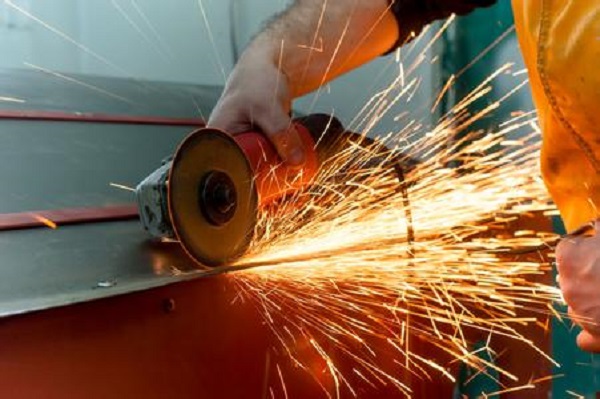
Angle Grinder with Cut-Off Wheel
A handheld angle grinder fitted with a thin cut-off wheel cuts sheet metal quickly. It is suitable for straight cuts and simple shapes on thin material.
Pros: Inexpensive, portable, good for small jobs.
Cons: Lower precision, rough edges, safety risks (wheels can shatter).
Nibbler
A nibbler punches small holes in sequence, creating a cut. It works well for curves and irregular shapes on thinner sheet metal.
Pros: Good for curves, minimal distortion.
Cons: Slower than other methods, leaves small crescent-shaped waste.
Aviation Snips (Tin Snips)
Hand-operated snips cut thin sheet metal (up to about 18 gauge) for ductwork, flashing, and small projects.
Pros: No power required, inexpensive.
Cons: Limited to thin material, hand fatigue on larger jobs.
How Do You Ensure Safety?
Cutting sheet metal involves sharp edges, high temperatures, and moving machinery. Safety should always come first.
Wear Proper Protective Gear
- Safety glasses or face shield: Metal chips and sparks can cause eye injuries.
- Cut-resistant gloves: Protect hands from sharp edges.
- Hearing protection: Laser and plasma cutting produce noise; shearing can be loud.
- Steel-toed boots: Heavy sheets can cause serious foot injuries if dropped.
Secure the Workpiece
A moving sheet is dangerous. Clamp material securely before cutting. For manual cutting, ensure the sheet cannot shift during the process.
Maintain Equipment
Dull blades, worn electrodes, or misaligned lasers produce poor cuts and increase safety risks. Follow manufacturer maintenance schedules.
Ventilate the Area
Plasma cutting and some manual methods produce fumes. Work in a well-ventilated area or use fume extraction equipment, especially when cutting coated metals or stainless steel (which can produce hexavalent chromium).
What Common Mistakes Should You Avoid?
Ignoring Material Properties
Cutting aluminum with a standard plasma cutter without the right gas mixture can produce poor results. Cutting galvanized steel with a laser without proper fume extraction releases toxic zinc oxide. Always match method to material.
Overlooking Kerf
Kerf is the material removed by the cutting process. Laser and plasma cutting remove a small amount of material—typically 0.1 mm to 0.5 mm depending on thickness. Shearing has minimal kerf. If you design parts with tight nesting, account for kerf to avoid undersized parts.
Forgetting About Heat Distortion
Thin materials can warp under heat. Laser and plasma cutting introduce heat. For very thin sheets, consider waterjet cutting (not covered here) or use techniques like pulse cutting to reduce heat input.
Pro Tip: When laser cutting thin stainless steel, use a piercing delay to prevent blowback that marks the surface. Skilled operators adjust parameters to maintain clean edges.
Conclusion
Cutting sheet metal effectively comes down to matching the method to your material, thickness, accuracy needs, and volume. Laser cutting delivers precision and complexity for thin to medium gauges. Plasma cutting handles thick materials quickly and cost-effectively. Shearing excels at straight cuts in high volume. Manual methods work for small, simple jobs.
Before cutting, understand your material, secure your workpiece, and wear proper safety gear. With the right approach, you will achieve clean cuts, tight tolerances, and efficient use of material and time.
FAQs
What is the best cutting method for thin stainless steel sheets?
Laser cutting is generally best for thin stainless steel (up to about 5 mm). It provides high precision (tolerances as tight as ±0.05 mm) and a minimal heat-affected zone, which helps prevent corrosion and maintains material integrity. This makes it ideal for medical devices, kitchen equipment, and precision components.
Can I cut different types of metals with the same equipment?
Yes, but adjustments are required. Plasma cutters can handle steel, stainless steel, aluminum, copper, and brass by adjusting gas type and power settings. Laser cutters can cut various metals, but highly reflective metals like copper and aluminum may require fiber laser technology. Shearing works on most metals but requires appropriate blade clearance and force settings.
How do I ensure safety when cutting sheet metal?
Always wear safety glasses, cut-resistant gloves, and hearing protection. Secure the workpiece firmly. Keep the work area clean. For plasma cutting, ensure proper ventilation to avoid fume inhalation. Follow equipment manufacturer guidelines and never bypass safety guards. Have fire extinguishing equipment nearby when using high-heat methods.
What is kerf, and why does it matter?
Kerf is the width of material removed by the cutting process. Laser and plasma cutting remove 0.1–0.5 mm of material along the cut line. If you nest parts closely on a sheet, failing to account for kerf can result in undersized parts or parts that do not separate cleanly. Shearing has minimal kerf.
Contact Yigu Technology for Custom Manufacturing
At Yigu Technology, precision cutting is at the core of what we do. We operate fiber laser cutters, plasma cutting tables, and high-capacity shears to handle a wide range of materials and thicknesses. Our team helps customers select the right cutting method based on design complexity, material, and volume. Whether you need prototype parts or full production runs, we deliver clean cuts and tight tolerances. Contact us to discuss your sheet metal cutting needs—we will help you get it right the first time.