Manufacturers face a constant push. Parts must be stronger to meet safety standards. They must be lighter to improve fuel efficiency and reduce costs. And they must be affordable to produce at scale. Traditional mild steel requires thicker gauges to achieve the needed strength, adding weight and material cost. High-alloy steels can deliver strength but often come with higher prices and forming difficulties. HSLA (High-Strength Low-Alloy) steel offers a middle path. It delivers exceptional strength with minimal alloy content, enabling thinner, lighter parts without sacrificing performance. But stamping HSLA requires specialized knowledge. It behaves differently than mild steel. It shows more springback. It wears tools faster. This guide covers HSLA’s characteristics, stamping techniques, and applications. You will learn how to work with this material efficiently.
What Makes HSLA Steel Different?
HSLA steel is not a single alloy. It is a family of steels designed to provide higher strength than mild steel while maintaining good formability and weldability. The “low-alloy” part is key. HSLA achieves its strength through small additions of alloying elements and controlled rolling processes, not through high carbon content.
Alloying Elements
HSLA contains small amounts of specific elements that enhance strength without compromising ductility.
| Element | Typical Range | Effect |
|---|---|---|
| Manganese | 1.0–1.5% | Increases strength and hardenability |
| Copper | 0.2–0.5% | Improves corrosion resistance |
| Nickel | 0.2–0.5% | Enhances toughness and strength |
| Niobium | 0.02–0.05% | Refines grain structure, increases strength |
| Vanadium | 0.02–0.10% | Improves strength through precipitation hardening |
These small additions create a fine-grained microstructure with dispersed carbides. This structure gives HSLA its strength while maintaining ductility.
Mechanical Properties
| Property | HSLA Range | Mild Steel |
|---|---|---|
| Tensile strength | 340–590 MPa | 250–400 MPa |
| Yield strength | 275–485 MPa | 200–350 MPa |
| Elongation | 15–22% | 20–30% |
HSLA offers significantly higher strength with only a modest reduction in ductility. This allows designers to use thinner gauges—typically 10% to 20% thinner than mild steel—for the same load-bearing capacity.
Toughness and Impact Resistance
HSLA maintains its ductility even at low temperatures. This makes it suitable for outdoor applications, cold-climate equipment, and structures that must withstand impact loads. Agricultural equipment, construction machinery, and railway components all benefit from this toughness.
Weldability
HSLA’s low carbon content (typically ≤0.20% ) minimizes the risk of brittle welds. It welds more reliably than many high-strength steels. Post-stamping assembly is simplified because welding procedures are similar to those for mild steel.
How Does HSLA Compare to Other Steels?
| Material | Strength | Formability | Cost | Best Use |
|---|---|---|---|---|
| Mild steel | Moderate | Excellent | Low | General fabrication |
| HSLA | High | Good | Moderate | Structural, lightweighting |
| DP steel | Very high | Moderate | Higher | Automotive crash structures |
| Stainless steel | High | Moderate | High | Corrosion-critical applications |
HSLA occupies a sweet spot. It is stronger than mild steel. It is more formable and less expensive than dual-phase or stainless steels. For applications that need strength without extreme corrosion resistance, HSLA is often the most cost-effective choice.
How Do You Stamp HSLA Steel Successfully?
Stamping HSLA requires adjustments to process parameters and tooling.
Blanking and Punching
HSLA’s higher strength increases the force required to cut it. Use sharp, carbide-tipped punches to maintain edge quality. Die clearance should be 8% to 10% of material thickness—slightly more than for mild steel. Insufficient clearance causes burrs. Excessive clearance creates rough edges that can crack during subsequent forming.
Bending and Forming
HSLA shows 1.5 to 2 times more springback than mild steel. This must be compensated in die design.
| Compensation Method | Application |
|---|---|
| Over-bending | 5 to 10 degrees beyond target angle |
| Bottoming dies | Strikes material to reduce elastic recovery |
| FEA simulation | Predicts springback for complex parts |
Minimum bend radius for HSLA is typically 2× to 3× material thickness. Tighter radii risk cracking.
Deep Drawing
HSLA can be deep-drawn for shallow to moderate draws, with draw ratios up to 2:1. Use:
- Slower press speeds: 10 to 15 strokes per minute
- High-pressure blank holders: To control material flow
- Heavy lubrication: With extreme-pressure additives
For draws approaching the material’s limit, intermediate annealing may be needed to restore ductility.
Progressive Die Stamping
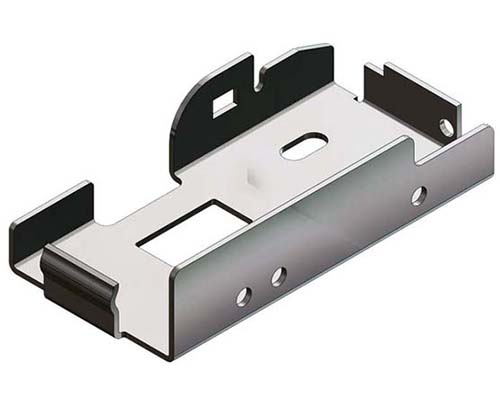
Progressive dies are ideal for high-volume HSLA parts like automotive brackets. Design considerations:
- Generous radii: Minimum 2× material thickness to reduce stress
- Balanced stations: Avoid concentrating forming in one station
- Adequate carriers: Keep the strip stable between stations
Press Machine Selection
| Material Thickness | Recommended Press Type |
|---|---|
| ≤2 mm | Servo-mechanical press |
| ≥3 mm | Hydraulic press |
Hydraulic presses offer variable force control, which is valuable for thick HSLA. Servo-mechanical presses provide high speed and efficiency for thin-gauge parts.
What Tooling and Lubrication Work Best?
Tooling Materials
HSLA’s hardness increases tool wear by 20% to 30% compared to mild steel. Extend tool life with:
- Carbide inserts: For high-volume production
- Coated tool steel: Titanium nitride (TiN) or aluminum titanium nitride (AlTiN) coatings reduce friction and wear
- Regular maintenance: Sharpening and inspection at scheduled intervals
A manufacturer stamping HSLA chassis brackets found that switching from uncoated tool steel to TiN-coated punches increased die life from 200,000 to 500,000 strokes.
Lubrication
Use high-pressure lubricants with extreme-pressure (EP) additives. These lubricants form a protective film under the high contact pressures of HSLA stamping. Chlorinated or sulfurized oils are effective. Apply lubricant evenly and replenish regularly.
What Quality Controls Are Essential?
Material Verification
Verify incoming HSLA against specifications. Check certificates for:
- Chemical composition
- Tensile and yield strength
- Elongation
- Grain size
Random sampling should confirm these properties.
Dimensional Inspection
Use coordinate measuring machines (CMMs) to verify critical dimensions. Pay special attention to bent areas, where springback can affect fit. Tolerances for HSLA parts are often ±0.05 mm or tighter for structural applications.
Non-Destructive Testing
For critical components, use:
- Ultrasonic testing: Detects internal defects in thick parts
- Magnetic particle inspection: Reveals surface and near-surface cracks
HSLA’s strength can mask small cracks that might propagate under stress. NDT catches these before they become failures.
Process Monitoring
Track key parameters:
- Punch force (increases indicate dull tools)
- Strip alignment (drift indicates feed or die issues)
- Part dimensions (trends indicate process drift)
Implement statistical process control (SPC) to detect trends early.
Where Is HSLA Steel Stamping Used?
Automotive Components
HSLA is a staple in automotive manufacturing. Common parts include:
- Chassis frames and subframes
- Control arms and suspension components
- Body panels (where strength is critical)
- Seat structures
- Engine cradles
Automakers report 5% to 10% weight reduction in HSLA components compared to mild steel equivalents. This directly improves fuel efficiency and range.
Construction Materials
Construction applications leverage HSLA’s strength-to-weight ratio:
- Steel beams and columns
- Structural brackets and connectors
- Fasteners and anchors
- Roof trusses
Copper-alloyed HSLA grades offer improved corrosion resistance for exposed structures.
Agricultural Equipment
Agricultural machinery operates in harsh conditions. HSLA provides:
- Impact resistance for plows and tillage tools
- Durability for tractor frames and implements
- Strength for harvester components
The material’s toughness at low temperatures is valuable for equipment used in cold climates.
Railway Components
Railway applications demand strength and fatigue resistance:
- Train car bodies
- Undercarriage components
- Couplers and draft gear
- Structural reinforcements
HSLA’s ability to withstand constant vibration and load cycling makes it suitable for these demanding applications.
Energy Sector
Renewable energy infrastructure uses HSLA for:
- Wind turbine towers
- Solar panel mounting structures
- Transmission towers
- Substation frames
The material’s weldability simplifies field assembly of large structures.
What Are the Key Advantages?
| Advantage | Impact |
|---|---|
| Enhanced strength without weight | 10–20% thinner gauges possible |
| Cost savings | 10–15% cheaper than DP steel |
| Better fatigue resistance | Longer part life, reduced maintenance |
| Good weldability | Simplified assembly |
| Design flexibility | Complex shapes achievable |
What Challenges Come with Stamping HSLA?
| Challenge | Solution |
|---|---|
| Springback | Over-bend, bottoming dies, FEA simulation |
| Tool wear | Carbide or coated tooling, regular maintenance |
| Cracking | Generous radii, slower press speeds |
| Burring | Proper die clearance, sharp tools |
| Lubrication | EP additives, consistent application |
Conclusion
HSLA steel offers a compelling combination of strength, formability, and cost-effectiveness. It allows manufacturers to produce lighter, stronger components without the expense of high-alloy steels. Its weldability and toughness make it suitable for demanding applications in automotive, construction, agriculture, and energy.
Stamping HSLA successfully requires understanding its behavior. It shows more springback than mild steel. It wears tools faster. It needs proper die clearance and lubrication. But with the right tooling, process parameters, and quality controls, HSLA delivers consistent, high-quality parts that meet modern performance requirements.
For manufacturers seeking to reduce weight, improve strength, and control costs, HSLA is not just an option. It is a proven solution.
FAQ About Metal Stamping HSLA Steel
How does HSLA compare to stainless steel for corrosion resistance?
HSLA offers better corrosion resistance than mild steel but less than stainless steel. Copper-alloyed HSLA grades provide moderate corrosion resistance suitable for many outdoor applications. For harsh environments, stainless steel remains the better choice, or HSLA can be coated with paint, galvanizing, or other protective finishes.
Can HSLA be painted or coated after stamping?
Yes. However, surfaces must be cleaned thoroughly to remove mill scale, lubricants, and contaminants. Phosphating or galvanizing improves paint adhesion and adds corrosion protection. Standard automotive painting processes work well with HSLA.
What is the maximum thickness for stamping HSLA?
HSLA can be stamped up to 8 mm thickness in practical production. Thicker material may require pre-heating to 150°C to 200°C to improve formability, especially for complex bends or deep draws. Above 8 mm, hot stamping or other processes may be more appropriate.
How does HSLA’s springback compare to mild steel?
HSLA shows 1.5 to 2 times more springback than mild steel of the same thickness. This must be compensated through over-bending, bottoming dies, or die angle adjustments. FEA simulation is recommended for complex parts to predict and compensate for springback accurately.
Is HSLA weldable after stamping?
Yes. HSLA’s low carbon content (≤0.20%) makes it readily weldable. Standard MIG, TIG, and resistance welding processes work well. No special filler metals are typically required, though matching the filler strength to the base metal is recommended for structural applications.
Contact Yigu Technology for Custom Manufacturing
Stamping HSLA steel requires precision, experience, and the right equipment. At Yigu Technology, we specialize in custom metal stamping for automotive, construction, and industrial clients. Our team helps you select the right HSLA grade for your application. We design tooling with FEA simulation to control springback. We use carbide and coated tooling to extend die life. Our presses handle thicknesses from thin gauge to 8 mm plate. Quality control includes material verification, dimensional inspection, and non-destructive testing for critical parts. Whether you need chassis components, structural brackets, or agricultural equipment parts, we have the capabilities to deliver. Contact us today to discuss your project.