Introduction
You are designing a project that needs sheet metal, but weight is a concern. You want something thin enough to form easily, yet strong enough to hold up under normal use. Maybe you have looked at thicker gauges and worried about adding unnecessary weight or cost. Perhaps you have used very thin material before and found it too flimsy. 26 gauge sheet metal sits in that middle zone—thin enough to be lightweight and workable, but thick enough to provide real utility. Understanding exactly what 26 gauge means, how it varies by material, and where its limits lie will help you make the right choice for your next project.
Understanding Gauge: What Do the Numbers Mean?
The gauge system measures sheet metal thickness. Here is the key rule: higher gauge numbers mean thinner metal. This inverse relationship often trips up newcomers.
For 26 gauge sheet metal, the thickness depends on the material. Different metals have slightly different thicknesses at the same gauge number due to industry standards.
| Material | Thickness (inches) | Thickness (mm) |
|---|---|---|
| Mild Steel | 0.0179 | 0.455 |
| Aluminum | 0.0159 | 0.404 |
| Galvanized Steel | 0.0217 | 0.551 |
| Stainless Steel | 0.0187 | 0.475 |
These differences matter. When you specify 26 gauge, you need to also specify the material. A 26 gauge aluminum sheet is noticeably thinner than a 26 gauge galvanized steel sheet.
Common Materials for 26 Gauge Sheet Metal
Stainless Steel: When Do You Need Corrosion Resistance?
Stainless steel 26 gauge offers excellent corrosion resistance. The chromium content forms a passive oxide layer that protects against rust and degradation.
In the food and beverage industry, manufacturers use 26 gauge stainless steel for equipment surfaces that must remain hygienic. A commercial kitchen might use it for splash backs or equipment housings. The material resists cleaning chemicals and moisture without corroding.
Medical equipment also relies on stainless steel. Hospital carts, instrument trays, and sterilizer components benefit from its ability to withstand repeated cleaning and sterilization cycles.
Carbon Steel: Is It the Budget-Friendly Choice?
Carbon steel 26 gauge is strong and cost-effective. It forms easily, making it suitable for general manufacturing and automotive applications.
A car manufacturer might use 26 gauge carbon steel for interior brackets or small support components. The material provides adequate strength for these non-structural parts while keeping costs low.
The trade-off is corrosion resistance. Carbon steel rusts when exposed to moisture. For indoor applications in dry environments, this is rarely a problem. For any outdoor or high-humidity use, you will need to add a protective coating.
Aluminum: When Does Lightweight Matter Most?
Aluminum 26 gauge is significantly lighter than steel. Its density is about one-third that of steel, making it ideal for weight-sensitive applications.
The aerospace industry uses aluminum sheet metal for interior panels and non-structural components. Every pound saved on an aircraft reduces fuel consumption. For a commercial airliner, reducing weight by 100 pounds can save roughly $10,000 per year in fuel costs.
Aluminum also conducts heat well. Electronics manufacturers use it for heat sinks and enclosures where thermal management matters. Its non-magnetic property is another advantage in sensitive electronic environments.
Galvanized Steel: Why Add a Zinc Coating?
Galvanized steel starts as carbon steel and receives a zinc coating. This coating provides corrosion protection that plain carbon steel lacks.
Roofing and siding are common applications. A residential roofing contractor might specify 26 gauge galvanized steel for a standing seam metal roof. The zinc coating protects against rain and moisture, giving the roof a service life of 30 to 50 years with proper installation.
The zinc layer also provides some sacrificial protection. If the coating gets scratched, the zinc corrodes first, protecting the underlying steel.
Key Benefits of 26 Gauge Sheet Metal
Formability: How Easily Can You Shape It?
26 gauge sheet metal bends and forms readily. Its thin profile requires less force to shape than thicker gauges, making it suitable for complex geometries.
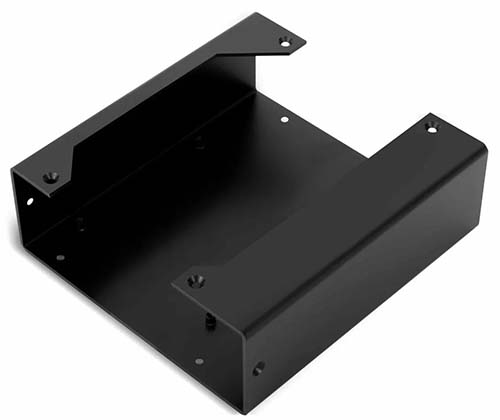
Consider a custom electronics enclosure. The manufacturer needs to create precise bends for a tight-fitting case. 26 gauge material bends cleanly with standard press brake equipment. The bends remain accurate without excessive spring-back.
For stamped parts, the thin material allows high-speed production. A stamping press can run 26 gauge sheet metal faster than thicker material, increasing throughput and lowering per-part costs.
Weight Savings: How Much Lighter Is It?
Compared to thicker gauges, 26 gauge offers significant weight reduction. A 24 gauge steel sheet weighs roughly 30% more than a 26 gauge sheet of the same dimensions.
This weight difference matters in applications where portability or structural load is a concern. A mobile equipment enclosure made from 26 gauge aluminum might weigh 50% less than the same enclosure made from 16 gauge steel. That difference can determine whether a technician can carry the equipment or needs a cart.
Cost Efficiency: Does Thinner Mean Cheaper?
Generally, thinner sheet metal costs less per square foot. Material cost is based on weight. Since 26 gauge weighs less per square foot than thicker gauges, the raw material cost is lower.
For large production runs, these savings add up quickly. A manufacturer producing 10,000 enclosures might save $5 to $10 per unit by specifying 26 gauge instead of 22 gauge, depending on the material. Over the full run, that represents substantial cost reduction.
Potential Drawbacks to Consider
Durability in High-Stress Situations
26 gauge sheet metal has its limits. Under significant mechanical stress, it may not hold up as well as thicker gauges.
Consider tensile strength. A 26 gauge mild steel sheet subjected to 10,000 pounds of tensile force may begin to stretch and deform. By comparison, a 10 gauge mild steel sheet can withstand up to 50,000 pounds without significant deformation.
In industrial settings with constant vibration, 26 gauge components may eventually show fatigue. A factory using 26 gauge steel for machine guards might need to replace them more frequently than if they used 18 gauge material.
Limited Thickness for Specialized Needs
Some applications simply require thicker material. Extreme environments demand greater structural integrity.
Deep-sea equipment faces immense pressure. At depths of 10,000 feet, water pressure exceeds 4,400 psi. A submersible hull made from 26 gauge sheet metal would collapse instantly. These applications require thick plates, often 0.5 inches or more.
High-altitude aerospace components face rapid temperature swings and aerodynamic forces. Industry studies show that components operating above 50,000 feet typically need a minimum thickness of 0.1 inches—far thicker than 26 gauge—to maintain structural stability.
Quality Considerations for 26 Gauge Sheet Metal
Thickness Tolerances: What Variation Is Acceptable?
Thickness tolerances vary by material and manufacturing standard.
| Material | Typical Tolerance (± inches) |
|---|---|
| Mild Steel | 0.002 |
| Aluminum | 0.0015 |
| Stainless Steel | 0.002–0.003 |
These tolerances matter for precision applications. In an electronics enclosure, thickness variation of even 0.002 inches can affect how panels fit together. For parts that will be welded or assembled with tight clearances, specifying tighter tolerances may be necessary, though it will increase cost.
Surface Quality: What Should You Look For?
Surface quality affects both appearance and performance. Look for:
- Uniform finish without scratches or pitting
- Flatness across the sheet—no warping or waves
- Clean edges without burrs that can cause injury or assembly issues
For galvanized material, check that the zinc coating is uniform. Bare spots or uneven coverage will lead to premature corrosion.
Practical Applications: Where Does 26 Gauge Excel?
- HVAC ductwork: Lightweight and easy to form into ducts and fittings
- Residential roofing: Galvanized 26 gauge provides durability at reasonable cost
- Electronics enclosures: Thin material allows precise forming for tight fits
- Automotive interior components: Brackets, trim, and non-structural parts
- Signage: Easy to cut, form, and install for indoor and protected outdoor signs
- Appliances: Internal components and outer panels for smaller appliances
Each application leverages the balance 26 gauge offers: sufficient strength for the task without excess weight or material cost.
Conclusion
26 gauge sheet metal occupies a useful niche in the world of metal fabrication. At approximately 0.018 to 0.022 inches depending on material, it offers a practical balance of strength, weight, and cost. The material choice—stainless steel, carbon steel, aluminum, or galvanized steel—determines corrosion resistance, weight, and cost characteristics.
Understanding the limits of 26 gauge is just as important as knowing its strengths. It performs well in applications with moderate stress levels and controlled environments. For high-stress industrial use or extreme environmental conditions, thicker gauges are necessary.
When matched to the right application, 26 gauge sheet metal provides a cost-effective, formable, and lightweight solution that meets the needs of many manufacturing, construction, and consumer product applications.
FAQs
What is the actual thickness of 26 gauge sheet metal?
The thickness varies by material. For mild steel, it is approximately 0.0179 inches (0.455 mm) . For aluminum, it is about 0.0159 inches (0.404 mm) . For galvanized steel, it measures roughly 0.0217 inches (0.551 mm) . For stainless steel, it is approximately 0.0187 inches (0.475 mm) . Always verify with your supplier, as tolerances can cause slight variations.
Can 26 gauge sheet metal be used for roofing?
Yes, galvanized 26 gauge steel is a common choice for residential and light commercial roofing. The zinc coating provides corrosion protection, and the material thickness offers adequate durability for typical weather conditions. In coastal areas with salt spray or regions with extreme hail risk, thicker gauges like 24 gauge may be recommended for longer service life.
How does 26 gauge compare to 24 gauge in strength?
24 gauge is thicker and stronger. For mild steel, 24 gauge measures approximately 0.0239 inches compared to 26 gauge at 0.0179 inches. The additional thickness gives 24 gauge better resistance to bending, denting, and impact. Choose 26 gauge when weight and cost are primary concerns. Choose 24 gauge when the application demands greater structural rigidity or impact resistance.
What are the typical thickness tolerances for 26 gauge sheet metal?
Typical tolerances are ±0.002 inches for mild steel, ±0.0015 inches for aluminum, and ±0.002 to 0.003 inches for stainless steel. These tolerances ensure consistent material properties but can affect fit in precision assemblies. For applications requiring very tight dimensional control, specify tighter tolerances or discuss your requirements with your fabricator.
Contact Yigu Technology for Custom Manufacturing
At Yigu Technology, we specialize in custom fabrication using a wide range of sheet metal gauges and materials. Our team works with 26 gauge stainless steel, carbon steel, aluminum, and galvanized steel to create precision components for clients across industries. We use laser cutting for clean, accurate edges and CNC bending for consistent, repeatable angles. Our quality control process includes thickness verification and surface inspection to ensure every part meets your specifications. Whether you need electronics enclosures, HVAC components, or custom brackets, we deliver reliable solutions. Contact us today to discuss your project requirements.