
Blogs
Our Fluorinated Ethylene Propylene FEP Injection Molding Services
Our Fluorinated Ethylene Propylene FEP Injection Molding Services, explained the way we would explain it across a table: what it is good at, what it costs you, and the details that keep the part out of the scrap bin.
Key takeaways
- Elevate your components with our premium Fluorinated Ethylene Propylene FEPInjection Molding services—where exceptional chemical resistance, optical clarity, and high-temperature stability meet micro-precision and high-volume production.
- At our shop, our FEP injection molding capacityis designed to meet diverse project needs—from low-volume prototypes to high-volume production runs.
- FEP injection molding is a manufacturing process that shapes FEP (Fluorinated Ethylene Propylene), a thermoplastic fluoropolymer, into custom parts using injection molding technology.
- Achieving high-quality FEP parts requires strict control over every process step.
Our Fluorinated Ethylene Propylene FEP Injection Molding Services
Elevate your components with our premium Fluorinated Ethylene Propylene FEPInjection Molding services—where exceptional chemical resistance, optical clarity, and high-temperature stability meet micro-precision and high-volume production.
From medical devices to aerospace parts, we deliver FEP molded solutions that redefine reliability.

Our FEP Injection Molding Capabilities: Precision You Can Trust
At our shop, our FEP injection molding capacityis designed to meet diverse project needs—from low-volume prototypes to high-volume production runs. We pride ourselves on holding tight FEP molding tolerances and offering specialized services that set us apart.
Below is a detailed look at our core capabilities:
| Capability | Specification | Application Fit |
| FEP molding tolerances we hold | ±0.001” (0.025mm) for micro parts; ±0.005” (0.127mm) for standard parts | High-precision components like semiconductor wafer carriers. |
| Micro FEP molding capability | Molding parts as small as 0.5mm (0.02”) with complex geometries | Medical catheters, micro-sensors, and electronic connectors. |
| High-volume FEP production | 100,000+ parts/month per production line | Automotive wire insulation, food-contact fittings. |
| Clean-room FEP molding service | Class 8 (100,000) cleanrooms compliant with ISO 14644-1 | Medical devices (e.g., surgical tools) and pharmaceutical components. |
| Multi-cavity FEP tooling | Up to 32-cavity molds for cost-efficient high-volume runs | Small, uniform parts like FEP couplings or valve cores. |
| Insert & over-molding FEP | Bonding FEP to metals (e.g., stainless steel) or other plastics | Sensor housings, where FEP’s insulation protects internal components. |
What Is FEP Injection Molding?
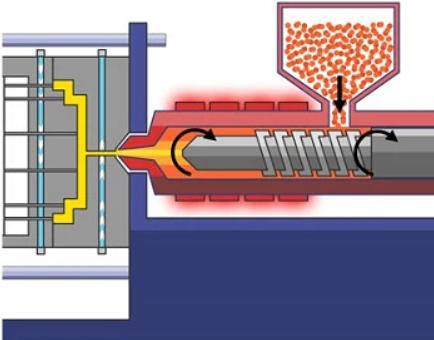
FEP injection molding is a manufacturing process that shapes FEP (Fluorinated Ethylene Propylene), a thermoplastic fluoropolymer, into custom parts using injection molding technology. Unlike other plastics, FEP combines the flexibility of polyethylene with the chemical inertness of PTFE (Teflon), making it ideal for harsh environments.
To simplify its core meaning, here’s a breakdown of key terms:
| Term | Explanation |
| FEP thermoplastic molding | The process of melting FEP resin (a thermoplastic) and injecting it into molds to form parts. |
| Fluorinated Ethylene Propylene molding meaning | Creating functional components from FEP, a material prized for non-stick, heat-resistant, and electrically insulating properties. |
| FEP plastic molding overview | A versatile method for producing both small, intricate parts (e.g., micro sensors) and large, high-volume components (e.g., wire insulation). |
In short, FEP injection molding turns raw FEP resin into tailored parts that thrive in applications where other plastics fail.
The FEP Injection Molding Process: Step-by-Step Excellence
Achieving high-quality FEP parts requires strict control over every process step. Unlike common plastics (e.g., PP or ABS), FEP has unique melting and cooling needs—our expertise ensures consistency.
Key Process Steps & Parameters
| Step | Description | Critical Parameter | Target Value |
| 1. Resin Preparation | Dry FEP resin grades for molding to remove moisture (moisture causes defects). | Drying Time/Temperature | 4 hours at 120°C |
| 2. Melting | Heat resin in the injection unit. | FEP melt temperature window | 290°C – 380°C (554°F – 716°F) |
| 3. Injection | Force molten FEP into the mold. | Injection Pressure | 800 – 1,200 bar |
| 4. Cooling | Solidify FEP in the mold. | In-mold cooling for FEP | 10 – 15 seconds (varies by part size) |
| 5. Demolding | Remove the part from the mold. | FEP degating technique | Automated cold degating (minimizes part damage) |
| 6. Finishing | Trim excess material and inspect. | FEP mold shrinkage control | 2.5% – 3.5% (controlled via mold design) |
Other critical factors:
- FEP screw & barrel design: Specialized hard chrome-plated barrels prevent FEP degradation (FEP is abrasive at high temps).
FEP molding cycle time: 30 – 60 seconds for small parts; 2 – 5 minutes for large, thick-walled components.
FEP Materials: Choosing the Right Resin for Your Project
The performance of your FEP part starts with the right resin. We offer a range of FEP resin grades for molding, each formulated to meet specific industry needs. Below is a comparison of our most popular options:
| Resin Type | Key Feature | Compliance | Ideal Application |
| FDA-compliant FEP compounds | Non-toxic, food-safe | FDA 21 CFR 177.1550 | FEP food-contact molded parts (e.g., beverage fittings) |
| Pigmented FEP pellets | Custom colors (black, blue, red) | RoHS, REACH | Consumer electronics (e.g., optical windows) |
| Anti-static FEP formulations | Surface resistance: 10⁶ – 10⁹ Ω | SEMI F47 | FEP molded semiconductor parts (prevents electrostatic damage) |
| High-purity FEP resin | < 10 ppm metal impurities | ISO 10993 | Medical devices (e.g., catheter components) |
| Bondable FEP modifiers | Improved adhesion to metals/plastics | ASTM D3359 (adhesion test) | Insert & over-molding FEP (e.g., sensor housings) |
| FEP copolymer vs homopolymer | – Copolymer: Better flexibility (Tg = -100°C)- Homopolymer: Higher rigidity (Tg = -90°C) | N/A | Copolymer: Aerospace hoses; Homopolymer: Chemical processing valves |
Advantages of FEP Injection Molding: Why Choose FEP?
FEP’s unique properties make it superior to many plastics for demanding applications. Here’s how its advantages translate to real value:
| Advantage | Technical Spec | Benefit for Your Project |
| FEP chemical resistance benefit | Resists acids, bases, solvents (even at 200°C) | Parts last longer in chemical processing plants. |
| FEP optical clarity advantage | Transmittance: 95% (400 – 700 nm wavelength) | Ideal for FEP optical window molding in sensors. |
| Low-friction FEP molding | Coefficient of friction: 0.15 (dry) | Parts like FEP impellers run smoothly with less wear. |
| FEP high-temperature stability | Continuous use temp: -200°C to 200°C | Suitable for FEP aerospace injection molding (engine components). |
| FEP non-stick properties | Surface tension: 18 mN/m | Easy release for food-contact parts (e.g., FEP fittings). |
| FEP electrical insulation value | Volume resistivity: >10¹⁸ Ω·cm | Perfect for FEP wire & cable insulation in high-voltage apps. |
| FEP UV resistance advantage | No degradation after 5,000 hours of UV exposure | Outdoor parts (e.g., FEP photovoltaic connectors) maintain performance. |
FEP Injection Molding Applications by Industry
FEP’s versatility makes it a top choice across industries. Below are key use cases where our services excel:
| Industry | Key Applications | Our Service Fit |
| Semiconductor | FEP molded semiconductor parts (wafer carriers, chamber liners) | Clean-room molding, anti-static FEP formulations |
| Medical | FEP medical device components (catheters, surgical tool handles) | FDA-compliant resins, Class 8 cleanrooms |
| Aerospace | FEP aerospace injection molding (wire insulation, hydraulic fittings) | High-purity FEP, temperature-stable formulations |
| Chemical Processing | FEP chemical processing fittings (valve bodies, pump impellers) | Chemical-resistant resins, tight tolerances |
| Food & Beverage | FEP food-contact molded parts (filling machine components) | FDA-compliant compounds, non-stick properties |
| Electronics | FEP wire & cable insulation, connectors | Electrical insulation, pigmented FEP pellets |
| Renewable Energy | FEP photovoltaic connectors, solar panel parts | UV resistance, high-temperature stability |
How to write a spec that gets priced correctly
A drawing is a contract. If it leaves a number open, the shop fills that number in with its own default. The default is rarely the one you had in mind. Put these five lines on every RFQ and most of the back-and-forth disappears before it starts.
- A model and a drawing that agree
- Material by standard number
- Tolerance only where it mates
- Finish and the faces it applies to
- Quantity and required date
The point is not paperwork. Each line removes a decision the shop would otherwise make for you. A complete RFQ comes back priced. An incomplete one comes back guessed.
What actually drives the price
Buyers usually push on material because it is the line they can see. In practice the material is rarely the biggest number on a quote. These five lines decide most of it:
- process choice
- material
- tolerance band
- finish
- volume
Ask for the quote split by line. A supplier who cannot break it down is guessing, and you will pay for the guess. The line you can usually renegotiate is the tolerance band, not the raw material.
Problems you will meet, and the fix
Every process has a failure mode it prefers. The same four show up again and again on this kind of work, and none of them are mysteries once you know what to look for.
- A drawing that contradicts the model
- A tolerance with no datum
- A cosmetic callout with no approved sample
- A quote compared against a different scope
Catch the fault on the first part, not the hundredth. A first-article check costs an hour. A bad batch costs the whole order. Write the check into the purchase order so nobody has to remember it.
What to check on the first article
The first article is the cheapest inspection you will ever buy. Use it properly and the rest of the run becomes boring, which is exactly what you want.
- Every dimension on the drawing, with the measured value written beside it.
- The material certificate, matched to the heat or lot number on the parts.
- The finish against the sample you approved, under the same light.
- Fit against the mating part, assembled rather than measured.
- Packaging, because parts that arrive damaged were never in tolerance.
Check in this order: datums, then mating features, then cosmetic faces. If the datums are wrong, every number after them is noise. Keep the report on file. When a problem shows up in month six, that document is the only thing that tells you what changed.
How to compare two quotes fairly
Two numbers are not comparable unless the scope matches. Line them up before you decide, because a low number with three gaps is not a low number.
Same drawing, same material, same finish, same inspection. Anything else is a different job wearing the same part number. Then look at what each quote leaves out. Freight, packaging, certificates and tooling are the usual gaps.
Ask each supplier to state their assumptions in writing. The one who does is usually the one who has run the process before.
Scaling from one part to a batch
The first part teaches you the process. The hundredth teaches you the process cost.
Watch three things as volume grows: setup amortisation, tool wear, and how much hand work the finish still needs. If the unit price barely moves between ten and a hundred, the cost sits in material or in hand work, not in setup. Ask which, because only one of them is negotiable.
Lead time behaves the same way. A one-off is scheduled around other jobs. A repeat order is scheduled around your forecast. Give the shop a forecast and the lead time gets shorter, not longer.
How to read a supplier's quote
A quote is a short document with a long shadow. Four things in it decide whether the job runs smoothly, and only one of them is the price.
- The scope line. It should name the process, the material and the finish, not just the part.
- The tolerance basis. General tolerance or the drawing, and which standard it follows.
- The exclusions. Tooling, freight, certificates and inspection are the usual omissions.
- The validity date. Material prices move, and an open-ended quote is a promise nobody can keep.
Read the exclusions before you read the total. A quote that leaves out tooling is not cheaper. It is a quote for a different job.
What to send with the first order
The first order sets the pattern for every order after it. Send a complete package once and the shop files it, and the second order takes a fraction of the time.
- A STEP or native model plus a PDF drawing carrying the same revision letter.
- The material callout by standard number, not by trade name.
- The finish and the exact faces it applies to.
- Any test the part must pass: fit, seal, drop, salt spray, dielectric.
- A contact who can answer a question inside one working day.
Then write down what was agreed. An email that confirms the material, the finish and the date is worth more than a longer purchase order that leaves them open.
When this is the wrong choice
A good supplier tells you when the process does not fit. These are the cases where we say so.
- The volume is so low that setup costs more than the parts are worth.
- The tolerance is tighter than the process can hold without a second operation.
- The geometry cannot be made without a tool feature that will not pay back.
- The material you need is not available in the form the process requires.
- The schedule is shorter than the tooling or setup time, and nobody has said so yet.
None of these are refusals. They are reasons to look at a different route, and the earlier that conversation happens the cheaper it is. The most expensive mistake in manufacturing is a process chosen before the question was understood.
Planning the ramp from prototype to production
The gap between one good part and a thousand identical ones is a plan, not a machine. Three decisions close it.
First, freeze the design. Every change after tooling starts is a re-cut, and re-cuts are where schedules go. Second, decide the inspection level. A prototype is checked by eye; a production part is checked against a report. Third, agree the change process in writing, including who pays for it.
Write the ramp down as dates and owners, not as intentions. A ramp plan with three names and three dates is worth more than a page of good intentions.
What documentation to expect
Paperwork is not bureaucracy when a part fails at the customer. It is the only record of what was agreed. A normal shipment should carry four documents.
- A dimensional report covering every callout on the drawing.
- A material certificate traceable to the heat or lot number.
- A finish or coating certificate where the specification requires one.
- A packing list that matches the carton labels.
If a supplier cannot produce these on request, they are not running a controlled process. Ask for one sample set before you place the first order and you will know exactly what you are buying.
Case Studies: Real-World FEP Molding Success
Our expertise isn’t just theoretical—here are three projects where we delivered results:
Case 1: High-Precision FEP Wafer Carrier for Semiconductor
- Challenge: A semiconductor client needed wafer carriers with ±0.001” tolerance to protect 300mm wafers from electrostatic damage.
- Solution: Used micro FEP molding capability with anti-static FEP resin and multi-cavity tooling.
- Result: 99.9% yield, 50% faster production than competitors, and compliance with SEMI F47 standards.
Case 2: FEP Catheter Molded Component for Medical Devices
- Challenge: A medical company required flexible, biocompatible catheter tips that could withstand sterilization (autoclaving at 134°C).
- Solution: Molded with FDA-compliant FEP compound and used plasma treatment for bonding to nylon shafts.
- Result: Parts passed ISO 10993 biocompatibility tests; 100,000+ units produced monthly with zero defects.
Our solution for Our Fluorinated Ethylene Propylene FEP
YiguProto runs custom manufacturing in house, from a single prototype to a production batch. We quote the process, the material and the finish as separate lines, so you can see where the money goes instead of arguing with one number.
Send a STEP file or a drawing and you get a DFM report in one to two business days. It flags the features that add cost and the features that will not hold tolerance on the process you picked.
Every order ships with an inspection report on the features you call out. If a part misses, we make it again. Ready to price a part? Start with a free quote and DFM review, or read more about our custom manufacturing. You can also talk to an engineer before you commit to a drawing.
FAQ about Our Fluorinated Ethylene Propylene FEP
What’s the difference between FEP injection molding and PTFE molding?
FEP is a thermoplastic (melts when heated, solidifies when cooled), making it suitable for injection molding. PTFE is a thermoset (cannot be melted again), so it’s typically molded via compression. FEP also offers better optical clarity and flexibility than PTFE, while PTFE has a higher maximum temperature (260°C vs. FEP’s 200°C).
Can you produce FEP parts in custom colors?
Lorem ipsum dolor sit amet, consectetur adipiscing elit, sed do eiusmod tempor incididunt ut labore et dolore magna aliqua. Ut enim ad minim veniam, quis nostrud exercitation ullamco laboris nisi ut aliquip ex ea commodo consequat.
How long does it take to get FEP parts from design to production?
For prototypes: 5 – 7 days with our rapid FEP prototyping service. For high-volume production: 4 – 6 weeks (includes tooling design, testing, and first-run production). Rush options are available for urgent projects (e.g., 2-week prototypes).
Can Our Fluorinated Ethylene Propylene FEP be made in small quantities?
Yes, and small quantities are where a good supplier earns the next order. Setup dominates the price at low volume, so the cheapest route is usually the one with the fewest operations, not the cheapest material.
What material should I specify?
Specify by standard, not by trade name. A trade name can change under you between two orders; a standard number cannot. Then add the one property that actually decides the part, whether that is strength, heat resistance or chemical exposure.
Is there a minimum order quantity?
No hard minimum. One part is fine. What changes with volume is which costs dominate, so a single unit is priced mostly on setup and a thousand units are priced mostly on cycle time and material.
The short version
Our Fluorinated Ethylene Propylene FEP rewards the buyer who reads the data sheet and the drawing together. Pick the option for the property that matters, not for the price per kilo.
Tighten only what mates. Test a sample before the run. Then let the process do the rest.