
Blogs
Our Transparent Plastics Injection Molding Services
Our Transparent Plastics Injection Molding Services, explained the way we would explain it across a table: what it is good at, what it costs you, and the details that keep the part out of the scrap bin.
Key takeaways
- Elevate your products with our premium transparent plastic injection molding services—specializing in optical-grade molding for lenses, light guides, and precision components.
- We offer a comprehensive suite of transparent plastic injection molding capabilities tailored to industries requiring optical clarity and precision.
- Transparent plastic injection molding is a specialized manufacturing process focused on creating clear, light-transmitting parts using high-performance polymers.
- The transparent plastic injection molding process is a highly controlled sequence optimized to preserve clarity and optical performance.
Our Transparent Plastics Injection Molding Services
Elevate your products with our premium transparent plastic injection molding services—specializing in optical-grade molding for lenses, light guides, and precision components.
We deliver glass-clear molding with >90% light transmission, low haze, and design flexibility that outperforms glass. Partner with experts in clear polymer injection to turn your optical and transparent part needs into reality—from medical cuvettes to VR headset lenses.

Our Transparent Plastics Molding Capabilities
We offer a comprehensive suite of transparent plastic injection molding capabilities tailored to industries requiring optical clarity and precision. Below is a detailed breakdown of our core strengths:
| Capability | Key Features | Typical Applications |
| High-Clarity Molding | Achieves >92% light transmission (LT); haze <0.5%; weld-line free | Optical lenses, LED light guides, VR headset optics |
| Multi-Shot Clear Parts | 2–3 shot cycles; bonds clear resins (e.g., PC) with soft-touch TPE or colored plastics | Consumer electronics windows, 2-shot mask frames |
| Insert Molding Transparent | Integrates metal inserts (e.g., threaded pins) or glass fibers into clear parts; no clarity loss | Sensor covers, automotive lens mounts |
| Clean-Room Molding | Class 7 clean rooms; ISO 13485 compliant; particle count <10,000 particles/ft³ | Medical cuvettes, pharmaceutical packaging |
| Thin-Wall Transparent | Molds parts as thin as 0.3 mm; maintains structural integrity and clarity | Microfluidic chips, thin optical lenses (0.5 mm PC) |
| Micro-Optic Molding | Produces micro-scale features (50 µm channels); precision ±0.005 mm | COC microfluidic devices, miniaturized sensor optics |
| Global Clear Supply | Warehouses in 4 regions (NA, EU, APAC, MEA); 3–5 day delivery for high-volume orders | Multi-national LED, automotive, and medical brands |
Our over-molding clear windows capability also lets us add protective or functional layers (e.g., anti-scratch coatings) during molding—streamlining production for parts like smartphone screens.
What Is Transparent Plastics Injection Molding?
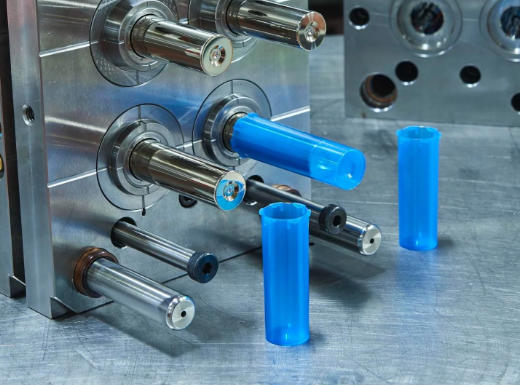
Transparent plastic injection molding is a specialized manufacturing process focused on creating clear, light-transmitting parts using high-performance polymers. Unlike standard injection molding, which prioritizes strength or cost, optical-grade molding centers on preserving clarity, minimizing defects (like warping or weld lines), and optimizing light transmission.
At its core, clear polymer injection transforms amorphous transparent resins (e.g., PC, PMMA) into precision parts via controlled heating, injection, and cooling. Our transparent thermoplastic service simplifies this technology: we explain how light-transmission molding differs from conventional methods—emphasizing its focus on low shear, uniform cooling, and defect-free surfaces to produce see-through plastic parts with <1% haze and consistent optical performance.
Key terms in precision optic molding include:
- Amorphous Transparent Resins: Non-crystalline polymers (e.g., PC, PMMA) that maintain clarity (crystalline resins like nylon become opaque).
- Low-Haze Injection: Molding processes that limit light scattering (haze <1%) for sharp, clear optics.
- Optical-Grade Molding: Production meeting strict standards for light transmission (>90%) and birefringence (optical distortion <5 nm/cm).
The Transparent Plastics Injection Molding Process
The transparent plastic injection molding process is a highly controlled sequence optimized to preserve clarity and optical performance. Below is a step-by-step overview with critical parameters:
Step 1: Material Preparation
- Resin Drying: Amorphous transparent resins (e.g., PC, PMMA) undergo 2–4 hours of drying at 80–100°C to remove moisture (moisture causes cloudiness; critical for >90% LT).
- Resin Handling: Stored in sealed, dry containers to prevent reabsorption before molding.
Step 2: Injection Setup
- Melt Temperature: 230–320°C (material-dependent: PC = 280–320°C; PMMA = 230–260°C); precise temp control (±5°C) avoids resin degradation.
- Mold Temperature: 80–120°C (maintained via water or oil heating); uniform temp prevents warping and ensures clear surfaces.
- Screw Design: Low-shear screw design (22:1 L/D ratio) to minimize resin shear (shear causes haze or discoloration).
Step 3: Injection & Monitoring
- Hot-Runner Valve Gate: Precise flow control; maintains melt temp to avoid cold spots (cold spots create opaque areas).
- Vacuum Venting: Removes trapped air (air bubbles cause clarity defects); reduces scrap rate by 90%.
- Injection Strategy: Slow-fill high-pack (fill speed = 20–30 mm/s; pack pressure = 800–1,000 bar) to avoid turbulence (turbulence scatters light).
Step 4: Cooling & Post-Molding
- Uniform Cooling: Coolant flow rate optimized (2–3 L/min) to ensure even cooling; prevents stress-induced birefringence.
- Stress-Relief Anneal: 1–2 hours at 80–100°C (for PC/PMMA) to reduce internal stress; critical for precision optic molding.
- In-Mold Coating: Optional clear protective coating applied during molding (e.g., anti-scratch HC coating); saves post-processing time.
Transparent Plastics Materials: Options for Optical & Functional Needs
The right transparent polymer is key to balancing clarity, performance, and cost. We offer a range of resins tailored to industry requirements:
| Material Type | Key Properties | Typical Grades | Ideal Applications |
| PC Polycarbonate | 90% LT; impact-resistant (60 kJ/m²); heat-resistant (130°C HDT) | Lexan™ 121R, Makrolon® 2405 | Automotive lenses, consumer electronics windows, VR headsets |
| PMMA Acrylic | 92% LT; high gloss; cost-effective; scratch-resistant (2H) | Plexiglas® GS, Acrylite® FF | LED light guides, cosmetic bottles, signage lenses |
| COC Cyclic Olefin Copolymer | 91% LT; low birefringence; biocompatible | Topas® 5013L, Zeonex® 480R | Microfluidic chips, medical cuvettes, optical sensors |
| Tritan™ Copolyester | 90% LT; BPA-free; dishwasher-safe; impact-resistant | Tritan™ TX1001, Tritan™ EX401 | Food containers, baby bottles, reusable drinkware |
| PSU Transparent | 88% LT; autoclavable (121°C, 200+ cycles); chemical-resistant | Ultrason® S 2010, Radel® R-5100 | Medical devices (surgical instrument handles), pharmaceutical equipment |
| PET-G | 90% LT; flexible; recyclable; cost-effective | Eastman™ PET-G 6763, Amcor® PET-G | Cosmetic bottles, packaging, thin-wall containers |
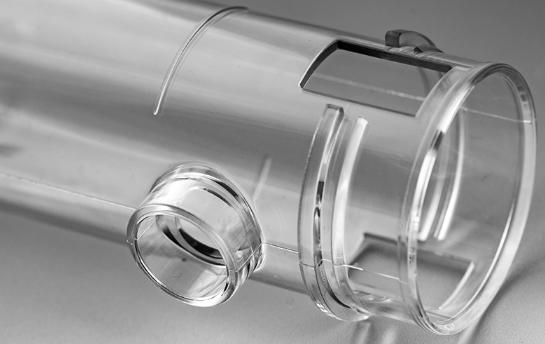
All materials meet global standards: FDA 21 CFR 177 (food-contact), ISO 10993 (medical), and IATF 16949 (automotive).
Key Advantages of Transparent Plastics Injection Molding
Transparent plastic injection molding offers unmatched benefits over traditional materials like glass or commodity plastics. Here’s how it delivers value:
| Advantage | Performance Metric | Why It Matters |
| Superior Light Transmission | >90% LT (PC/PMMA/COC); haze <1% | Sharp, clear optics for lenses, light guides, and displays |
| Lightweight vs. Glass | 50–70% lighter (PC = 1.2 g/cm³; glass = 2.5 g/cm³) | Reduces weight for portable devices (VR headsets) and automotive parts (fuel efficiency) |
| Impact Resistance | PC withstands 60 kJ/m² (10x more than glass); no shattering | Safer for high-use or fragile applications (baby bottles, automotive lenses) |
| Design Freedom | Molds complex shapes (e.g., 1m long PMMA light guides, 50 µm COC channels); no post-machining needed | Custom optics and parts that glass can’t match |
| Cost-Effective High-Volume | Tooling costs 30% lower than glass; production cycle time 50% faster | Affordable for mass production (500k+ LED optics/yr) |
| BPA-Free & Recyclable | Tritan™, PET-G, and COC are BPA-free; PC/PMMA are recyclable (PCR grades available) | Meets eco-friendly and safety demands |
Industry Applications of Transparent Plastics Injection Molding
Our transparent plastic injection molding services support diverse industries that rely on clarity, precision, and performance:
- Optics & Electronics: Optical lenses (0.5 mm thin PC with 92% LT), LED light guides (1m long PMMA), and VR headset lenses (AR-coated for less glare); critical for sharp visuals in devices.
- Medical: Medical cuvettes (COC, biocompatible), autoclavable PSU parts (surgical tools), and sensor covers (clear, chemical-resistant); meets strict sterility and clarity standards.
- Automotive: Automotive lenses (PC with anti-scratch coating), headlight bezels (multi-shot clear/black), and sensor covers (impact-resistant); withstands road debris and temperature swings.
- Food & Beverage: Food containers (Tritan™, BPA-free), cosmetic bottles (PET-G, recyclable), and baby bottles (dishwasher-safe); safe for daily use and compliant with food regulations.
- Aerospace: Aerospace canopies (PC, impact-resistant), cockpit displays (anti-glare AR coating), and sensor optics (low birefringence COC); reliable in extreme altitude conditions.
- Consumer Goods: Smartphone windows (anti-scratch HC coating), reusable drinkware (Tritan™), and cosmetic packaging (PET-G, high gloss); balances durability and aesthetics.
How to write a spec that gets priced correctly
A drawing is a contract. If it leaves a number open, the shop fills that number in with its own default. The default is rarely the one you had in mind. Put these five lines on every RFQ and most of the back-and-forth disappears before it starts.
- A model and a drawing that agree
- Material by standard number
- Tolerance only where it mates
- Finish and the faces it applies to
- Quantity and required date
The point is not paperwork. Each line removes a decision the shop would otherwise make for you. A complete RFQ comes back priced. An incomplete one comes back guessed.
What actually drives the price
Buyers usually push on material because it is the line they can see. In practice the material is rarely the biggest number on a quote. These five lines decide most of it:
- process choice
- material
- tolerance band
- finish
- volume
Ask for the quote split by line. A supplier who cannot break it down is guessing, and you will pay for the guess. The line you can usually renegotiate is the tolerance band, not the raw material.
Problems you will meet, and the fix
Every process has a failure mode it prefers. The same four show up again and again on this kind of work, and none of them are mysteries once you know what to look for.
- A drawing that contradicts the model
- A tolerance with no datum
- A cosmetic callout with no approved sample
- A quote compared against a different scope
Catch the fault on the first part, not the hundredth. A first-article check costs an hour. A bad batch costs the whole order. Write the check into the purchase order so nobody has to remember it.
What to check on the first article
The first article is the cheapest inspection you will ever buy. Use it properly and the rest of the run becomes boring, which is exactly what you want.
- Every dimension on the drawing, with the measured value written beside it.
- The material certificate, matched to the heat or lot number on the parts.
- The finish against the sample you approved, under the same light.
- Fit against the mating part, assembled rather than measured.
- Packaging, because parts that arrive damaged were never in tolerance.
Check in this order: datums, then mating features, then cosmetic faces. If the datums are wrong, every number after them is noise. Keep the report on file. When a problem shows up in month six, that document is the only thing that tells you what changed.
How to compare two quotes fairly
Two numbers are not comparable unless the scope matches. Line them up before you decide, because a low number with three gaps is not a low number.
Same drawing, same material, same finish, same inspection. Anything else is a different job wearing the same part number. Then look at what each quote leaves out. Freight, packaging, certificates and tooling are the usual gaps.
Ask each supplier to state their assumptions in writing. The one who does is usually the one who has run the process before.
Scaling from one part to a batch
The first part teaches you the process. The hundredth teaches you the process cost.
Watch three things as volume grows: setup amortisation, tool wear, and how much hand work the finish still needs. If the unit price barely moves between ten and a hundred, the cost sits in material or in hand work, not in setup. Ask which, because only one of them is negotiable.
Lead time behaves the same way. A one-off is scheduled around other jobs. A repeat order is scheduled around your forecast. Give the shop a forecast and the lead time gets shorter, not longer.
How to read a supplier's quote
A quote is a short document with a long shadow. Four things in it decide whether the job runs smoothly, and only one of them is the price.
- The scope line. It should name the process, the material and the finish, not just the part.
- The tolerance basis. General tolerance or the drawing, and which standard it follows.
- The exclusions. Tooling, freight, certificates and inspection are the usual omissions.
- The validity date. Material prices move, and an open-ended quote is a promise nobody can keep.
Read the exclusions before you read the total. A quote that leaves out tooling is not cheaper. It is a quote for a different job.
What to send with the first order
The first order sets the pattern for every order after it. Send a complete package once and the shop files it, and the second order takes a fraction of the time.
- A STEP or native model plus a PDF drawing carrying the same revision letter.
- The material callout by standard number, not by trade name.
- The finish and the exact faces it applies to.
- Any test the part must pass: fit, seal, drop, salt spray, dielectric.
- A contact who can answer a question inside one working day.
Then write down what was agreed. An email that confirms the material, the finish and the date is worth more than a longer purchase order that leaves them open.
When this is the wrong choice
A good supplier tells you when the process does not fit. These are the cases where we say so.
- The volume is so low that setup costs more than the parts are worth.
- The tolerance is tighter than the process can hold without a second operation.
- The geometry cannot be made without a tool feature that will not pay back.
- The material you need is not available in the form the process requires.
- The schedule is shorter than the tooling or setup time, and nobody has said so yet.
None of these are refusals. They are reasons to look at a different route, and the earlier that conversation happens the cheaper it is. The most expensive mistake in manufacturing is a process chosen before the question was understood.
Case Studies: Success with Transparent Plastics Molding
Our clients trust us to solve their most challenging transparent part needs. Here are 3 standout projects:
Case 1: High-Volume LED Light Guides
- Challenge: A global LED manufacturer needed 500k/yr PMMA light guide (1m long) with 92% LT, no weld lines, and uniform light distribution.
- Solution: Used low-shear screw design, vacuum venting, and slow-fill high-pack injection; added diamond-polish clear finish to enhance LT.
- Result: Light guides achieved 93% LT (1% above target); 99.8% defect-free rate; cost reduced by 20% vs. client’s previous supplier; delivered on time for global LED launch.
Case 2: Medical Microfluidic Chips
- Challenge: A biotech firm needed COC microfluidic chip with 50 µm channels (for DNA testing)—required biocompatibility, 91% LT, and no leakage.
- Solution: Used Zeonex® 480R (biocompatible COC); implemented micro-optic molding (precision ±0.005 mm); added plasma treatment to improve fluid flow.
- Result: Chips passed ISO 10993 biocompatibility tests; channels maintained 50 µm width (no clogging); 100k units delivered for diagnostic kits.
Our solution for Our Transparent Plastics Injection Molding
YiguProto runs custom manufacturing in house, from a single prototype to a production batch. We quote the process, the material and the finish as separate lines, so you can see where the money goes instead of arguing with one number.
Send a STEP file or a drawing and you get a DFM report in one to two business days. It flags the features that add cost and the features that will not hold tolerance on the process you picked.
Every order ships with an inspection report on the features you call out. If a part misses, we make it again. Ready to price a part? Start with a free quote and DFM review, or read more about our custom manufacturing. You can also talk to an engineer before you commit to a drawing.
FAQ about Our Transparent Plastics Injection Molding
Can transparent plastic parts replace glass in optical applications?
Yes. High-performance resins like PC, PMMA, and COC offer >90% LT (comparable to glass) while being 50–70% lighter and shatter-resistant. Our diamond-polish clear and AR coating further enhance optics—making them ideal for VR lenses, camera parts, and LED light guides. Glass is only preferred for ultra-high-precision optics (e.g., microscope lenses) where birefringence must be near zero.
Are transparent plastic parts safe for food or medical use?
Absolutely. We use food-grade resins (Tritan™, PET-G, COC) that meet FDA 21 CFR 177 and medical-grade resins (COC, PSU) that comply with ISO 10993. Our Class 7 clean rooms and ISO 13485 certification ensure no contamination—making parts safe for baby bottles, medical cuvettes, and pharmaceutical equipment.
What’s the lead time for custom transparent plastic injection molding?
For prototypes: Our rapid clear prototyping service delivers samples in just 7 days—ideal for validating designs (e.g., optical lens shape, fit of insert molding transparent parts) before mass production. We use fast-turn tooling and prioritize prototype runs to help you iterate quickly.For mass production: Lead times range from 4–6 weeks, depending on part complexity and volume. This includes mold design (for custom parts like micro-optic molding components or thin-wall transparent containers), tooling fabrication, sampling, and full-scale production. For high-volume orders (e.g., 500k+ LED light guides or Tritan™ bottles), we can expedite to 3–4 weeks using our 24/7 production lines and pre-approved material stock. Our global clear supply network also ensures on-time delivery—with 3–5 day shipping to most regions after production.
What is Our Transparent Plastics Injection Molding used for?
Our Transparent Plastics Injection Molding turns up wherever the part has to do a real job at a predictable cost: brackets, housings, fixtures, covers and the fittings that hold them together. The honest test is whether the properties match the load and the environment, not whether the material is fashionable.
What is the lead time for Our Transparent Plastics Injection Molding?
Expect 5 to 15 business days depending on process. Tooling, material stock and the finishing queue all move that number, so we confirm the date in writing before the run starts rather than after.
Is there a minimum order quantity?
No hard minimum. One part is fine. What changes with volume is which costs dominate, so a single unit is priced mostly on setup and a thousand units are priced mostly on cycle time and material.
The short version
Our Transparent Plastics Injection Molding rewards the buyer who reads the data sheet and the drawing together. Pick the option for the property that matters, not for the price per kilo.
Tighten only what mates. Test a sample before the run. Then let the process do the rest.